Herons have come home to roost
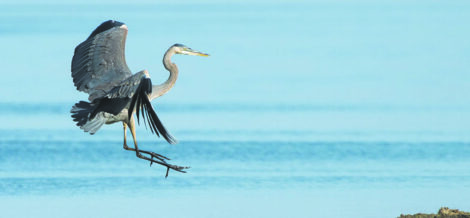
A great blue heron swoops to the water. (Submitted photo / Ohio Department of Natural Resources)
On a road east of Elkton in Columbiana County sits an unusual housing complex. A welcomed sign of spring is to see that the residents have returned and are setting up housekeeping.
The complex is a heronry and the residents are great blue herons.
This particular colony is high above Beaver Creek in a cluster of sycamore trees, a preferred nesting site of the heron because the trees are tall, strong and open, supporting nests that can reach 4 feet deep and wide.
Heronries usually are found adjacent to water where the heron feeds and can contain hundreds of nests.
The distribution of the great blue heron is throughout most of the United States as well as Central and South America. It is in the same family as egrets and bitterns, both of which also are found in Ohio, although not as common.
The blue heron is the largest heron in North America and can reach a height of 4 1/2 feet. Its eye-catching wingspan is 6 feet.
The great blue is identified as a wading bird due to its method of feeding. I have watched them feed in the creek near our home. They stand motionless in the water and using their excellent eyesight, watch for a meal to swim by. The head suddenly shoots into the water and the large bill comes up with a fish or frog. The bill is pointed up, the S-curved neck is straightened, and the meal is swallowed.
The bill also can be used as a spear for larger prey.
They feed day and night, also consuming crayfish, snakes, small mammals and birds. The heron can eat up to 50 percent of its body weight per day.
Herons are more gray than blue and have plumes off the back of the head and shaggy feathers on the chest. They claw these feathers causing them to fray then use the result to clean swamp water oils and slime from their other feathers.
In more northern states, blue herons are migratory, with some heading to the Gulf Coast for the winter. If there are areas of open water throughout the winter, they may stay year-round. Recent survey numbers show an increase in overwintering compared to 50 years ago.
Courtship and mating behaviors begin in early April. Three to seven bluish-green eggs are incubated for 25 to 29 days and the young can fly at around 60 days post-hatching. They leave the nest by 90 days.
If you think the great blue heron is an amazing bird, owners of stocked backyard ponds feel differently and consider it a nuisance. A heron doesn’t care if a pond is stocked with goldfish or expensive koi, it’s all on the menu. A small ornamental pond can be cleaned out in one visit.
Using a variety of methods including decoys, obstacles and hiding places for fish, the pond can become a safe habitat.
To learn more, go to http://go.osu.edu/greatblue.
Steffen is a Master Gardener Volunteer for The Ohio State University Extension in Mahoning County.
Lifestyles
Daughter-in-law’s mental health taking a toll
DEAR ANNIE: I need some serious help. Our son, 36, has been married for three years. In May 2024, our ...
Woman’s spinal pain after surgery fails to improve
DEAR DR. ROACH: My wife is suffering from a failed back surgery that was caused by a neurosurgeon. The operation ...
Bridge by Steve Becker
It’s funny how some players get mad at their partners. An acquaintance of mine, Abernethy C. Growler, is a member ...
Organizing the junk drawer
DEAR HELOISE: Every house has a junk drawer, and everyone knows exactly which drawer it is. The reason that it ...

Church services, weddings, birthdays and Mother’s Day