

Sojourn to the Past
Area students visit, study civil rights landmarks
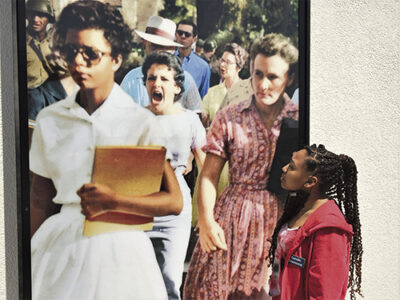
Correspondent photo / Sean Barron Camille Townsend, a Chaney High School senior, takes in the iconic photograph of Elizabeth Eckford, one of nine black students who integrated the all-white Central High School in September 1957 in Little Rock, Ark., being taunted by several whites, while on the recent Sojourn to the Past journey to major civil rights sites in the South. This photograph is at the Legacy Museum in Montgomery, Ala.
YOUNGSTOWN — Reena Evers Everette may not be a household name, but for Natalia McRae, she represents incredible strength and resilience — and the best version of what one can be in the face of extreme adversity.
“I could hear Reena touch her dad and say, ‘Get up! Get up!’ It makes me so emotional,” the Youngstown State University freshman and social work major said.
McRae was referring to Evers Everette’s reaction when, as an 8-year-old, she opened the side door to her Jackson, Miss., home and saw her father, NAACP field secretary and civil rights activist Medgar Evers, bleeding and mortally wounded after a sniper had shot him early June 12, 1963, as he got out of his vehicle. He staggered to the door under the carport. He died about an hour later at age 37.
McRae was among nine Mahoning Valley educators and students who met Evers Everette two weeks ago while on a weeklong Sojourn to the Past traveling American history journey to key civil rights sites in the South. Joining the Mahoning Valley group were more than 90 other adults and students, most of them from the San Francisco area. Several others from the Boston area also came.
The Millbrae, Calif.-based Sojourn program takes students and adults through the Deep South via chartered buses and introduces them to people who fought on the front lines during the modern civil rights movement of the 1950s and 1960s for voting rights, equality and advancing the philosophy of nonviolence. Also included are stops at historic sites such as Central High School in Little Rock, Ark., which nine black students integrated in September 1957.
The immersion program strongly urges participants to incorporate the principles of nonviolence into their lives, while promoting greater tolerance for others who are different from them. Also stressed are the power of forgiveness, critical-thinking and advocacy skills, standing up to injustices and understanding the corrosive effects of bullying and racism.
McRae, who also went on the journey last July, said a primary goal for her is to take what she’s learned to educate and empower others about that aspect of shared American history. The initial journey was a learning experience, but the most recent one allowed McRae to “take everything in more,” she said.
McRae added it’s vital to look at all people in a unified way and refrain from separating them by race or other means.
“We’re all family,” she said.
Malasia Hunter, a Chaney High School sophomore, said she was moved deeply by Elizabeth Eckford, one of the black students who integrated the all-white Central High.
“I was shocked,” Hunter said, referring to Eckford’s courage and resilience regarding her ability to freely discuss the traumas she faced just before and while at Central High.
As she arrived for her first day at the 4-square-block school Sept. 4, 1957, Eckford, who suffers from post-traumatic stress disorder, encountered an angry white mob that taunted and threatened her as she tried to enter and was turned away by the National Guard. Some in the crowd spit on her while others threatened to lynch her before she made it to a nearby bench to await the bus.
Hunter also said she was traumatized by the Sept. 15, 1963, terrorist bombing of the 16th Street Baptist Church in Birmingham, Ala., which killed Addie Mae Collins, Denise McNair, Carole Robertson and Cynthia Wesley, all ages 11 to 14.
Not lost on her was that the four girls were close to her age, Hunter added.
“They could have had many things going for themselves and somebody ended their lives,” a tearful Hunter said, adding she is committed to speaking up in the face of wrongs and injustices.
The other students who participated in last month’s journey were Cairo Tatum and Eric Hunter, sophomores at Academy of Urban Scholars High School in Youngstown; Charlissa Tate, an Urban Scholars junior; Zion Heller, a Howland High School ninth-grader; and Camille Townsend, a Chaney High senior.
Besides Eckford and Evers Everette, those who spoke to the participants were the Rev. Gwendolyn C. Webb, a former Birmingham police officer who took part in the May 1963 Children’s March to desegregate that city; Sarah Collins Rudolph, Addie Mae Collins’ sister and the author of a recently published book about her experiences in the 16th Street Baptist Church on the day of the church bombing; Lisa McNair, who’s a younger sister of Denise McNair; and Joann Bland of Selma, Ala., a U.S. Army veteran and longtime civil rights activist.
Minnijean Brown-Trickey, another of the nine black students who integrated Central High, spoke virtually to the group from her home in British Columbia.
The primary themes the presenters covered included the power of forgiveness, the long-term damaging effects of bullying, hurtful language and hatred toward others, the importance of tapping into one’s inner power and strength, and recognizing the many ways one can be a social activist.
Lynette Frost, Chaney High’s parent-engagement coordinator who also went on the journey, praised Dr. Martin Luther King Jr. for his tenacity, perseverance and commitment to upholding the principles of nonviolence despite numerous death threats against him toward the end of his life.
She said she was moved especially by his “Mountaintop” speech, which King delivered April 3, 1968, in Memphis, Tenn., to garner support for that city’s 1,300 striking sanitation workers who had walked off the job two months earlier. The speech was the last of King’s life because he was assassinated the following evening while standing on the balcony outside of his room at the Lorraine Motel.
It’s also vital to know and appreciate the sacrifices King and other civil rights foot soldiers made for students of all races to receive a proper and fair education, Frost said. Nevertheless, too many of this generation’s students take education for granted, she said.
Frost said she also admired Eckford for her ability to remain nonviolent while in the teeth of the mob that wanted to kill her. The philosophy of nonviolence needs to be taught to children at younger ages and equip them to “carry the torch” passed to them by King and others, she said.
Penny Wells, Mahoning Valley Sojourn to the Past’s executive director, said she hopes students who have participated in the journey realize they have the power to make a difference in their lives, schools and communities, and to grasp fully that those who changed this nation’s history were committed to practicing the concept of nonviolence.
In addition, the students on the journeys demonstrated they can work hard and stay on task without distractions such as cellphones, Wells said.
“They proved they can sit through classes and do more work than expected,” she said.
Lifestyles
Voices of hope recognized for their compassion
Religion news
MENS RALLY IN VALLEY: The 2026 Mens Rally in the Valley will be 8 a.m. to 3 p.m. May 23 at the Covelli Centre, ...
To Your Good Health: Aspiration pneumonia after an adenoma
DEAR DR. ROACH: I was 47 when my first colonoscopy found a villous adenoma, and during the past 21 years, I’ve ...

Variables to consider before downsizing a home in retirement

Bridge by Steve Becker
Hints from Heloise: Refreshing baby wipes and more
DEAR HELOISE: I use baby wipes frequently, and I have one package in each of our two bathrooms. After a while, I ...