Niles heart patient praises cardiac rehab program
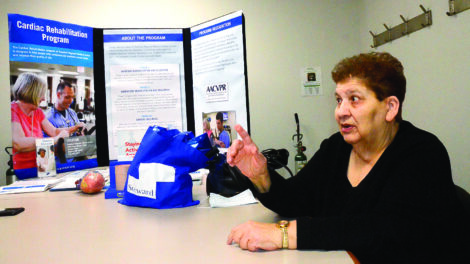
.Rose Wainwright of Niles talks about her cardiac rehab...Staff photo by R. Michael Semple
Editor’s note: This is the third of a weekly series focusing on cardiovascular health to be published in February, American Heart Month.
NILES — Rose Wainwright holds two cardiac rehabilitation graduation certificates.
The Niles woman said she wishes she was still being put through her paces in the exercise room of Trumbull Regional Medical Center’s Cardiac Rehabilitation Program — she just doesn’t want to have another heart surgery to land a reservation.
“I love my cardio rehab,” Wainwright said. “I love the stepper (exercise machine).”
The rehab program is “very comfortable. They teach you nutrition, exercises that you should and should not do,” she said.
During exercises, she’s hooked to monitors. Exercise physiologists and staff see blood pressure, heart rate and other numbers constantly. That makes it different than going to a neighborhood gym or riding a stationary bike at home.
“You feel more secure here. They know what they’re doing,” Wainwright said.
The energetic 77-year-old retired as a greeter at Sam’s Club (“I loved it”) but isn’t interested in living in her rocking chair. “I’m not going to sit on my butt because then you’re going to lie there and die.”
Wainwright is a survivor.
FAMILY HISTORY
“My family is full of heart diseases,” Wainwright said. Her mom died at 44. Her brother and three sisters also lost battles to cardiovascular problems. One sister was 38 when she died, another was 68.
“I’ve outlived everybody. When I made it to almost 74, I thought I had it made.”
Her son and daughter both are doing fine so far, but they do get check-ups.
As does Wainwright.
“Four years ago this March, I started having bad chest pains,” she said.
Her heartbeat became erratic, jumping from 40 to 103 beats a minute.
Her symptoms were chest pains, one of the classic symptoms.
“That day, I had scrubbed all my windows and I felt good,” she said. “Now, if I get on a ladder and feel lightheaded, I get back down. I try it again later, and I’m fine.”
A heart catheterization — a tube with miniature camera inserted into an artery that tracks to the heart — found one coronary artery completed blocked. Surgeons rerouted that artery to another one, bypassing the blockage.
“Ten days later, I had a pacemaker put in. That was good for one and a half years.”
When she felt chest pains again, she had another catheterization and coronary stents — tube-shaped implants– were placed to keep the arteries open and blood flowing to the heart.
What does she say to people who claim if you eat right and exercise, you’ll have no problem? “Bull crap. See a doctor, especially if it is in your family. I would advise anybody to go to a doctor.
“I still think you need to eat the best you can,” she said.
CARDIAC REHAB
After both surgeries, Wainwright enrolled in Trumbull Regional Medical Center’s Cardiac Rehabilitation Program, which boasts being the only program in the Mahoning Valley certified by the American Association of Cardiovascular and Pulmonary Rehabilitation. The local program first earned certification in 2014.
All of the staff are certified by the American College of Sports Medicine as clinical exercise physiologists. Treatment plans are designed around individual risk factor and exercise assessments aimed at reducing the chance of further heart events and improving physical fitness, according to the hospital.
Robert Halicky, clinical exercise physiologist at Trumbull Regional, said, “Every patient is different and so is their recovery. We provide every patient with an individualized treatment plan consisting of exercise, education and counseling support to help them reach their goals and improve their quality of life.”
While the number of sessions and which days of the week can vary by individuals, generally, rehab is three days a week for 12 weeks. Exercise programs are designed to fit the individual’s recovery needs and physical condition.
Wainwright did her first session in a straight shot. The second was interrupted by COVID-19 shutdowns.
Physiologists recommended at-home exercises that she continues to perform.
“If I hadn’t come here, I don’t think I would have made it this long. They gave me the encouragement to move,” Wainwright said.
According to Trumbull Regional, exercise gets the heart pumping and the cardiovascular system working. The education and counseling portion of the rehab program teaches participants how to keep their bodies moving in ways that promote heart health, and how to manage risk factors, such as stress, lifestyle and diet.
Wainwright admits that she wasn’t thrilled by all the advice, such as diet. “I do no processed foods — no bologna, no salami, no pepperoni. … I’m Italian; what am I supposed to do?” she demanded with a twinkle.
But behaving herself does mean that she gets to keep exercising, something that Wainwright said she “loves, loves, loves.”
bcole@tribtoday.com
Lifestyles
To Your Good Health: Whole fruit healthier than juice
DEAR DR. ROACH: I am a generally healthy 70-year-old man, and I like to drink orange juice — the kind that is ...
Mobility exercises important as we age
As they age, it’s not uncommon for many people to let out a muted groan when getting out of bed in the ...
Hints from Heloise: Spooning out seeds in squash
DEAR HELOISE: I use a serrated grapefruit spoon to spoon out the seeds from squash. It really gets them out easily. ...
Hobbies that can help get seniors out and about
The threat posed by social isolation has been known to medical researchers and health care professionals for years, ...
Dear Annie: When a spouse’s snoring steals your sleep
DEAR ANNIE: I’ve been happily married for 18 years, and for most of that time I’ve slept poorly — but lately ...