Local basketball coaches look to adjust to new foul rules
The National Federation of State High School Associations has altered rules to fouls and FTs
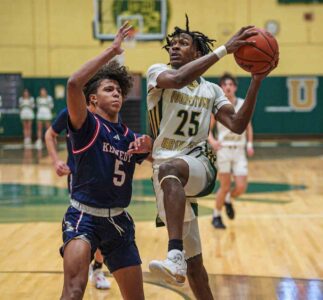
Staff file photo / Greg Macafee Ursuline’s Terrance Pankey goes up for a layup against Warren JFK’s Devonte Taylor this past season.
High school basketball in the Mahoning Valley will look and feel slightly different this upcoming season.
Earlier this summer, the National Federation of State High School Associations (NFHS) altered the rules for fouls and free throws. Now, teams will shoot two free throws for common fouls when they reach the “bonus,” thus eliminating the one-and-one scenario that previously existed.
Also, teams will now reach the “bonus” when the opponent commits five team fouls in each quarter and the team fouls will reset at the end of each quarter of play. Previously, teams earned the one-and-one free-throw situation when the opponent committed seven fouls in a half, and reached the “double bonus” for two free throws when 10 fouls were committed in each half.
“I’ll be honest, I like it — a lot of people don’t, but fouls start over every quarter, so I think it’s a good thing, especially if you’re a team that draws a lot of fouls,” said Ursuline boys head coach Keith Gunther. “Most everybody I’ve talked to is okay with it.”
Warren G. Harding boys head coach Keelyn Franklin thinks favorability of the new rules will be determined by the type of team.
For example, an aggressive, pressure defensive team may not be favorable about the new rules because it will send opposing teams to the line more often since they are likely to foul more. Whereas, a team that is aggressive offensively and likes to drive the ball and attack the rim will favor the new rules because it will give them the option to shoot more free throws and score more points.
“I’m not really sure what it will look like yet, but I think there could be some good things that come out of it,” Franklin said. “We’ve already started talking to our guys about it. (The new rules) really put a premium on being able to make free throws. Being able to make those two free throws can really be a huge advantage for you.”
The new rules will change how coaches might approach certain in-game situations, especially end-of-game situations.
Previously, if a team was trailing at the end of a game and still was only in the “bonus,” they might foul, hoping that the opposing team would miss the front end of the one-and-one so that they could get the rebound and have a chance to score and close the deficit. But now, coaches and teams will have to determine the risk and reward of sending a team to the line.
“(If you’re) aggressive defensively, then you’re going to have to adjust to how many fouls are getting called,” Gunther said. “As coaches, that’s the main thing you’re going to have to adjust to. It takes the pressure off the free-throw shooter — if you’re at the end of the game and you get two shots instead of one, it takes a little bit of the pressure off.
“I think it will stop people from just aggressively fouling at the end of a game. You get two shots instead of one, so I think it changes your perspective on just hacking about unless the team is a horrible free-throw shooting team.”
Teams that have been playing in camps and tournaments this summer have already gotten a taste of the new rules and have had a chance to see how the rules will affect their players.
“The tournament we went to up in Sandusky, (Midwest Live), used those new rules,” said Canfield girls head coach Matt Reel. “I don’t know if it’s going to be as drastic of a change as some people think. I think it’s going to be relatively minor, in my opinion.”
Reel said he thinks the new rule changes are another step in the direction of high school basketball finally implementing the shot clock.
“I think we’re getting closer and closer to the college game, especially on the female end of things,” Reel said. “I’ve seen it in both (girls and boys basketball) where coaches will hold the ball for an entire quarter. I don’t think that’s good for fans enjoyment and I don’t think it’s good for player enjoyment.”
Poland head coach Nick Blanch agrees that the high school game is inching closer towards finally adding the shot clock, but notes that simply adding the shot clock is not quite as simple as some might think.
“It’s coming, it’s just a matter of how much longer they’re going to wait because I think behind closed doors, they’re trying to figure some things out on how they’re going to be able to (implement the shot clock) at all these schools throughout the state,” Blanch said. “You have to find people that understand how to work it and people are already struggling enough trying to find enough workers for these games — ticket takers, referees, announcers, scoreboard operators and some even have video boards now.
“Now you’re going to add a shot clock. …There’s going to be more stress on referees to pay attention to that and you don’t have instant replay, so if there’s an issue, there’s going to be more room for human error at the high school level. So that’s a rule change I’m more hesitant about than the one this year.”
Local Sports
Lakeview trounces Northwest to capture second straight district title

Guardians complete sweep of Tigers, extend win streak to 6

Cavaliers can’t keep up with Knicks in Game 2, lose 109-93

Cardinal Mooney beats Champion 10-1 to win first district title since 2017

West Branch’s walk-off walk wins playoff game vs. Orange