
Sojourn program sprouts wings in Selma, Alabama
Trending
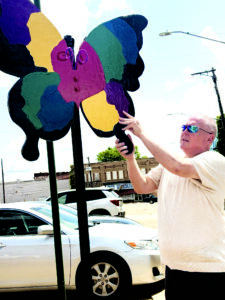
YOUNGSTOWN -- For several years, Marc Ellis has primed his young students for better understanding and appreciation of the civil rights movement in the 1950s and 1960s, and most recently, the children have worked to prime a butterfly that landed hundreds of miles away.
"Everybody had some part in my classroom in the process," Ellis, a Volney Rogers Elementary School third-grade teacher, said.
He was referring to a multi- and brightly-colored butterfly that many of his students helped paint that was recently installed in Selma, Alabama -- a city rich in civil rights history. The piece rests near the top of a pole 20 to 25 feet from a mural the Mahoning Valley Sojourn to the Past organization commissioned and developed, in partnership with the city, that is on the side of a nearby building a short walk from the Edmund Pettus Bridge, where those who took part in the famous 1965 Selma-to-Montgomery march for voting rights crossed.
The mural, unveiled in 2020, captures many of the city's roots and connections to the movement, with depictions of several civil rights icons such as Viola Liuzzo, a Detroit mother of five who came to the city after the march; the Rev. James W. Webb II, who, at age 16 nonviolently stood up to a Dallas County sheriff's deputy; and John Lewis and Hosea Williams, who led the march. One panel shows Patricia Blalock, the library director who integrated the Selma Public Library with neither a court order nor public demonstrations forcing her to do so.
The butterfly represents Mahoning Valley Sojourn to the Past and serves as "a metamorphosis of how we can change to be better people," Penny Wells, the organization's executive director, said.
The third graders worked on the project periodically over several days in May, Ellis said, The veteran teacher added that beforehand, he had his students read many age-appropriate books pertaining to the civil rights movement.
Ellis didn't stop there, however. He also has invited a few civil rights movement icons to his classroom in recent years and had them speak to the students. The invited guests included Minnijean Brown Trickey and the late Jo Ann Bland.
Brown Trickey was one of nine black students who integrated the all-white Central High School in September 1957 in Little Rock, Arkansas, and paid a high price. Bland, a U.S. Army veteran, grew up in Selma and often conducted tours of the city and gave lessons on the movement. She also was on the bridge on March 7, 1965, a day known infamously as "Bloody Sunday" after Alabama state troopers and local police positioned on the eastern side of the bridge attacked about 600 peaceful marchers.
Bland, a longtime social justice activist, died Feb. 19. She was 72.
No one died in the attack, though 17 marchers were hospitalized for their injuries in an event that outraged people across the nation and led to massive protests. Soon after, Dr. Martin Luther King Jr. called on ministers, rabbis and others of goodwill to come to Selma, which resulted in about 450 of them making the trip from across the country, including Unitarian ministers James J. Reeb, Orloff Miller and Clark B. Olsen, who, before his death in 2019, spoke to many Sojourn to the Past groups.
"My students know what happened in Selma, on the Edmund Pettus Bridge and the march. In fact, knowing about Selma is a big deal to them," Ellis said, adding that his third graders were highly excited that the butterfly they worked on would be shipped 800 miles to the south.
The local art project also ties into the fact that Selma was declared the Butterfly Capital of Alabama in 1982, at which time more than 40 area artists had decorated them. Several of the works remain scattered throughout the city of about 16,000.
Ellis' first trip to Selma this month "was very empowering and very emotional for me. Walking across the bridge, knowing what happened on the other side, flooded me with emotion. John Lewis had a skull fracture, but he still marched for the right to vote," Ellis said about the late Georgia congressman, humanitarian and longtime civil rights icon who also spoke at the Aug. 28, 1963, March on Washington for Jobs and Freedom.
The Selma excursion also included a 54-mile trip to Montgomery, where Ellis saw the state capital where the five-day 1965 march ended, along with Dexter Avenue Baptist Church, where King pastored from 1954 to 1960 before becoming pastor of Ebenezer Baptist Church in Atlanta. In addition, he visited the site where Rosa Parks boarded the city bus before refusing to relinquish her seat to a white person and being arrested Dec. 1, 1955, for violating the city's segregation laws.
Integral to the butterfly's design was Lil Snider, a 2026 Chaney High School graduate and Mahoning Valley Sojourn to the Past member, who crafted the Sojourn to the Past logo. Snider, who will be attending the Cleveland Institute of Art this fall to major in game design and animation, also helped create the nine faces etched on the butterfly that symbolize unity and diversity.
In addition, she sought to slightly change the colors on the original Sojourn butterfly and have those on this one stand out, "so I took some liberty with the colors," Snider said, adding that she received assistance from Montanna Little, a close friend and fellow artist.
"It was really fun getting to paint the butterfly with the third graders," Snider continued. "They were so excited about it, and it was warming my heart."
The project's genesis came when Wells asked Sheryl Smedley, the Dallas County Chamber of Commerce's director, to set up an appointment with Selma Mayor Johnny "Skip" Moss III, who was sworn into office in November 2025. Smedley had created opportunities for local businesses to have butterflies, which represent the city much as the penguin does in Youngstown, Wells explained.
From there, Wells reached out to Selma artist Anthony Langdon, who, along with his wife, Lashum Langdon, also runs two businesses in the city. In addition, the couple was recently credited with transforming a formerly abandoned alley into "a safe and welcoming space.This street isn't just about us. It's about what can happen when you put God first, people believe, work together and build," Anthony Langdon told the Selma Times-Journal.
"I was just the glue to have Lil design and Marc do the painting. I wanted Marc to go to Selma when we put it in," Wells said, adding, "We love our connection with Selma."
In addition to standing as a colorful reminder that the human spirit has no limitations -- and that people can strive to be their best and most tolerant and loving selves -- the butterfly that was recently erected in a city that bore witness to much of the nation's pivotal parts of history also symbolizes the importance of reviving the past to paint a brighter future, Ellis explained.
"It's exciting to teach these lessons to new students and to be carrying it forward. My third graders are eager and want to know more; my students ask deep questions," he said, adding that it's urgent to have such stories taught with no age requirements.
Suffice it to say that the Selma trip and butterfly installation project brought back remnants of the past for Ellis himself.
"This time, I was there; I stood there and I saw, which was something I was never able to do before," he said, adding, "One of the benefits is to teach kids early that their voice and vote matter."
In addition, Ellis will be the local Simeon Booker Award for Courage recipient during a ceremony Oct. 6 at the Tyler History Center in downtown Youngstown that will be part of the annual Nonviolence Week.