Speaker focuses on fossils found in Ohio
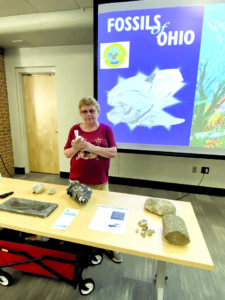
Correspondent photo / Karla Dines Donna Campbell of Warren attends a talk at the Warren-Trumbull County Public Library on Ohio fossils
WARREN — Just how abundant fossils are in Ohio, and what types of ancient animal and plant life inhabited Ohio were the topics of a presentation by Carrie Schweitzer, a professor in the Department of Earth Sciences at Kent State University, on Wednesday at the Warren-Trumbull County Public Library.
Although Schweitzer’s main research interests are crustacean fossils — shrimp, lobsters and crabs — her talk covered fossils from ancient marine life and plant fossils to ice age mammals.
“Most of the fossils you would find in Ohio are 488-359 million years old,” Schweitzer said.
Glaciers had little impact on fossils in the area. Mostly, fossils are found in areas where bedrock is exposed. Although sometimes ice age mammals are found in glacial deposits.
The most common type of fossil found in Ohio is Brachiopods.
“They are an interesting animal because superficially they look a lot like clams. Like clams, they have two shells. If you peel open a Brachiopod, and you can see the guts sticking out, it is totally different than what is inside a clam,” Schweitzer said.
They were probably occupying the same niche in the environment as clams and were very abundant during the Paleozoic period. The shells of Brachiopods are not mirror images like clams are. These are very abundant in the Cincinnati area, where rocks are full of them.
The second most common fossil in Ohio are the Bryozoans. These can still be found in the oceans and have a branching, coral-like appearance.
The next most likely fossil in Ohio are corals. Horn corals are very common in Cincinnati, Kelleys Island, Put-in-Bay and Marblehead. Snails are also common to these areas.
Ice age mammals, mastodons and mammoths also lived in Ohio, as did other vertebrates, such as the Dunkleosteus — Ohio’s state fossil fish.
Donna Campbell of Warren attended Schweitzer’s talk because of her interest in dinosaurs.
“We print 3-D dinosaurs as a side hobby,” Campbell said.
Ohio’s most famous fossil parks are Sylvania Fossil Park, Paulding County Community Fossil Garden, Hueston Woods State Park, Trammel Fossil Park, Oakes Quarry Park, Caesar Creek Spillway, Cowan Lake State Park and East Fork State Park Fossil Park.
“For just finding tons of fossils — Caesar Creek. Everyone can find fossils. You can’t not find fossils there. Because these rocks are just all fossils. You are allowed to take any fossils smaller than your hand,” Schweitzer said.
Schweitzer said that a common question she gets is if trilobites, which are extinct marine arthropods, are found in Ohio. They are, but it is rare to find complete specimens, and they are not common in Northeast Ohio.
Schweitzer explained that while dinosaur bones have not been found in Ohio, they have been found in New Jersey, so it is assumed dinosaurs also lived in this area.
Local News
Trumbull commissioners reappropriate TNP funds
WARREN — The Trumbull County Commissioners on Wednesday approved moving $325,000 from Trumbull Neighborhood ...
Trustee defends work of water advisory board
WARREN — Vienna trustee Phil Pegg sought to defend the work of the Trumbull County Water Advisory Board at ...
On the record: Milton Township
Milton Township WHEN: Monday WHAT: July trustees meeting PRESENT: Bryce Bond, Wendy DiBernardi, Dave Tomaino ...
Pleasants County, WVa hit by suspected tornadoes
Liberty couple loses about 10 trees