

Protecting protectors
Valley firefighters prioritize safety of first responders at accident sites
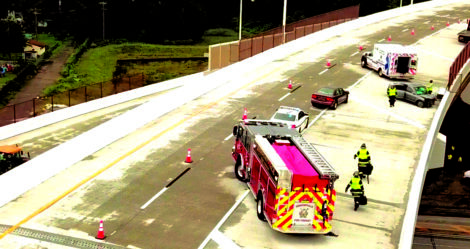
This illustration from the Emergency Responder Safety Institute website shows an example of “blocking,” a way in which a fire truck can be used to protect first responders and others at crash scenes on a highway. Mahoning County EMA Director Conner O’Halloran says this is typically how first responders align their vehicles at a crash scene.
When the life of Trooper Nicholas Cayton of the Canfield Post of the Ohio State Highway Patrol was tragically cut short last Oct. 16 when a truck slammed into the back of his cruiser on state Route 11, the weight of loss hit hard.
Cayton, 40, a husband and father of two children, was honored not just for his service in law enforcement, but for serving his country in Iraq and Afghanistan and being engaged with his family in his local community.
Cayton was honored last month in Washington, D.C., during the annual National Law Enforcement Officers Memorial Ceremony. His funeral at Youngstown State University in October included poignant remarks by his pastor about Cayton’s “daily commitment to serve, to stand for what is right.”
At the funeral and in the months since his death, the Ohio State Highway Patrol has emphasized the importance of the public moving over when they see emergency vehicles on the roadway.
“Ohio’s Move Over Law requires all drivers to move over to an adjacent lane when approaching any public safety vehicle with flashing or rotating lights parked on the roadside. If moving over is not possible due to traffic, weather conditions or a second lane not being available, motorists should slow down and proceed with caution,” Gov. Mike DeWine stated in a February press release that mentioned Cayton’s death.
The release stated that during the previous four years, 62 patrol cruisers were involved in crashes while they were stopped on the side of the road because of drivers failing to move over and slow down. Two people died, and 43 people were injured. All 50 states have move-over laws, the Highway Patrol stated.
VIENNA FIRE DEPARTMENT
Locally, the Vienna Fire Department and its chief, Gus Birch, have quietly taken a few steps in their daily practices to protect law enforcement officers and other first responders — including paramedics and tow truck drivers — when they are responding to area highways for calls for service.
Recently, a reporter for this newspaper observed a Vienna fire truck and an Ohio State Highway Patrol cruiser along the exit ramp of state Route 11 north at the state Route 82 West exit while attending to a two-vehicle crash on the exit ramp.
It was noted that the fire truck was at the back of the lineup of vehicles with the OSP cruiser in front of the fire truck. The vehicles involved in the crash were in front of those two vehicles. Having noted that Cayton had been honored in recent days in Washington D.C., the reporter wondered if the fire truck being in the back of the row of vehicles was related to Cayton’s death.
Birch said the policy at the Vienna Fire Department is to stage its fire truck at the back of the row of vehicles on the highway whenever possible — behind police and other vehicles — to serve as a barrier to injury as long as the fire truck is not needed closer to the accident scene.
“What happens typically in an auto accident, we will respond with an ambulance, myself if I am available and also a rescue truck, which is a fire truck also,” Birch said.
“And when we get there, depending on what the situation calls for, if there’s no rescue attempt needed and for instance there was no need for the Jaws of Life, we don’t have to pull lines for fire or whatever, we will stage the truck behind the crash scene and block traffic,” Birch said.
“Sometimes we shut down the whole road. Other times we will close down one lane, depending on the situation. And we would leave that truck in the back because it’s a bigger vehicle, provides better protection,” he said. “We set up a safety zone to protect the police officers and our personnel and also tow truck drivers,” Birch said.
He noted that if the fire department gets another emergency while they are at the crash scene, they will “break away what we need to. We will stay there as long as we can.”
When asked if providing that protection to first responders was new, Birch said no. But the increase in the number of first responders being injured while responding to accidents on highways in recent years has resulted in the practice becoming more prevalent.
“It used to be kind of hit and miss back in the old days. But due to multiple police officers, multiple tow truck drivers, being injured on highways, I know that’s our policy just to protect them. It’s gotten worse. People aren’t paying attention at the accident scene; they’re on their phones. It has gotten worse over the years,” Birch said.
Birch was with the Vienna Fire Department for about 20 years early in his firefighting career and was later with the Liberty Township Fire Department, where he retired for a couple of years and then came back to help the Vienna Fire Department about 18 months ago.
Birch said the Vienna Fire Department has taken extra steps to protect first responders, including tow-truck drivers, for many years, but has “put an emphasis on it now because of all of the bad stuff that has happened,” Birch said. He agreed that Cayton’s death last year reinforced the importance of protecting first responders on the highway.
TOW TRUCK DRIVERS
“We see all the time with the tow truck drivers also, they are put at risk,” Birch said. “A lot of times, there’s only one (tow truck employee) there, and so there’s nobody watching out for them. So we try to do that if we have the people and we’re there, we will stay until everybody has cleared the scene safely.”
He said the fire service works closely with all law enforcement agencies.
“We don’t want to see anybody get hurt. We are in the business of taking care of people who are injured. If we can prevent that, then that’s our goal,” Birch said.
He added, “Nowadays, I think a lot of departments put forth a little bit of extra effort to hang around to help them.
“But it goes back to their staffing levels, the call volumes. There are certain cases where they can’t do it, and I understand that. And I’m sure the officers and wrecker drivers understand it also. If you’re available and don’t have other calls, I don’t know why you wouldn’t stay there and protect them.”
SAFETY INSTITUTE
The Emergency Responder Safety Institute, a committee of the Cumberland Valley Volunteer Firefighters Association, provides guidance on its website on how to “set a block” at a highway crash site with “the biggest and heaviest emergency vehicle available at the scene.”
It recommends angled parking of a fire truck or law enforcement vehicle on the highway to block the widest possible part of the highway and demonstrate to drivers that the emergency vehicle is “stationary,” a section on blocking states.
MAHONING EMA DIRECTOR
Conner O’Halloran, Mahoning County Emergency Management Agency director, is a former Canfield firefighter and is part-time assistant chief for Poland’s Western Reserve Joint Fire District.
O’Halloran said he believes the type of policy Birch described with a fire truck in the back and the other first responders in front of the truck “should be the norm,” except, as Birch mentioned, when there is a need for the fire truck to be closer to the crash.
O’Halloran said one thing he has seen change in the 15 or so years since he became a firefighter and paramedic is that there is less hesitancy to close a roadway today to address a crash.
O’Halloran said there was a greater urgency to “get the road open” back then. “Now that conversation has switched to ‘Shut the road down.’ There is no question.”
He said he was the first responder on the scene of a crash on Interstate 76 in the Akron area a couple of weeks ago in which he saw an accident and turned around to provide aid. He and a state trooper shut the road down, “And there was no question,” O’Halloran said.
“I asked him, ‘What do you want to do, trooper?’ He said ‘Shut the road down.'” O’Halloran said that has become “the norm” in recent years. He said he could not say specifically when that mindset took hold.
When this newspaper asked the Ohio State Highway Patrol its perspective on the steps Birch discussed for protecting first responders, Sgt. Jeremy Kindler, a regional OSP public information officer, stated that the OSP “continues to work closely with our public safety partners to keep Ohio’s roadways safe. We rely on one another at incident scenes, and we appreciate the collaborative efforts that help protect first responders, roadside workers and wrecker operators.”
Local News
Canfield man indicted in trooper death
Mahoning Dems to induct four into hall of fame
YOUNGSTOWN — The Mahoning County Democratic Party will induct four new members into its hall of fame Sept. 10 and ...
Property transfers
Property transfers recorded July 13 to 17 in Mahoning County and July 13-16 in portions of Trumbull County: ...
Trumbull agency warns of potential outbreak of measles
Because Ashtabula County residents with measles were at a July 18 horse sale auction in Bloomfield, the ...
New system makes county documents more accessible
YOUNGSTOWN — The Mahoning County Recorder’s Office is working to make property records more accessible ...
‘Stop the Violence’ march set Sunday in Youngstown
YOUNGSTOWN — The United Pastors, Clergy and Community Leaders of Greater Youngstown Against the Violence will be ...