
Flood washes in partnership
Boardman students join KSU scientists in study at stormwater park
Trending
BOARDMAN -- What began as an effort to reduce flooding in one of the township's most problematic areas has evolved into a hands-on research partnership that is giving local students the opportunity to work alongside university scientists.
The Forest Lawn Storm Water Park, built at the site of the former Market Street School, is one of several projects undertaken by Boardman Township and the ABC Water and Stormwater District to address flooding throughout the Cranberry Run watershed.
But from the beginning, township officials, stormwater district leaders and Boardman schools administrators envisioned the site as more than a stormwater retention facility.
Because the districtadonated the former school property for the project, discussions centered on preserving its educational mission even after the building was demolished.
That goal has since grown into a partnership with Kent State University's Environmental Science and Design Research Institute, where students are helping to collect and analyze environmental data at the park and presenting their findings to professionals in the field.
"In May, seven researchers worked with our kids for a week, and they were in the stream taking samples. On Friday of that week, they took their data and started to graph things," said Amy Radinovic, Boardman schools communications coordinator. "It was a great learning experience for them, and it's not going to be a one off, because it's a pilot program. They're going to take part in obtaining data for the KSU grant project."
MORE THAN FLOOD CONTROL
While Forest Lawn began as the township's best first stab at meaningful flood mitigation, it seemed destined from the start to become an educational site. Indeed, much of the $750,000 that came from the state of Ohio to support the project will be used to construct an educational pavilion at the front of the property. Engineering firm Verdantas is still working out what that will look like.
But if the park has proven anything so far, it's that Boardman's students don't always need a building to complete impressive feats of scholarship.
"Originally, several years ago when they were designing the park, the township and stormwater district and Verdantas reached out to get kids involved because it was the former site of Market Street School," Boardman High School teacher Scott Lenhart said. "They were doing capstone projects, kids coming up with ideas for the park. Picking out things like what plants would fit well in the environment, ideas for the plaza."
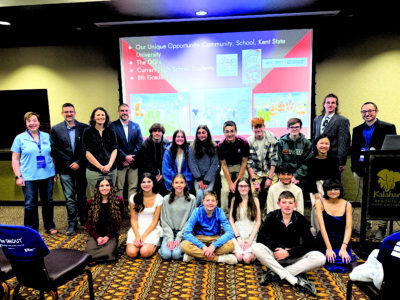
Lenhart was the junior high science teacher at the time, a position now held by Laura Frost. Some of the students who worked on the project under Lenhart returned this year as high school students, joined by Frost's current eighth graders. Both groups participated in the recent trip to the Ohio Stormwater Conference in Sandusky.
The students then discussed what they learned from the design phase of the project. They also helped to write the informational plaques posted around the park.
The educational component of Forest Lawn took a hiatus while the project was under construction, and the students worked their way up through the grades until the stormwater park opened in late October.
By then, it had caught the attention of researchers at Kent State.
Lauren Kinsman-Costello, associate professor of biological sciences at KSU and a lead investigator on the grants supporting the research in Boardman, said that the outreach and engagement coordinator for Kent State's ESDRI at the time happened to be a Boardman graduate and the daughter of a Boardman vice principal. Looking at the list of wetland projects provided by the Ohio Department of Natural Resources to labs like Kinsman-Costello's, Siena Larrick brought it to their attention.
"Part of the reason we hired her was to build opportunities to empower local communities around H2Ohio Wetlands to help us monitor and collect data," Kinsman-Costello said. "She was aware of how involved the district already was."
Larrick and Kinsman-Costello reached out to (outgoing)) township administrator Jason Loree and Verdantas to learn more about the park.
"We established a partnership where they would help us collect water samples. We visited the site for the ribbon cutting and saw how engaged they already were," she said. "We knew there was a really good opportunity to build a partnership."
Kinsman-Costello said there are two funding sources supporting the work in Boardman.
The partnership is supported by two funding sources: a Kent State Community Engaged Research Institute seed grant that funds the Boardman-Kent State collaboration and student engagement efforts, and a separate Ohio Department of Higher Education Harmful Algal Bloom Research Initiative grant that supports Kent State's broader wetland monitoring research in Northeast Ohio.
"For the larger grant, that's to both assess the effectiveness of wetlands that were restored or created as part of H2Ohio by ODNR, and to learn how the wetlands work. We're trying to inform continued management of wetlands and decisions made across about where and how to invest in them," Kinsman-Costello said. "The overarching goal in investing in that for Ohio is because of their ability to filter water to remove nitrogen and phosphorus that can fuel harmful algal blooms."
Kinsman-Costello said the students' role will not only help with actual ongoing research but also the university's ability to keep funding it.
"Our goal with that (community-engaged research)] project is to not only develop community science opportunities with Boardman schools students but, as we do that, collect preliminary data for a grant application for the National Science Foundation's Science of Science Discovery, Communication and Impact Program.
FROM CLASSROOM TO CONFERENCE
Once KSU was involved and the park opened, the work resumed and progressed as Kinsman-Costello and other KSU researchers joined Lenhart, Frost and their students.
"KSU worked with the kids in class, then went on-site, did some water monitoring and testing, and then they presented it all at the stormwater conference" Lenhart said. "Any conference like that is just really businesses and professionals, but the first time we went it caught everyone's attention. We're very lucky that all these parts are coming together to provide these opportunities."
District and township officials -- including Loree, who was at the conference -- said attendees were impressed by the students' work and the collaborative effort among the school district, township and university.
Lenhart, Frost and Radinovic, say they are impressed by the impact the work has had on the students.
"It's different than being in the traditional classroom, because they're getting real world experience, and that's the goal -- hands-on learning," Lenhart said. "Hopefully, we do more activities like this, and the data they gather can inform their own community. We're very fortunate and excited."
Radinovic said teachers such as Lenhart and Frost are why the district has seen such long-term success in its students, many of whom like the sciences.
"For whatever reason, the kids really like these teachers; they know how to get the kids excited," she said. "A lot of our kids wind up in environmental-type jobs."
Kinsman-Costello praised not only the students and their teachers, but the school district as well.
"I have to really compliment how well-resourced these teachers already are, and committed and involved the school administrators are in this partnership. I've worked with K-12 teachers in the past and had fantastic experiences, but many had to work really hard to convince admin for things like bus time to visit field sites," she said. "And everyone we met with, including people from the school board, have been really supportive and willing to provide reasonable resources so we can work with their students and provide these opportunities."
She said she is optimistic that the Boardman collaboration will serve as a model for communities across the state that are building wetlands and hoping to learn from them and maximize their benefits.
Last month, Boardman Township trustees honored the students and teachers at their regular board meeting.
"It's just something we wanted to acknowledge as the board of trustees, what it means to the township to have students like yourselves present and represent this township at a statewide conference that received a lot of recognition," Trustee Steve Yacovone said. "Jason Loree, who we know you know and have worked with, couldn't say enough nice things about your presentation."