
Trending
YOUNGSTOWN -- Despite what seemed like conflicting and complicated testimony, a jury only deliberated about 80 minutes Wednesday before finding Robert C. Powell, 25, of North Carolina, guilty of aggravated vehicular homicide, drunken driving and improperly handling firearms in a motor vehicle.
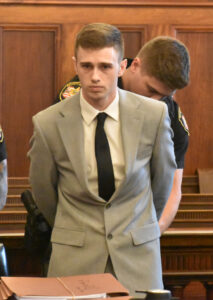
Powell was handcuffed after the verdict and was taken to the Mahoning County jail after Mahoning County Common Pleas Court Judge Anthony Donofrio revoked Powell's bond. Powell will be sentenced at 2 p.m. July 7 and he could get about 10 years in prison.
At the scene of the 6:48 p.m. April 10, 2025, crash, Powell refused a breath test, but Coitsville Township Police Sgt. Charles Butch administered field sobriety tests and arrested him. The crash was at the intersection of U.S. Route 422 and Hubbard Road in Coitsville. Driver John Kulnis, 62, of New Castle, Pa. was killed in the crash.
Kulnis was traveling east on Route 422, a four-lane road that had no stop signs or traffic signals at that intersection, while Powell was traveling south on Hubbard Road, which has two stop signs at different distances as Powell approached the Route 422 intersection.
The placement of the stop signs was a big part of the defense's case, arguing that the placement of a stop sign about 92 feet back from the intersection was not in the right place and created problems for Powell seeing Kulnis' car. A second stop sign is on the left side of Hubbard Road about 52 feet away from Route 422.
In closing arguments, Assistant Prosecutor Pat Fening said the defense focused on the stop sign to the right, "referring to it as 'the' stop sign, singular stop sign. Which one did they continually use in their analysis? The one that was 92 feet away."
"There was one 52 feet away from the intersection that was conveniently ignored for the entire conclusion of the defense expert," Fening said, noting that the one 52 feet away was "two feet over what the requirement is for the placement of a stop sign. However, you have to think to yourself why is it that he refused to acknowledge or address his conclusion (on) that stop sign? Because it makes (Powell) look bad."
Fening said the defense mentioned that Powell was traveling through that intersection for the first time in his life because he was new to the Youngstown area.
"He was (24) at the time of this accident. It defies logic that (Powell) does not know how to approach an intersection -- or if he approaches one that is 92 feet away from the stop sign, his decision that he makes is gun it and hope for the best," Fening said.
"We are taught from the youngest age to look both ways when you cross a road. It's clear that he did not do that or he would have seen (the other car) coming and would have been able to adjust for it. And it would not have happened," Fening said.
"The reason for the cause of this accident is he entered the intersection without looking (to see) if any cars were coming. If he would have done that, this would not have happened," Fening said.
Among the conflicting narratives that played out in the trial was whether Powell might have suffered a head injury in the crash that affected his ability to perform field sobriety tests.
Defense attorney Jeffrey Jakmides said the evidence showed that Powell was "diagnosed with a closed-head injury, which is another way of saying he had a concussion. That's what the medical records say."
Fening conceded in his closing argument that the medical records do discuss Powell having a "closed head injury." But he said the nurse who testified at the trial said that if Powell would start having symptoms at the jail, "they can refer to that and know how to address it. She specifically said he was not diagnosed with a concussion."
The defense put on an expert witness, Eric Brown, a sergeant at the Stark County Sheriff's Office who has his own accident reconstruction company and teaches crash reconstruction. Brown has worked in law enforcement for 20 years. He has investigated about 3,000 crashes in his career, Brown said
Brown agreed when Jakmides asked him if there is an obstructed view of Route 422 if a person is stopped at the stop sign 92 feet from the intersection.
Brown agreed that Powell was not indicted on a charge of failure to obey a traffic-control device. But Fening noted later that Powell has a pending failure to yield charge in Campbell Municipal Court related to this crash.
Brown found a historic image of a stop sign on the north side of Hubbard Road where Powell approached the intersection that evening. It was within about 12 feet of the intersection at that time, "properly" and "where you are used to seeing a stop sign," Brown said.
A 2023 photo shows that the stop sign had been moved back -- 92 feet from the intersection -- as it was the night of the crash, Brown said. "The Ohio Uniform Manual of Traffic Control Devices tells us where stop signs have to be," Brown said. The manual requires them to be "at the point where the vehicle is to stop," Brown said. There are some exceptions but "no further than 50 feet from the intersection."
Brown said, "We know it could have been placed correctly because it had been -- in 2011," he said. When a person is stopped at the 92-foot-back stop sign, there is "all the brush, and the terrain here is obstructing your view," Brown said.
Brown said Powell indicated he stopped at the stop sign 92 feet away and "accelerated hard to get through the intersection because he knew he had at least some distance to travel."