
County EMA director goes out in a big way
Lees oversees mass casualty drill before retirement
Trending
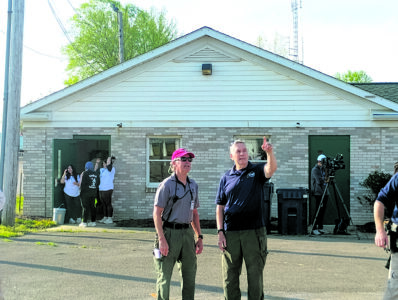
CANFIELD -- A mass casualty event occurred at Canfield Fairgrounds on Friday morning. Thankfully, nobody was actually hurt.
But the training exercise did mark the close of a longtime public servant's professional career.
Though Mahoning County Emergency Management Agency Director Robin Lees is still on the schedule four days next week, Friday's event was more than likely his last major undertaking as a formally employed public safety professional.
Lees initially planned to retire at the end of March, but between his scheduled vacation and that of Emergency Planning and E-911 Director Conner O'Halloran's and Lees' desire to help see the training exercise through, he remained on board for April.
O'Halloran will step into Lees' role, and he said he feels well prepared because of his time serving with the former Youngstown police chief.
"He's been just the greatest, easiest supervisor I've probably ever worked with," O'Halloran said. "Take this project, for example, the way he saw his role was just 'Conner, what do you need?' and he made it happen. The leadership qualities I learned from him will be key as we move forward."
Lees joined the agency in 2021 after his seven-year tenure as chief of police in Youngstown. He took over about two years ago as EMA director.
He was originally hired to augment the efforts of Andy Frost III, who was slated to take over as director. But Lees said when an opportunity at Mahoning County Career & Technical Center came up, it was too good for Frost to pass on, and the two of them switched jobs at the EMA, with Frost staying on to help Lees.
Lees only took the position after some personal events and financial considerations pushed him to consider how he was going to meet his retirement goals. But in his time, the agency has made at least two bold leaps forward, he said.
MOBILE COMMAND POST
"The most obvious thing is that we told the commissioners is that the mobile command post needed to be replaced and they freed up (American Rescue Plan) money so it didn't come out of the general fund or sacrifice any other county projects," he said.
The new $732,000 mobile command unit, revealed in March, came in under the expected price tag, after commissioners made $800,000 in ARP money available for it.
Manufactured by MBF Industries of Sanford, Florida, the MCP is outfitted with two full slide-outs for expanded interior space; dedicated and separate command and communications areas, separated by a central galley with kitchen and bathroom amenities; and the capability to convert to a fully operational 911 dispatch center.
It replaces a unit that was more than 20 years old, known affectionately as the "emergency Winnebago," acquired in the late 1990s by late EMA director Walter Duzzny.
IPAWS CONVERSION
Lees said the other highlight has been converting the county to the Integrated Public Alert and Warning System, mostly for tornado watches and warnings -- a grand improvement, he says, over the old Emergency Broadcast System.
"We're in a unique position that we have free network affiliates, so usually the area is very well informed anyway," he said. "But IPAWS is tied into the National Weather Service and alerts all the phones in the affected area."
He said the system is overseen by Federal Emergency Management Agency, and the county has to send the messages so that they meet strict standards
"We are very careful about using it because we don't want people to turn that alert off," he said. "I think maybe a lot of people have silenced things like Amber Alerts. This system is programmed into the phone when it's built, and most people never know it's there until it goes off, because it's very selective in the type of alerts that come through."
TRAINING EXERCISE
Friday's mass casualty training was O'Halloran's project from the time he was a captain at Canfield's Cardinal Joint Fire District, and Lees said he takes no credit for it. But he does believe in the value of the exercises, such as those Duzzny used to run.
"For us, it had a lot to do with making sure our communications systems were up and running," he said. The event was largely managed from inside the new mobile command post. "That's our mission, to help coordinate resources and bring that to the agencies involved."
The EMA is not a first-responder agency, but it is the first step in getting Ohio EMA and/or FEMA involved, as well as aid from the Red Cross.
O'Halloran said the communications are absolutely an area where they know improvement is needed. He said that end of operations won't be fully satisfactory at least until the county completes its switch over to the state-run MARCS network that allows all emergency agencies to communicate on the same channel.
Finding the gaps is even more important than identifying the successes, Lees said.
"I think one of the keys to this is you're going to experience where you're not meeting goals in particular areas," he said. "It's about finding the growth areas. It's where you have a failure.
"Either it's something we didn't think of, or what we have in place is not working the way we hoped. I'd rather see a couple missteps we can identify so we can make those adjustments before something real occurs."
While many such successes and failures were identified and discussed in the immediate aftermath of the exercise, O'Halloran said he's also waiting to learn about other aspects of the event from reports expected in coming weeks.
The training simulated a bleacher collapse at a high school football game, with multiple casualties of varying severity.
It involved 40 to 50 local and regional safety and emergency response agencies, totaling more than 350 people, including more than 250 students from Youngstown State University's Bitonte College of Health and Human Services.
Those students played the roles of everyone from victims to nurses, parents, coaches, lab techs, and emergency first responders.
O'Halloran said he wants to see what lessons they can learn from the patient hand-off reports.
"Does the report from the field match...what ultimately gets to the hospital? What gets lost in translation?" he said. He also noted that the nursing students learned valuable lessons about field triage and making do without the regular amenities of a real hospital environment.
Alyssa Osman, communications officer for Bitonte, said the students also had to cope with - and learn from - how their personal and professional feelings might conflict.
"If you're a nurse by profession but you're at this event as a parent of someone on the field or in those bleachers, what do you do?" she said. "They were not given much advance direction or time to think about it. They were just told 'this is your role, now figure out what to do with it.'"
NEW LEADERSHIP
With Lees' departure, O'Halloran will become the new EMA Director. Appointed in July as the county's Emergency Planning and E911 Director, O'Halloran earned his associate and bachelor's degrees and received his paramedic training at YSU. He obtained a master's degree in emergency management from Eastern Kentucky University.
The county already has posted an advertisement to hire his replacement, who will hold a new title, Emergency Management Agency officer.
On Thursday, the county also approved hiring Youngstown Fire Department Battalion Chief Fred Beehler as the new HAZMAT director.
O'Halloran noted that HAZMAT is under the umbrella of the EMA, but is run somewhat differently and the county is in the process of restructuring that for more seamless and uniform operations. He said the agency also will use that restructuring as the basis for identifying and building up other areas where they can develop more specialized technical units similar to HAZMAT
"We want to allow EMA to function so that we have countywide specialized and technical rescue teams," he said. "Like drowning response and swift-water. So, dealing with the Mahoning River, for example, making sure we have a response to handle something that could be a multi-jurisdictional incident."
Lees said his treatment from the county has been excellent.
"As I told the commissioners, there's a season for everything and this one is passing and it's time to go," he said. "I met with them at the end of the year, told them my plans so they had time to decide where they wanted to go. They've treated me well and I have no complaints."
Lees said he plans to be available when needed as a volunteer. That's not only because he has the experience to offer leadership and guidance in emergencies, but also because he possesses a CDL and so is among the few people authorized to drive the mobile command post.