

Civil rights reporter addresses Sojourn students
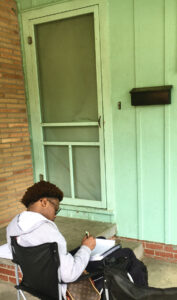
JACKSON, Miss. — Even though she hasn’t been touched by a major tragedy, that didn’t dampen or diminish how moved Nyla Singer felt to hear a major civil rights reporter share a few eye-opening recollections.
“I’m glad he got justice in those cold cases — especially a white reporter. I was moved by it,” Singer, a Cardinal Mooney High School freshman and member of her school’s cheerleading squad, said.
She was referring to Jerry W. Mitchell, an investigative reporter who worked for the Clarion Ledger paper in Jackson, Mississippi, and whose reporting led to the reopening of several cold civil rights killings from the 1960s and the imprisonment of several Ku Klux Klansmen.
Mitchell, who in 2019 founded the Mississippi Center for Investigative Reporting, was among those who gave presentations to Singer and 14 other Youngstown area high school students and adults Sunday who are on an eight-day Sojourn to the Past immersive traveling American history journey to major civil rights sites in the South.
In one of his pieces that ran March 24 in Mississippi Today, Mitchell published a story about Mississippi Department of Public Safety officials having stumbled upon a blue suitcase that contained a cache of Klan materials such as a handbook, a robe, recruitment materials and other items. The handbook was for the White Knights of the Ku Klux Klan, which was based in Laurel, Mississippi, and is said to be the nation’s most violent Klan organization. The White Knights were responsible for at least 10 killings, including the Jan. 10, 1966, firebombing of civil rights activist Vernon Dahmer’s Hattiesburg, Mississippi, home.
The materials in the suitcase were given to the Mississippi Department of Archives and History.
During his presentation, Mitchell, author of “Race Against Time: A Reporter Reopens the Unsolved Murder Cases of the Civil Rights Era,” discussed how his dogged reporting and follow-ups of leads ultimately resulted in a murder conviction against Samuel H. Bowers, the Klan organization’s Imperial Wizard, for Dahmer’s killing. He was sentenced to life in prison 32 years after the murder and died in prison in 2006 at age 82.
Mitchell’s reporting also led to the early release of thousands of files from the Mississippi Sovereignty Commission, an elaborate spy organization that operated for about two decades and created files on many civil rights workers and others before the information was given to the Klan.
In addition, his work helped put behind bars several other Klansmen: Byron de le Beckwith, who shot to death Medgar Evers, the state’s NAACP field secretary, on June 12, 1963; Edgar Ray Killen, who helped orchestrate the June 21, 1964 killings of civil rights workers Michael “Mickey” Schwerner, Andrew Goodman and James Chaney in Philadelphia, Mississippi; and Bobby Frank Cherry, one of four men who carried out the Sept. 15, 1963, bombing of the 16th Street Baptist Church, which killed four girls and injured 21 others.
The group’s time in Jackson also took them to the home of Evers, who was shot to death June 12, 1963, as he emerged from his vehicle’s driver’s side — and just after President John F. Kennedy had delivered a speech in which he advocated for civil rights, Evers was 37.
Beforehand, Evers’ daughter, Reena Evers-Everette, spoke to Singer and the others about the importance of voting and understanding their history, as well as embracing and internalizing one of her father’s mantras: striving to see others’ positivity.
“Look at the good in people, but look inside your own good, put it out in the world and receive it when presented by someone else,” Evers-Everette said, adding, “Change things that are not right, and vote for these changes.”
Evers-Everette, the Medgar and Myrlie Evers Institute’s executive director and a Sojourn to the Past board member, is the former chairwoman of the Claremont Chapter of the American Red Cross’ board of directors and that city’s Committee on Dialogue and Human Relations.
Myrlie Evers is her mother and lives in Claremont, California.
Evers-Everette, whose father was fatally shot when she was 8, recalled that he often played with the neighborhood children, even after returning home from a stressful day. He also nicknamed her “sunshine,” Evers-Everette recalled.
One of her father’s major influences and mentors was Theodore Roosevelt Mason Howard, a wealthy black from Mound Bayou, Mississippi, who founded the Regional Council of Negro Leadership and president of the National Medical Association. One of his slogans was “Don’t buy gas where you can’t use the restroom.”
“I’m grateful to know what my dad did for the world,” Evers-Everette told the students and adults. “My father always had a vision, and he knew his purpose in life.”
The Sojourn participants’ travels also took them to a small cemetery off Fish Lodge Road, a few miles from Meridian, Mississippi, which is the resting place for civil rights activist James Chaney.
On June 21, 1964, Chaney, Michael “Mickey” Schwerner and newcomer Andrew Goodman were arrested and taken to the Neshoba County jail around 3 p.m., then released about seven hours later, before sheriff’s deputy Cecil Price pulled their station wagon over a second time before several Ku Klux Klan members shot the three men to death.
Beforehand, the three civil rights workers investigated the bombing of Mount Zion Baptist Church in nearby Longdale.
Addressing the group assembled at Chaney’s gravesite was his daughter, Angela Lewis, who was 10 days old when her father was killed at age 21.
Lewis, a nurse who works with children in a mental health facility and the mother of four, said she learned about her father largely through her grandmother, such as the fact that he maintained a sense of humor, despite the seriousness of his civil rights work.
Chaney’s passion for such work germinated during his time at Harris Junior College, which resulted in him joining the Congress of Racial Equality, a major civil rights organization, where he played a pivotal role in organizing the Freedom Summer campaign.
The three men’s killing sparked national outrage and drew attention to Klan violence in Mississippi at that time.
“I was told he got into the civil rights movement because he was tired of seeing the injustices and suffering of the people, and he wanted to see things change,” she told the participants.
Lewis added that she felt her father would have gone on to achieve a higher level of greatness had he been able to do so.
After her presentation next to her father’s grave, Lewis gathered several students to sing their rendition of “Amazing Grace.”
Next to Chaney’s headstone is the inscription, “There are those who are alive but who will never live, those who are dead and will live forever. Great deeds encourage and inspire the living.”
SELMA STOP
The journey’s itinerary also included several hours in Selma, Alabama, the pinnacle of which was their crossing of the Edmund Pettus Bridge in a quiet, two-by-two manner reminiscent of those who marched 54 miles to Montgomery from March 21 to 25, 1965, for voting rights.
Singer and the others also paid homage to the Rev. James J. Reeb, a Unitarian minister from Roxbury, Massachusetts, who was among the estimated 450 people of faith who came to the city, at the behest of Dr. Martin Luther King Jr., days after the mayhem on the bridge March 7, 1965, a day infamously known as “Bloody Sunday,” in which Alabama state troopers and other law enforcement attacked an estimated 600 peaceful marchers, including civil rights icon and future Georgia congressman John Lewis. He suffered a skull fracture.
They also spent time in Foot Soldiers Park, which the late Jo Ann Bland created. Bland, who was on the bridge during the attack when she was 11, died Feb. 19 at age 72.
The participants each collected a small rock at the park, where the Selma-to-Montgomery march began, as a reminder that ordinary people still have the power to make powerful and needed changes to society.
In another sense, the group’s time in Selma also was to not only honor Bland, but to provide them an opportunity to see the importance of carrying on her life’s work and legacy.
Local News
Mastodon fossil to be displayed in Canfield
Aggravated robbery, abduction are among Mahoning indictments
YOUNGSTOWN — The following people were indicted last week by a Mahoning County grand jury: • Marquis J. ...
Boardman daughter saves parents from scam
BOARDMAN — A local woman is credited with saving her parents from a telephone scam that got a little too close to ...
City’s 1st black firefighter dies at 96
Woman refuses medical attention after being stabbed on head at home
YOUNGSTOWN — A woman refused medical attention after calling 911, saying a juvenile boy in her home stabbed her ...
City Council approves spending up to $295K on postponed projects
YOUNGSTOWN — City council authorized the board of control to spend up to $295,000 to move ahead with projects on ...