
Mastodon fossil to be displayed in Canfield
Originally was dug up 95 years ago
Trending
CANFIELD -- On April 18, a big piece of Canfield history will be coming home for several months in an exhibit at the Bond House.
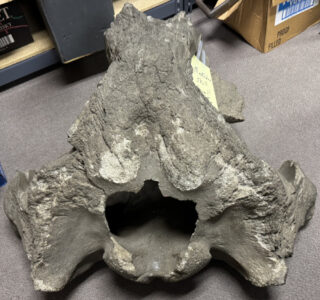
It is a piece of a mastodon skull that was dug up around 95 years ago in Fair Park.
Laura Zeh, curator for the Canfield Historical Society, is arranging a special exhibit featuring the mastodon fossil, along with other fossils on loan.
"I was able to borrow other mastodon fossils from Carnegie Natural History Museum in Pittsburgh and the Ohio History Connection in Columbus," she said. "Carnegie is loaning us replica tusks and a jawbone with teeth."
According to information the Canfield Historical Society has on file, the mastodon fossil was discovered during an excavation of a bog near Smith's Pond in Fair Park nearly 95 years ago. A business in that area had done the excavation to bring a water source to its greenhouses, which were known for their tomatoes.
Around 1931, the fossil was dug up and laid by a tree where it remained for several years. Zeh said it was discovered by Leo Dunning of the Dunning-Crum Coal Co. and was brought to his office as a conversation piece.
Zeh said the fossil was eventually donated to Mill Creek MetroParks for display in the Lanterman's Mill nature center. At the time, the old mill housed a collection of stuffed birds and animals, including rare ones like the two-headed snake.
When the Ford Nature Center was opened, the mastodon fossil was moved there and placed on display. After being on display there for a while, it disappeared from the scene.
At the Canfield Historical Society, newspaper articles were found that covered the original discovery in 1931. Oddly, the Mahoning Dispatch had no articles on it and there were no records indicating where the fossil was moved to from the Ford Center.
Canfield Historical Society member Jerry Dixey mentioned the fossil to friends he knew at the Mahoning Valley Historical Society. He was informed by them that the MVHS had the fossil in storage. Talks were initiated and arrangements made to have the historic fossil brought to Canfield on loan for the spring and summer.
For Dixey, the history of the mastodon fossil brought back many memories. He grew up near Smith's Pond and used to hang out there with his friends.
"Smith's Pond was named for the original property owner where the greenhouses were," Dixey said. "Smith's Pond was the spooky one with trees hanging over it and murky water."
Dixey will again be hanging out at Smith's Pond, but this year he will be doing it as a tour guide.
On April 18, rain or shine, he will be giving a tour for anyone who wants to see the original location of the fossil. Anyone wishing to take part can simply meet at the Fair Park open air pavilion at 11 a.m. Dixey will open the tour with a talk on the area. Following the talk, Dixey will lead the group to Smith's Pond and the location where the mastodon skull was found.
"I suggest dressing appropriately and don't wear your best tennis shoes," Dixey said.
There will only be one hike to the pond. Afterwards, the Bond House will be open with the actual fossil on display. The Canfield Historical Society walking tour and the exhibit are free.
To help raise some funds, the society will be selling mastodon cookies, plush mastodons, paleontologist notebooks for young explorers, and other themed souvenirs. The mastodon fossil will remain on display through June 29 and can be seen every Monday from 11 a.m. to 4 p.m.
As for the future of the fossils in Canfield, Zeh asked, "I wonder why no one ever dug up the rest of the mastodon bones?"