

Regional writers go to camp, work out on creative exercises
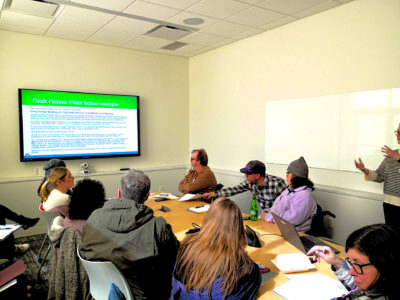
Correspondent photos / Susan Wojnar Participants in the “Flash Fiction” workshop listen to instructions at Lit Youngstown’s ninth annual Winter Writing Camp on Saturday at the main branch of the Public Library of Youngstown and Mahoning County.
YOUNGSTOWN — Writers of all ages filled the meeting rooms of the main branch of the Public Library of Youngstown and Mahoning County on Saturday for Lit Youngstown’s ninth annual Winter Writing Camp, a free, daylong workshop designed to make creative writing accessible, welcoming and fun.
The multi-generational event offered sessions in poetry, fiction, memoir and publishing for participants ages 5 through adult. Lunch, catered by Aladdin’s Eatery, was provided at no cost, and the day concluded with a Youngstown-style wedding cookie table and open mic session where attendees read some of their material.
The camp is part of Lit Youngstown’s broader mission to nurture literary arts in the Mahoning Valley. Co-founder Karen Schubert said the idea for a literary nonprofit dedicated to Youngstown first took shape in 2015.
“There are literary arts nonprofits all over Ohio, and I thought we should have one, too,” Schubert said.
The Winter Writing Camp grew out of a desire to create a less intimidating entry point than the organization’s annual Fall Literary Festival, which features nationally known authors and carries a significantly higher price tag.
“We are trying to reach people on a tighter budget, or who have children,” Schubert said. “We created an event that is one day, friendly to all experience levels, and welcoming to kids, teens and adults.”
While the Fall Literary Festival costs more than $60,000 to produce, Schubert said the Winter Writing Camp operates on a roughly $10,000 budget, allowing organizers to keep it free and remove financial barriers to attendance.
“I love this high-energy event, where kids and adults write all day with their peers, then share their work at Cookies & Open Mic,” she said. “It’s the fun kind of writing: creative expression, brain play. Whether attendees are serious about a writing career or are writing for personal enjoyment, they are kind and welcoming, and it’s such a nice environment.”
Workshop leaders came from across the region — the Mahoning Valley as well as Cleveland, Pittsburgh and Akron — bringing a range of expertise and publishing experience.
Among them was Chris Barzak, professor of English and creative writing at Youngstown State University and author of four novels and three short story collections. His novel “One for Sorrow” was adapted into the Sundance feature film “Jamie Marks Is Dead.” Barzak’s work has earned honors, including the Stonewall Honor and the Shirley Jackson Award.
Barzak participated in a publishing panel exploring the differences between traditional, indie or small press, and self-publishing routes. He focused on the traditional publishing path, joined by fellow published authors Abby Vandiver and Kara M. Zone.
Poet Russell Brickey led a haiku workshop that blended reading and writing. Participants examined both traditional and contemporary haiku before crafting their own pieces inspired by images, tactile objects and sound.
“Poems help us see the world in new ways,” Brickey said. “With haiku, we investigate how an image or object can trigger the imagination.”
Brickey studied creative writing at the University of Oregon and Purdue University and has three poetry collections in print. He also writes horror fiction under the pen name Eddins Sinclair.
Teresa Leone of Coitsville introduced participants to letterlocking, a historical method of securing correspondence before the invention of gummed envelopes in the 1800s. Leone, an instructor at Youngstown State University and Westminster College, helped launch the emerging field of letterlocking studies.
In her session, writers composed letters, stories or poems and then folded, tucked and sealed them into secure packets using techniques similar to those employed by figures such as Jane Austen or Shakespeare.
Isabella Moreno, a Nuyorican (person of Puerto Rican descent living in New York) author and certified Amherst Writers & Artists facilitator from the Bronx now living in Cleveland, led a workshop titled “Food Stories of the Diaspora.” The session explored how food traditions carry memory, history and compromise across generations and geographies. Participants read narrative food stories from cookbooks by People of Color and drafted their own pieces inspired by culinary memory.
“Joy can always be found in collective spaces of shared creation,” Moreno said.
Family creativity was the focus of “Pages of Connection: Adult-Child Journaling,” led by Trennae Roe, founder and publishing consultant of Writers Roe & Wellness Co. Roe, a former Pre-K educator and internationally bestselling author who has written more than 30 books and short stories, guided adults and children through shared journaling prompts, affirmations and storytelling exercises designed to deepen communication and connection.
Beat poetry and its contemporary influence took center stage in a session led by John Burroughs of South Euclid, a recent Ohio and U.S. Beat Poet Laureate. Participants drew inspiration from Beat writers to energize their own work and break through creative blocks.
Memoirist JRW Case encouraged writers to tap into personal challenge and transformation. In his session, attendees explored memories of times when they pushed themselves beyond their comfort zones. Case, an Akron native, is the author of “Cycling Through Columbine” (Bottom Dog Press, 2022), recounting his bicycle journey across the western United States.
Short fiction writer Lisa Ferrante introduced participants to flash fiction — stories of 1,000 words or fewer that can “encapsulate whole worlds.” Writers began drafting their own flash pieces, experimenting with compression and surprise. Ferrante’s work has been nominated for The Best American Short Stories anthology, the Pushcart Prize and Best Small Fictions.
In “The Stories We Tell Ourselves,” writer and mindfulness teacher Meghan Cliffel invited participants to examine the narratives their minds construct — narratives that can either hinder or fuel creativity. Drawing on her experiences and advocacy work, Cliffel encouraged playful engagement with self-talk to help writers get unstuck and sustain momentum.
For some attendees, the camp offered a return to the page. Danamarie Donatelli of Youngstown came seeking inspiration after stepping away from writing during a long bout of depression. Although she has not yet pursued publication, she is interested in eventually writing a memoir.
Sarah Francis, also of Youngstown, holds a Master of Fine Arts degree from Youngstown State University and is working on her first series of contemporary romantic fiction. She was particularly interested in the publishing panel led in part by her former professor, Barzak.
Winter Writing Camp 2026 was made possible through support from William Mullane, the Pollock Personal Foundation, Christine and Elliot Legow, Elizabeth Kauffman, Lisa Gates and Linda Baker, along with donations from Aladdin’s in Boardman, Giant Eagle and Cornersburg Sparkle Market.
For Schubert and the Lit Youngstown team, the goal remains simple: to provide a space where creativity thrives without cost or intimidation.
“It’s important to us that it be free, so there are no barriers to attend,” she said. “We are exceedingly honored and grateful to the public library for hosting us in their beautiful space.”
For more information about upcoming programs, visit www.lityoungstown.org
Local News
Honors awaiting teachers in Valley
Forty-one educators from across Trumbull, Mahoning and Columbiana counties will be recognized Tuesday at the second ...
City couple reported missing last week is OK
YOUNGSTOWN — Youngstown police Detective Jerry Fulmer issued an update Saturday on Angel Ortiz and Anita Pagan, a ...
Victim identified, vehicle located in fatal hit-skip
WARREN TOWNSHIP — The victim of a fatal hit-skip crash Thursday morning has been identified as Jeffery Hillard, ...

East High students sport school pride in T-shirts from Idaho
On the record: McDonald
WHAT: Village council meeting Feb. 18 PRESENT: Sean Schmidt, Kerry Reckard, John Metzinger, Brian Bosheff, Joe ...
Watkins opposes parole for two violent criminals
WARREN — Trumbull County Prosecutor Dennis Watkins is opposing parole for two violent convicted felons who are ...