Addressing the behavioral health crisis in youth
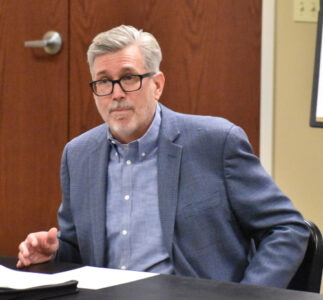
YOUNGSTOWN — The head of Mahoning County Children Services convened a roundtable discussion with the judge and magistrates of the county’s juvenile court, mental health and recovery board, county board of health, developmental disabilities and about six other organizations to talk about ways to better address the needs of “the most needy community children.”
The discussion was about the “increasing numbers of children with acute behavioral health needs, complex trauma histories, developmental disabilities and co-occurring conditions whose needs exceed the capacity of the current local service system.”
Mahoning CSB Executive Director Richard Tvaroch said in opening remarks he was talking about children with “profound, multiple … needs,” who in Tvaroch’s view are “not having their needs met.” He said it is becoming a “community health issue because we have children, and by extension, families struggling to maintain (and) get the services they need … and we need to figure out how to address these issues.”
Tvaroch was apparently intentionally vague at times because of privacy issues that prevent such a discussion from taking place completely in the open. But he spoke especially about 26 children who are Mahoning County residents who are the responsibility of Mahoning County CSB who are in residential care, meaning in facilities throughout Ohio and in several other states.
But the problem, he said, is that even though the cost of placing the 26 children is a collective $13,600 per day, Tvaroch is not so sure the 26 are “getting better.”
He said, “I would like to tell you that those 26 kids are all getting better. But I’m not going to lie to you. I don’t know that residential care is always the right approach for them. So we need to figure out how to get those children back in the community.”
Tvaroch said if the current cost of placing children in out of county residential care continues, “that will be roughly a quarter of the agency’s operating budget. I would gladly do that if I thought children were getting better, if I felt there was a clear pathway to get them home, but there is not. And it is why we so critically need to have these conversations because only by coordinating our efforts, can we see better outcomes for children we touch in all of our agencies.”
Tvaroch noted that Mahoning County is not the only county struggling with what his agency called a “growing health crisis” in a press release about the round table discussion.
He said he and an assistant were in Columbus last week at a conference, and all 88 child welfare agencies in the state are experiencing this issue.
Tvaroch said he and Mahoning County Juvenile Court Judge Theresa Dellick and her magistrates have talked about three to five kids “where we are struggling to figure out the right, best approach, not only for our two organizations, but as a community.”
He added, “What I see today is just the beginning of an ongoing conversation, a conversation about what we can do to meet the needs of our most acute children.”
He said he invited leaders from government entities and organizations such as Akron Children’s Hospital, Alta Care Behavioral Health, Cadence Care Network and Direct Care Consultants because they have experience outside of just the “child welfare lens” Tvaroch sees through to “hear from you so we can better align.”
Mahoning County Commissioner Carol Rimedio Righetti asked Tvaroch why there is no facility in Mahoning County for children with “acute” needs. “I don’t care if he quotes me on this. It’s crazy for us to move our children to other areas, to other counties to other parts of Ohio. How about their families? Maybe they want to visit them and hug them or something,” she said.
“I echo and agree with all of your points,” Tvaroch said. “It’s an issue that I and Judge Dellick talk about all the time,” Tvaroch said.
Dellick said one reason children are sent far and wide is that “There are different needs for each of these kids, and different facilities address those needs. So there is not one facility that addresses all needs. And there is not one facility that will accept all students.
“We have students who have been refused residency at certain facilities, so we have to keep trying. I applaud Children’s Services for their effort and trying and trying and trying. And the problem is costly. It costs an awful lot to send these students to a facility for one day. That is the dilemma we are facing right now because it is becoming unmanageable. I don’t think they are getting great service to tell you the truth,” Dellick said. She brought her two magistrates with her to the roundtable discussion.
Tvaroch said the facilities that accept the “acute” children are licensed by either the Ohio Department of Children and Youth or Ohio Department of Mental Health and Rehabilitative Services.
Tvaroch at one point early in the round table said, “What we are going to talk about before we kick our friends in the media out and really start talking is some of the pressure points we are facing.”
Local News

Ohio State president resigns
Girard addresses feral cat problem
GIRARD — City officials said they have already spent $2,000 to address the increasing number of feral cats within ...
Warren’s Bill White named Buck O’Neil award winner
Staff report A Warren native will be honored in Cooperstown this summer. Bill White was named the recipient of ...
Mostly drug charges in recent grand jury report
YOUNGSTOWN — The following people were indicted Thursday by a Mahoning County grand jury: • Daniel A. Green, ...
Justice to lead conference on mental health, criminal reform
YOUNGSTOWN — Mental health and criminal justice are far more intertwined than many in both fields would prefer. ...