Engineer: Road tax goes the distance for taxpayers
AUSTINTOWN — Mahoning County Engineer Patrick Ginnetti made the first of many stops this week on his campaign to ensure roads and bridges get the attention they need.
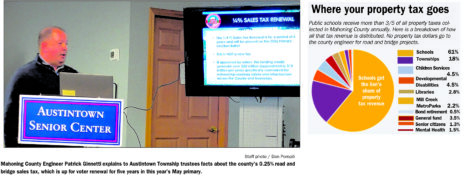
He gave a presentation on Mahoning County’s 0.25-percent sales tax before the Austintown Township Board of Trustees during this week’s regular meeting at the Austintown Senior Center.
“We’re in our third year of the sales tax, and it will be on the May primary ballot for renewal,” Ginnetti said. (The Vindicator incorrectly reported earlier this week that the issue would be on the November ballot.)
Ginnetti said in the three years that the funding has been available, his office has paved 150 miles of roads in Mahoning County and is on pace to finish 250 miles by the end of the five-year cycle in 2027.
He said the county will open bids Wednesday for the 2026 paving project.
The sales tax, passed by voters in November 2021, which increased the total sales tax countywide to 1.75%, will generate more than $50 million — or $10 million annually, for county and township paving projects and bridge repairs.
Ginnetti said there are no proposed changes in what the money may be used for or the distribution between the county and the townships.
The money is split evenly for paving projects — $4 million each for county and townships — with the remainder dedicated to bridge repair and replacement, which Ginnetti’s office manages.
The tax costs 25 cents per $100 in sales, $2.50 per $1,000, $25 per $10,000, and so on. Ginnett said 35% to 40% of sales tax revenue is generated by out-of-county visitors.
“And this is information that we’ve received from the [Mahoning County] commissioners office, which tracks the spending and where revenues come into the county,” he said.
Each community uses the money differently, but within the parameters of what the original levy language allows. Ginnetti’s office can use it for local grant matches, loan fees, grant applications and, of course, the paving and bridge contracts. Poland Township, for example, has used it for safety upgrades.
“My office is solely dedicated to paving and bridges, because that is the most critical infrastructure that we have,” he said.
The money cannot be used for salaries, equipment or buildings.
Ginnetti said the county simply cannot hope to achieve what it has done the past three years without the sales tax revenue.
“Stagnant revenue, rising costs, where do we go from here? Our budget as county engineer has been relatively stagnant for the last three decades,” he said.
In 2003, his office received $11,320,951 in revenue. In 2023, it received $13,795,699. That represents a 21.85% total increase, or just over 1% per year, which Ginnetti said does not keep up with inflation.
Per his presentation, over the same time period, the national highway construction cost index shows a 278.6% increase in material costs. Mahoning County has seen a 265.7% increase for asphalt and a 500% increase for tack coat. Ginnetti notes a 68% surge in costs just between 2021 and August 2025.
“With the stagnant revenue and rising costs of equipment, that’s just another element that makes it more and more difficult every year for us to do our job,” he said. While equipment does not come out of the sales tax revenues, it is a cost that reduces what his office has available to spend on roads and bridges.
The cost of a single-axle dump truck with snow and ice pack in 2017 was $158,000, in 2024 it was $242,000 and in 2025 it was $260,000. This year it will be higher.
“One other thing, and [Austintown Township Administrator] Mark [D’Apolito] and I have talked about this, is that if we buy a truck today, it’s gonna sit for 18 months until we can get the plow package installed because of the delays,” he said. “But we’re running into another issue where the warranty is going to be voided because the truck is sitting for so long without being used.”
One of Ginnetti’s most pressing concerns about the levy is the public’s perception of how his office is funded.
NO PROPERTY TAX
REVENUE
In Ohio, all 88 county engineers offices’ operating budgets are funded almost entirely by the state’s gas tax and motor vehicle registration fees. County engineers do not receive any revenue from property taxes or income taxes.
“We are not a general fund department,” Ginnetti said. “Because we are funded by gas taxes and license plate fees, we do not receive any general fund revenue.”
Ginnetti’s presentation included images of tax duplicates from municipalities and townships, which will show residents exactly where their tax revenue goes. The same information about property tax distribution can be found on the Mahoning County Auditor’s website. Regardless of the size of a property, none of the taxes will go to the county engineer.
It is interesting to note that the distribution of the county engineer’s two funding sources varies by the size of the county. For the three largest counties in Ohio, the funding is 92% motor vehicle registration fees and 8% gas tax revenue. For the three smallest, it’s 72% gas tax and 28% vehicle registration.
“So if you raise one of those, you’re not actually helping everybody, you’re only helping certain groups,” he said.
He showed that the federal gas tax has not been increased since 1993, and the state gas tax only went up once, by $0.10 in 2019. Ohio’s gas tax rate is 38 cents per gallon.
Ginnetti said that when the state collects that money it distributes 11% to Ohio’s 88 county engineers divided equally, regardless of county size.
As for the other revenue stream, there’s no improvement coming.
“The county license plate permissive fees have been maxed out since 1991, and we cannot increase them any further,” he said.
As a result, Mahoning has joined with counties such as Delaware, Logan and Holmes in dedicating a portion of sales tax revenue to roads and bridges.
“This, of course, provides a stable, predictable revenue stream that allows us to plan long-term projects that we really would not have been able to do prior to this,” he said.
The office relies quite a bit on grants from the Ohio Public Works Commission, but rising costs mean those dollars have been stretched thinner too. However, Ginnetti said, the revenue from the sales tax has more than made up for the difference.
Over the past three years, the county has completed at least a majority of its proposed paving plans despite reduced value from OPWC’s contributions.
In 2023, the OPWC grant afforded Mahoning County a small portion of its planned paving project, while the sales tax revenue allowed for a significantly better outcome overall.
In 2024, the number of roads with only the grant was fewer, but the total number of roads paved, with the sales tax revenue, actually outpaced 2023.
In 2025, the OPWC grant only covered the cost to pave four roads, but again the list of paved roads went up from the previous year.
Ginnetti shared maps highlighting what OPWC grants could cover compared to what the county actually achieved thanks to the sales tax, and also showed the total picture comparison over three years.
Austintown officials said they, like Ginnetti, understand very well what the sales tax means.
“I think we’ve averaged only 2 miles of road per year with the grants, and because of this, I think this past year we did 7.5 miles,” said Trustee Robert Santos.
Zoning Inspector Dominic Moltchan put it into an even clearer perspective.
“We have about 150 miles of township roads, and about 230 of that is lane miles,” he said. “At only 2 miles per year, it would take us 58 years to repave the entire township. But with this [sales tax] money we’ve been getting, it only takes about 16 years to repave the township.”
Ginnetti said the county, which manages about 500 “center line” miles of road, also has paved roads in Austintown, including Kirk Road, New Road, Silica Road, Raccoon Road, Ohltown Road and many others.
Local News
Valley airport gets $5M lift in US aid
Trumbull and Mahoning counties will receive $7.9 million from four federal appropriations bills signed into law ...
Joyce, Rulli boost campaign funding edge
Candidates trying to defeat Congressmen Dave Joyce and Michael Rulli, the two Republicans who represent the ...
County leaders close doors on Clerk Ciccone
YOUNGSTOWN — Embattled Mahoning County Clerk of Courts Michael P. Ciccone had his access to all courthouse ...
65 fewer deer killed in third year of hunt
Property transfers
Property transfers recorded Jan. 26-30 in Mahoning County and portions of Trumbull County: Austintown Shon ...