

Donation steels labor and industry museum endowment
Contribution reflects family’s connection
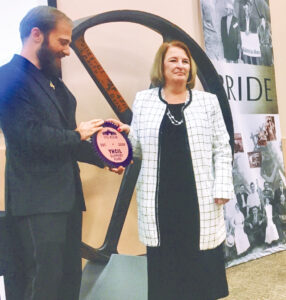
Jonathan G. Cambouris, the Youngstown Historical Center of Industry & Labor’s administrator, presents a commemorative gear to Martha I. Pallante, former chairwoman of YSU’s Department of History, during a kickoff reception Friday at the museum. The event, which was to celebrate the launch of the YHCIL support fund, also coincided with an America250 event to honor the nation’s 250th anniversary. Correspondent photo / Sean Barron
YOUNGSTOWN — For Martha I. Pallante, seeding a special endowment fund was about more than being invested in its growth and potential: It also was personal.
“I remember when I complained about the orange goo on the cars. My dad said, ‘As long as there is the goo, people are working,'” Pallante, the Charles Darling Endowed chairwoman of American Social History, said.
Pallante, who’s also a leading expert on the Mahoning Valley’s history and chaired Youngstown State University’s Department of History, was referring to a type of fallout from the booming steel mills that were much of the area’s economic lifeblood, as well as the sources of many good-paying jobs.
Her connection to the local steel industry can be traced back several generations. Pallante’s paternal grandfather arrived in the area at age 10, then helped her great-grandfather, who came in the early 1890s from Italy to Niles. The two men were among the industrialists who built refractory fire bricks used to line blast furnaces, she said.
“It was an ancillary industry,” Pallante added. “My grandfather worked there for about 50 years.”
That personal connection to the steel mills also helped fuel her desire to make an initial contribution of more than $12,000 to the Youngstown Historical Center of Industry & Labor support fund, as well as certain other gifts, which was the central topic of a kickoff reception Friday evening at the YHCIL, also known as the “Steel Museum,” 151 W. Wood St., downtown.
The event also marked the first endowment fund for the 32-year-old museum. In addition, the reception, at which a few dozen attended, coincided with the YHCIL’s February kickoff of America250’s monthly theme of business, innovation and work.
The support fund’s primary purpose “is to provide ongoing financial assistance to the Youngstown Historical Center of Industry & Labor, or its successor entity, to help preserve and promote the history of the steel industry in Youngstown and the Mahoning Valley,” Pallante said, adding, “Distributions from this endowment may be used to support the center’s general operations, curation and research activities, including but not limited to personnel, supplies, exhibits and emergency repairs.”
In a broader sense, the fund will aim to allow the museum’s stakeholders to ensure the region’s industrial heritage will continue to be preserved and interpreted, Pallante continued.
Pallante, who also taught early American history at YSU, worked closely with the Ohio History Connection, along with YSU, on behalf of the museum’s continued well-being. In 2010, the university became YHCIL’s managing partner.
It is hoped the endowment fund will grow to about $2 million, as it represents a significant step forward toward maintaining continued relevance of the steel industry’s stories in the region, Jonathan G. Cambouris, museum administrator, said in his remarks.
Charles Howell, dean of YSU’s Beeghly College of Liberal Arts, Social Sciences and Education, said the endowment is needed also to launch new creative ways for the museum to further connect with the community. In addition, the fund will go toward protecting the region’s storied history now and for generations to come, he added.
“Our region has such a rich historical legacy,” YSU President Bill Johnson said, adding that he places a high value in the museum’s role of telling the story of much of that legacy.
In the bigger picture, the YHCIL represents the history of a nearly 200-year-old industry that was a shining and innovative example of how Ohio, between 1865 and 1970, had led the way in being home to countless innovations and inventions, Johnson explained.
“Our state has always been on the leading edge of solving problems,” he said.
In addition, the museum became able to create many student-based projects and other temporary exhibits. Two such projects won the Ohio Academy of History’s Public History Award, one each in 2012 and 2023.
Local News
Valley airport gets $5M lift in US aid
Trumbull and Mahoning counties will receive $7.9 million from four federal appropriations bills signed into law ...
Joyce, Rulli boost campaign funding edge
Candidates trying to defeat Congressmen Dave Joyce and Michael Rulli, the two Republicans who represent the ...
County leaders close doors on Clerk Ciccone
YOUNGSTOWN — Embattled Mahoning County Clerk of Courts Michael P. Ciccone had his access to all courthouse ...

65 fewer deer killed in third year of hunt
Property transfers
Property transfers recorded Jan. 26-30 in Mahoning County and portions of Trumbull County: Austintown Shon ...