Museum photos show American answer to Pearl Harbor attack
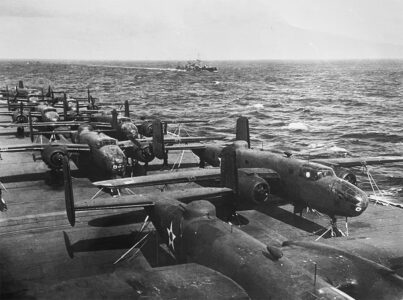
Courtesy of Canfield War Veterans Museum B-25 Mitchell bombers lined up on the deck of the USS Hornet to partake in an air strike on Japanese targets, later known as Doolittle’s Raid, in response to the Pearl Harbor attack.
CANFIELD — A series of photos at the War Veterans Museum showcases an American response to the devastating attack on Pearl Harbor.
The series of three 8-by-10-inch photographs shows what has become known as Doolittle’s Raid.
“We have tons of photographs from World War II,” said museum officer Doug Speece. “Many photos were brought home by veterans who served during that era.”
The three “Doolittle” photos showed the key to the raid, which was the B-25 bomber. According to information from the museum archives, the B-25 was one of a handful of bombers considered for the campaign.
The raid came as a response to the attack on Pearl Harbor on Dec. 7, 1941. The attack by the Japanese aircraft saw more than 2,400 killed and nearly 1,200 wounded.
The destruction of Navy ships and land-based aircraft and structures was enormous.
The attack also brought on a sense of insecurity and fear among Americans, something the Pentagon took into consideration.
President Franklin D. Roosevelt and his Joint Chiefs of Staff knew action needed to be taken to retaliate and bring confidence back to Americans.
The plan was to do a raid on Japanese soil. Joint Chiefs of Staff Adm. Ernest King came up with the idea to put U.S. bombers on an aircraft carrier.
Several bombers were considered, but it was the B-25 Mitchell bomber that seemed to fit the bill. The airplane’s wingspan was best suited for a carrier, and it could land and take off from the deck. An aircraft carrier deck was painted on an airfield at Norfolk, Virginia, so the bombers could practice.
The only problem with the bombers was the range. The B-25 had a normal range of around 1,300 miles, but modifications made to the aircraft doubled its fuel supply so it could make the 2,400-mile route.
The bombers would be on their own as fighter plane escorts could not make that range.
The mission took place April 18, 1942, and involved 16 B-25s. The raid was led by Lt. Col. James Doolittle. He served as a test pilot and aeronautical engineer in civilian life and was instrumental in choosing the B-25.
The bombers launched from the deck of the USS Hornet and struck industrial and military targets in Japan.
Once the bombing runs were complete, the planes continued toward China as a landing place. Unfortunately, 15 of the 16 planes crashed. The final one made it to the Soviet Union and was confiscated, along with the crew.
Of the 16 five-man crews, 14 were able to make it back to the safety of American forces, with one killed while bailing out and two drowning in the sea.
A total of eight were captured by Japanese forces and the five in the Soviet Union were held for a year before they were released to return home.
The raid had the effect that was hoped for in the long run. While it didn’t destroy the targets, causing mostly minor damage, it did put fear into the Japanese by showing their country was vulnerable to attack. The raid also raised morale in America and served as a form of retribution for the Pearl Harbor attack.
As for Doolittle, President Franklin D. Roosevelt awarded him the Medal of Honor for leading the raid. He was also promoted to the rank of brigadier general.
The B-25, the untested bomber prior to the raid, went on to build a positive reputation during World War II.
Local News
Trumbull commissioners reappropriate TNP funds
WARREN — The Trumbull County Commissioners on Wednesday approved moving $325,000 from Trumbull Neighborhood ...
Trustee defends work of water advisory board
WARREN — Vienna trustee Phil Pegg sought to defend the work of the Trumbull County Water Advisory Board at ...
On the record: Milton Township
Milton Township WHEN: Monday WHAT: July trustees meeting PRESENT: Bryce Bond, Wendy DiBernardi, Dave Tomaino ...
Pleasants County, WVa hit by suspected tornadoes
Liberty couple loses about 10 trees