
Trending
YOUNGSTOWN -- As the implementation of the Youngstown City School District's two-pronged reconfiguration plan draws closer, school officials are strategizing to restructure the district's transportation needs while trying to solve a variety of related challenges and complexities.
"Everybody has a role on the team. This is not an 'us versus them,' but us figuring this out," said the Rev. Kenneth M. Donaldson, a YCSD board member.
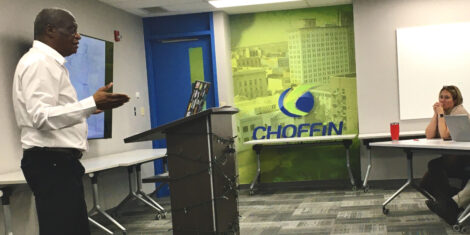
Donaldson, who also pastors Rising Star Baptist Church on the East Side, led a special one-hour ad hoc fact-finding meeting Wednesday afternoon at Choffin Career and Technical Center to begin discussions centered around ways to tackle a complicated web of ongoing transportation-related problems. The session also sought input from bus drivers and other stakeholders who attended.
During its regular meeting Dec. 9, the board adopted a resolution to form an ad hoc committee to address such problems ahead of the reconfiguration plan to merge Chaney and East high schools as well as Chaney and East middle schools into a single high school and middle school, both of which will be on the East Side. The plan will go into effect at the beginning of the 2026-27 school year.
"Transportation is experiencing systemic breakdowns across attendance accountability, payroll accuracy, supervision, employee conduct and adherence to established procedures," Nancy Mikos, the district's business manager, said in her presentation.
Leading the list of challenges are bus driver shortages, inconsistent attendance and high driver absenteeism, particularly on Friday pay days. Last Friday, for example, 17 call-offs were reported, she said. Also, of the district's 76 drivers and bus aides, 29 of them have used unpaid days, excluding those on the Family Medical and Leave Act, Mikos noted.
Further contributing to the problem has been drivers who refuse to take on additional, necessary assignments while on the clock, which has resulted in the district having to pay more for Community Bus Services Inc. to cover those routes, she explained.
"These issues did not appear overnight," Mikos said, adding, "That is not an acceptable practice."
The district has implemented a hybrid model in which regular drivers and those with Community Bus Services have provided transportation, though using a CBS driver costs the district's general fund $450 per day, she explained.
Nevertheless, YCSD's contract with CBS has provided more predictable coverage, faster vehicle repairs and repair timelines, clearer accountability and a pool of backup drivers. Mikos said.
In June 2024, the board of education voted to cease district-provided transportation because of driver shortages, which resulted in most high school students having to rely on Western Reserve Transit Authority city buses to get them to and from school. An exception has been students with Individualized Education Programs.
Under the structure in place, coupled with current practices and other operational conditions, the district remains unable to expand busing to high school students because of the driver shortage, resistance to required routing changes, an unwillingness to modify certain routes, assignments or operational expectations, and a high likelihood of service disruptions if changes are implemented under the existing model, Mikos said.
The district has attempted to remedy the situation, though such efforts have been met with limited results. They have included repeated communications pertaining to attendance and unpaid days within American Federation of State, County and Municipal Employee union contract regulations, recommendations to terminate employees for repeated offenses, schedule adjustments, route modifications and outsourcing to prevent route cancellations, Mikos showed in her PowerPoint presentation.
Other transportation challenges have been psychological and behavioral, including call-offs when given additional assignments, resignations related to stress, stretch pay or behavioral instability and routine challenges to and undermining of operational decisions. Another problem has been unauthorized door-to-door pickups that in some cases, have led to the Youngstown Police Department intervening, Mikos noted.
All of these factors increase the risk of compromised transportation reliability, financial burdens because of uncontrolled absenteeism, inconsistent administrative oversight that can lead to an increased chance for audits, unsustainable reliance on emergency coverage and a greater likelihood of driver burnout and turnover, she continued.
Another issue has been efficiency, Mikos said. Too often, drivers have traveled through different parts of the city with empty buses largely because of longstanding route preferences that give an unwarranted priority to certain students. The results have had a negative effect on the district's ability to route buses effectively, along with avoidable operational waste and restrictions on being able to expand service, Mikos said.
"Any time you drive across town with an empty bus, it's not efficient," James Perry, community bus transportation supervisor, said in his remarks. "Routes change, routes evolve, kids move."
A simple way to fix that problem is consolidation, which also can save fuel costs. For example, if two 72-passenger buses serve the same school, with one vehicle carrying 26 students and the other transporting 19, that underused capacity can be consolidated, Perry said.
He also warned that it's imperative the district find viable solutions to the transportation problem because it will be essential to have enough drivers to transport students from all parts of the city to the East Side when the reconfiguration model takes effect.
Two cosmetic changes that can help are eliminating a culture that encourages insubordination, such as drivers who refuse to fill extra routes on company time, as well as developing and enforcing a tier disciplinary system to handle students who misbehave while on the buses, Donaldson noted.
Also at the meeting, a few bus drivers complained of not receiving their full pay, something Donaldson said can be rather quickly corrected. Another driver expressed concern about students "acting out" on buses and having no help in handling such matters.
While Wednesday's session did not produce concrete solutions to the multi-faceted transportation situation, it generated dialogue and will be the first of other such opportunities to glean feedback and collectively try to find solutions, Donaldson said. A key step forward will be for all stakeholders to continue to work collaboratively and resist casting blame for what has gone wrong.
"I'm a team guy," the pastor added.