
Volney Elementary School students recognize girl’s 1960 fight against racism
First to integrate all-white New Orleans elementary
Trending
YOUNGSTOWN -- Amira Deiley didn't hesitate to mention what she would have done had she been privy to Ruby Bridges' plight more than six decades ago.
"She was a beautiful girl who went to school and wanted to learn. If I knew her, I would have been kind, I would have taken responsibility and care of her and be her friend forever," Amira, a Volney Elementary School third-grader, said.
Amira, who is white, was referring to Ruby Bridges, 71, a black longtime civil rights activist who, as a 6-year-old first-grader on Nov. 14, 1960, became the first black student to enter the all-white William Franz Elementary School in New Orleans. That date also coincided with the start of Louisiana schools desegregating in accordance with a federal judge's order -- and six years after the landmark 1954 Brown v. Board of Education of Topeka, Kansas, U.S. Supreme Court ruling.
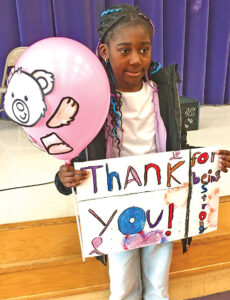
Amira also joined an estimated 100 fellow third-graders in a walk around the South Schenley Avenue school as part of a program Monday to honor Bridges' courage and tenacity in standing up to racism and injustices while fighting nonviolently for fairness, equity and greater tolerance toward others. Many of the students also wore white ribbons in their hair, as Bridges had done during her historic walk into the school.
Sponsoring the event was Mahoning Valley Sojourn to the Past.
As a result of the integration effort, Bridges, who was from Tylertown, Mississippi, and moved to New Orleans at age 4 with her family for better job and education opportunities, faced blatant racism and discrimination, had objects tossed at her and, she recalled years later, encountered a white woman who displayed a black doll in a wooden coffin.
"The crowd that was outside, they immediately rushed in behind me," Bridges recalled last year. "They started to run into every class, and they took every child out of school. So, by the end of that day, 500 kids ... were taken out."
Once Bridges was ensconced in the school, but before the mass exodus of students, U.S. marshals were assigned to escort her, including to the restroom. She also was forbidden from being in communal spaces such as the playground and cafeteria (Bridges brought her own lunch, fearing she could be poisoned).
In addition, Bridges, who never missed a day of school, was the only student in her classroom for the remainder of the 1960-61 academic year. Nevertheless, her teacher, Barbara Henry, a white woman from Boston, treated the young student with kindness and dignity, Bridges remembered.
"Even though she looked exactly like people outside of the school, she showed me her heart," Bridges said in 2015.
Also displaying part of his heart was Robert Coles, a white child psychologist who volunteered to help and support the young girl, via weekly visits, because she faced in a short time such heavy adversity, which also included her parents separating because of the difficult circumstances. Coles later developed a career studying the impacts of integration on young children.
Beforehand, Bridges was one of six children who passed required entrance exams set up to gauge which black students were most likely to succeed in all-white institutions. Nevertheless, the consequences of her decision to integrate the school created wider repercussions because Bridges' parents, Abon and Lucille Bridges, lost their jobs as a mechanic and a domestic worker, respectively. In addition, her father was a Korean War veteran.
Her second year at the school, however, was much different, perhaps most notably because she was neither the only student in the classroom, nor the sole black child among the student body. In addition, she was no longer greeted with almost daily protests.
Bridges' story of fortitude, strength and courage resonated with the other third-graders Monday, including Nala Jones, Azariah Smith, Amarion Chilton, Tia'Lynn Williams and Ariea Avery-Stubbs, all of whom were struck by the fact that Bridges needed federal marshals to accompany her during the school day.
"I want to be brave, strong and beautiful. And I want no bullying," Nala said, adding, "Be kind; treat others how you want to be treated."
Azariah imparted a few direct messages she gleaned from having read books about Bridges, as all of the school's third-graders had done to prepare for the honor.
"Don't be mean to people. It's very rude because (the protesters and racists) didn't even know her or try. If they just tried, maybe they would be a little nicer," she said.
All Bridges wanted was to go to a school near her home and receive a good education, Amarion and Tia'Lynn added. Amarion said that before Monday's gathering, she had read two or three books about the civil rights activist.
For Ariea, it was highly difficult to imagine having to go through most of a nine-month school year and be the only student in a classroom, she said.
Also Monday, Superintendent Jeremy Batchelor urged the students to use Bridges' story to better understand not only what she endured, but to also understand and appreciate the value of a solid education.
"Continue to read --- read, read, read," he said. "What nobody can take from you is your education."
Bridges' history-making efforts resonated with Batchelor on a personal level, because his father attended a segregated school in North Carolina.
"I'm only one generation removed from Jim Crow," he added.
After high school, Bridges worked 15 years as an American Express travel agent, got married and had four sons. In 1993, she faced another huge adversity when her brother, Malcolm, was murdered in a drug-related incident in New Orleans, leaving four daughters.
In 1999, she founded the Ruby Bridges Foundation, which seeks to promote and uphold the "values, tolerance, respect and appreciation of all differences," according to its website. In addition, she published several books that included "Through My Eyes," "This is Your Time" and "Dear Ruby, Hear our Hearts."
Despite her initial treatment at William Franz High, after Hurricane Katrina had caused heavy damage to the structure in 2005, Bridges stopped it from being demolished, then successfully had it placed on the National Register of Historic Places. The school continues to operate today.
"I felt like if anybody was to save the school, it would be me," Bridges said.
Over the years, she has been the subject of a variety of iconic photographs, films and works of art, such as Norman Rockwell's 1963 painting, titled "The Problem We All Live With." Bridges also holds honorary degrees from Connecticut College and Tulane University, the latter of which she received in 2012.
She remains a champion of anti-racism efforts and has upheld the legacies of her parents, as well as Henry and Coles, all of whom she credits with helping her develop a solid foundation to work for needed social change and reforms.
In addition, Bridges wants people of all ages to realize they can be change agents.
"All of us are standing on someone else's shoulders, someone else that opened the door and paved the way. And so, we have to understand that we cannot give up the fight, whether we see the fruits of our labor or not. You have a responsibility to open the door to keep this moving forward," she told The Guardian in 2021.