
Students report on YSU internships
Trending
YOUNGSTOWN -- If you're interested in learning more about everyday stress, measuring isotope shifts and Rubidium atoms, advanced transdermal patches, reinforcement learning and the Fermat point, a dozen high school students and recent graduates likely would be happy to fill you in.
"Stress does not need to be debilitating. Stress and nursing go hand in hand, and I will know if they're stressed so I can help them cope," Elizabeth Rutana, a Poland Seminary High School senior who intends to attend Youngstown State University to major in nursing, said, referring to future patients.
It's likely safe to say that Rutana has already made considerable emotional and psychological headway toward achieving her goal of fusing the physical and emotional aspects of what her field of interest will inevitably bring. That's because she was one of 12 area high school students and incoming YSU freshmen who took part in a seven-week Williamson & Watanakunakorn Science, Technology, Engineering and Mathematics paid summer research internship program.
The students, who represented Poland Seminary High, the Mahoning County Career & Technical Center and Canfield, Boardman, Cardinal Mooney and Ursuline high schools, presented the findings of their scientific and mathematical projects during a special program Friday afternoon in YSU's Moser Hall.
Attendees included most of the faculty mentors who coached and guided the students along the way.
Rutana and Maria Awad, a MCCTC senior, worked on the first phase of a pilot study related to rebranding stress that is common in undergraduate students and, by extension, everyone. Perhaps their greatest and most significant takeaway was that, contrary to reflexive popular opinion, stress often is positive and can make people more focused, alert and better able to perform.
"What I learned here will help me take care of my patients a lot and know what they're going through and manage it," said Awad, who plans to attend YSU with a double major of nursing and political science.
Having teamed up with Rutana to conduct her research had the added benefit of helping Awad to better handle her own stress, she said.
Sharing the students' perspective on stress was Jill Tall, a biological sciences professor who served as their faculty mentor.
"We have a hunter-and-gatherer nervous system, yet we are living in a modern world," Tall said, adding, "We need to rebrand stress. The things we experience with stress are good if it has a beginning, middle and end."
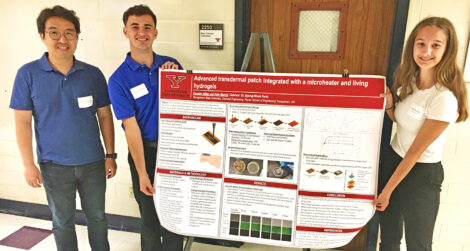
Kate Blumel and Karsten Miller, Poland Seminary and Canfield High students, respectively, delved into experimenting with an advanced transdermal patch with a micro-heater and living hydrogels, which are three-dimensional networks of polymers capable of absorbing and retaining large quantities of water or biological fluids, which makes them highly flexible.
Assembling the patch to aid in bacterial wounds was a complex six-step process, Blumel and Miller explained in their presentation.
Byung-Wook Park, a chemical engineering professor who also served as the two students' mentor, noted that such a patch can facilitate the healing process of bacterial injuries, unlike more traditional prescriptions for which the body can develop a tolerance over time.
"We want to take advantage of the good bacteria to attack the bad bacteria," said Park, who also was praiseworthy toward Miller and Blumel for their work on the complicated, multi-faceted project.
"They did a great job," he added. "I'm impressed with their performance the last seven weeks."
Evan Brockway, an Ursuline High senior, teamed up with fellow senior Douglas Stoudt of Poland Seminary High to discuss "Networking with Fermat," named after Pierre de Fermat, the 17th century French mathematician perhaps best known for having founded the fundamental principle of analytic geometry. He also has been credited for being the inventor of differential calculus.
In their presentation, Brockway and Stoudt explained how they borrowed from geometry, algebra, the concept of inequalities and the Pigeonhole Principle, which states that if one has more items than categories for which to place the items, at least one category must contain more than a single item.
They also showed a series of complex triangles to make the case for a concept called Fermat's Point, a location within a triangle at which the sum of the distances from the point to each of the shape's vertices is minimized. The concept has valuable applications in building roads, creating electronic networks and constructing pathways, they noted.
"This has strengthened our critical-thinking skills," Ryan Dangol, a YSU freshman, who, along with Canfield High senior Gage Watson, conducted water-quality tests from Mill Creek MetroParks' Lake Newport.
Watson and Dangol looked at identifying bacteria at the lake to ascertain whether the water quality was acceptable for recreational use. They collected then tested samples for enterococcus counts, which often occur in chains and can cause urinary-tract infections and other ailments, and are resistant to some antibiotics.
Other student findings dealt with atoms from Rubidium, a soft, silvery-white metal that is easily oxidized and reacts with water, and Super Mario gameplay using artificial intelligence and Deep Reinforcement Learning (a concept that allows participants to learn optimal actions in complex environments via interacting with them and receiving rewards).
"This is a big day, and I'm glad you got through these seven weeks," Tim Harrington, YSU's vice president of strategic communications and chief of staff, said in his remarks Friday. "Parents, you should be very, very proud. This is a big moment.