
Freedom School educates on country’s tragic past
Students learn about killing of 14-year-old Emmett Till
Trending
YOUNGSTOWN -- The tragic killing of 14-year-old Emmett Till shocked Gionna Floyd and pulled forcibly on her heartstrings.
"It makes me mad that he died because he was really little," Gionna, 9, a Volney Rogers Elementary School student, said Monday. "I felt really, really, really mad."
That was her unequivocal assessment upon learning the horrific details about the lynching of Till on Aug. 28, 1955, in Money, Mississippi. Further stoking her anger was that Till merely had whistled at a white woman named Carolyn Bryant "and did nothing wrong," she added.
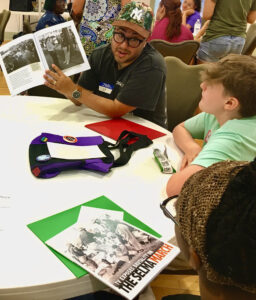
Gionna is one of the students in grades four to eight who is participating in a six-day Freedom School series of events and programs Mahoning Valley Sojourn to the Past is hosting, most of which are at the Tyler History Center, 325 W. Federal St., downtown. The Freedom School ends Saturday with a walking tour in Salem.
Beforehand, Gionna and a few dozen other students heard a presentation from Jackie Mercer, a Youngstown State University English professor and a local expert on Till.
The series of programs and events are piggybacking off the success of last year's Freedom Summer program that Sojourn to the Past hosted to honor the 60th anniversary of the Mississippi Freedom Summer project. In June 1964, after having received two week-long training sessions in nonviolence techniques at the Western Women's College in Oxford, nearly 1,000 mostly white, college-aged middle- and upper-middle-class northerners came to Mississippi mainly to register blacks to vote and to set up Freedom Schools in which blacks were taught civics, reading and writing, black history, music and dance and other subjects, Penny Wells, Mahoning Valley Sojourn to the Past's executive director, noted.
This year's Freedom School's primary goals are to allow the students to develop critical-thinking, reading, writing and research skills, learn then incorporate into their lives Dr. Martin Luther King Jr.'s six principles of nonviolence, discover more about black history and see the value in working for social justice, Wells said.
Before Till's train ride to the Mississippi Delta to visit relatives, his mother, Mamie Till Bradley, had trepidation about allowing her son to take the trip because southern customs were vastly different from what he accustomed to in his native Chicago, and she feared her son, who enjoyed joking with others, could run afoul of them, Mercer explained.
A few days after his arrival, Till and his cousins stopped at Bryant's Grocery & Meat Market, which had many black customers, in the tiny town of Money. Once inside, he wolf whistled at Carolyn Bryant, and the teenagers fled when Bryant came outside to her vehicle, fearing she might be retrieving a gun.
"All we know for sure is that he whistled at Carolyn Bryant. No one else was in the store," Mercer said.
At 2 a.m. a few days later, Bryant's husband, Roy Bryant and his half-brother, J.W. Milam, knocked on the door of the home of Till's uncle, Mose Wright, before kidnapping the child, Mercer said. Even 70 years later, certain details remain murky, such as the identity of a female voice in the car when Till was kidnapped. Disagreement remains as to whether it was Carolyn Bryant, Mercer added.
Before Till was taken from the home, Mose Wright and his wife, Elizabeth Wright, pleaded with the men not to harm the teen, including having offered them money, but to no avail. Roy Bryant and Milam were initially charged with kidnapping, but the charge was upgraded to murder after a 14-year-old fisherman named Robert Hodges found Till's mutilated remains in the Tallahatchie River, along with a 75-pound cotton gin that had been tied to his neck.
Many feel that the two men's trial in September 1955 was a spectacle. The all-white male jury took 67 minutes -- most of which consisted of a soda break -- to acquit Bryant and Milam, who, a few months later, sold their story to William Bradford Huie of Look magazine. In the Jan. 24, 1956, piece, titled "The Shocking Story of Approved Killing in Mississippi," the men confessed to the crime, and each was reportedly paid $4,000 to tell his story.
"What else could we do? He was hopeless. He thought he was as good as any white man. … I just decided it was time a few people got put on notice," Milam reportedly said.
Mercer told the young students that even though photography was forbidden in the courtroom, someone snapped what became an iconic image of a silhouetted Mose Wright testifying and pointing a finger at Milam. When asked if he saw Till's killer in the room, Wright said, "There he is."
The trial also marked the first time a white man in Mississippi was tried for killing a black, Mercer noted.
After petitioning Mississippi officials to allow her son to be buried near Chicago, Mamie Till Bradley opted for an open casket at the funeral, which an estimated 50,000 people attended. A large part of her desire was to show the world what the tragic end result can be from unchecked racism and hatred.
"Can you imagine a mother's grief?" Mercer said. "She sent her son on vacation and he came back in a casket."
To dispel the longtime false narrative that the body found in the Tallahatchie River was not that of Till, his body, with permission from the family, was exhumed in mid-2005 and had been well preserved. DNA and other forensic tests confirmed it was Till, Mercer explained.
In 2017, Tim Tyson, author of "The Blood of Emmett Till," revealed that Carolyn Bryant had recanted her testimony in the 1955 trial.
"Nothing that boy did could ever justify what happened to him," Bryant said before her death in 2023 at age 88.
To this day, no one has been legally held accountable for Till's murder.
Before Mercer's presentation, the students heard from Miah Pierce, a Mahoning Valley Sojourn to the Past member who earned a master's degree from YSU in social work. Her topic, "Why Kindness Matters," centered on the importance of treating others in such a fashion, as well as on physical, social, verbal and cyberbullying.
"You have no idea what storms someone is going through," Pierce told her young audience.
She also introduced them to Shane Koyczan, a Canadian spoken-word poet, writer and member of the group Tons of Fun University. Koyczan, 49, is perhaps best known for his anti-bullying poem "To this Day," as well as for writing on topics such as cancer, eating disorders, bullying and death.
During her high school years, Pierce was a victim of online bullying from a former friend - something that damaged her self-esteem, she said, adding that key bullying tips are to be a friend to someone being mistreated, speak up, obtain help and take a firm stand against it.
In addition, cyberbullying is a major contributor to an uptick in suicides among young people, Pierce noted.
She also gave the students a primer on the late longtime Georgia congressman and civil rights icon John Lewis for his lifetime display of courage.
"He fought for us before he even knew us," Pierce said.
Also at the Tyler History Center on Monday was a book table on which were titles that included "The Mis-Education of the Negro" by Carter G. Woodson and the Stephen Middleton book "The Black Laws: Race and the Legal Process in Early Ohio."
The civil rights movement of the 1950s and 1960s may have taken place long before Gionna Floyd's time, but she's determined to incorporate into her life a significant lesson many can glean from that often tumultuous time.
"Stop bullying and tell another teacher or the principal, and help them if someone is being bullied," she said.