

Let’s grow, YSU provost tells faculty
Pintar outlines plans, goals to attract more programs, students
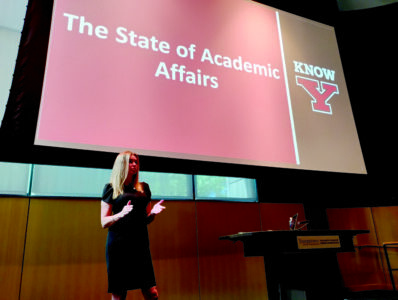
Staff photo / Dan Pompili YSU Provost Jennifer Pintar presents a proposal for her new Academic Master Plan and other objectives for growing and supporting the university’s academic programs and its faculty Thursday in Williamson Hall.
YOUNGSTOWN — Youngstown State University Provost Jennifer Pintar followed up on President Bill Johnson’s State of the University address with a presentation of her own on Thursday.
Pintar, appointed as provost at June’s regular Board of Trustees meeting, gave a State of Academic Affairs address in Williamson Hall before faculty, staff, administrators, some trustees and the president.
The address focused on her plans to engage faculty in conversations about how the university will grow and support its academic programs, and how it will allocate resources for faculty and students.
“How do we build enough shared trust, responsibility and transparency that you all feel comfortable enough to engage in conversations like we had for the work we did to develop the Eastern Gateway programs?” she said.
Pintar referred to the more than 60 new associate degree and certificate programs the university developed since the spring semester to meet the needs of students displaced by the closure of Eastern Gateway Community College in the wake of its financial distress.
Pintar said she wants YSU to compete for a larger share of Ohio’s graduating high school students who go on to two- and four-year colleges.
“The more the faculty feel like they are heard – not just listened to, but really heard – the more likely they are going to engage with the institution, knowing that we want to break into the top 5. That is our goal,” she said.
Pintar showed that in the 2023-24 academic year, 132,520 students graduated from Ohio high schools. Of those, 66 percent – 87,478 students – are going on to college. She said 11 percent went to out-of-state schools.
The “top five” she was referring to are the schools that recruited the most incoming freshmen this fall: The Ohio State University [6,140], The University of CIncinnati [4,119], Columbus State Community College [3,653], Sinclair Community College in Dayton [3,109], and Kent State University, Kent Campus [3,087]
Pintar said that leaves 194 institutions to vie for the remaining 53,167 students. She said YSU averages about 1,750 students every fall.
“We’re going to have to work together as a team, we’re going to have to look at this and say how can we combat this?” she said.
She said the work the university did to accommodate EGCC students shows what YSU is capable of doing.
“We had a shared vision, we had a common goal, we were responsive to the needs of the community,” she said. “The faculty got busy working on curriculum, the chairs and deans got busy on, ‘How can we assist that curriculum to get through?’ Academic senators got together, and they worked on some policies that created major changes.”
Pintar’s plans to move forward already are underway, with the formation of a Provost Leadership Group that includes five volunteer representatives from each college to work on new ideas from the state and new proposals from the faculty and departments. She said that is in addition to the input she receives from other sources, such as the academic senate, Student Government Association, and individual faculty and staff members.
Pintar said she plans to continue the Academic Program Enhancement and Effectiveness Initiative and grow and improve the Focus Plus Group that evaluates struggling or low-enrollment programs.
For the APEEI, Pintar said the university will tweak the system so that new programs proposed by faculty, once approved by chairs and deans, will go directly to her office.
“We’re going to do a lot of the leg work. We’re going to look at market research, we’re going to look to see that we have the budget to support that type of program for its life here at YSU, and we’re going to look at the curricular efficiencies too,” she said. “If we give you the thumbs up, that means go back to your department and if you decide that you still want that program, then go for it because you know we have your back. That eliminates some of that lack of trust because you don’t know what Tod Hall (administration building) will or will not say.”
Pintar said the Focus Plus Group has already worked with faculty leading 12 programs that were low-enrollment or had high operating costs.
As a result of those discussions, the university learned about what the programs need to succeed and has allocated $1.3 million to provide support and marketing to grow them.
She said the once-unpopular initiative now has some faculty asking to have their programs included in the next round of reviews.
Pintar said all programs, existing and new, will be part of constant reviews to ensure they are not struggling and meet state enrollment requirements, or at least YSU’s, which are more lenient.
Pintar said the university has dropped from nearly 500 low-enrollment courses to just over 300. The state defines low enrollment at below 60 in a program, while YSU draws the line at 40. Pintar said YSU’s goal is to have fewer than 100 low-enrollment undergraduate programs.
The university also recently hired 24 new faculty, though Pintar said many of those are to meet the needs of the new associate and certificate programs, which do not require tenure-track faculty.
She said the university’s new Academic Master Plan – the first in YSU’s history – will, in part, determine where faculty and resources go.
“Starting in September, we will be working with faculty in every department, asking them to help us understand, ‘How would you run this institution to focus on your program?’ she said. “We want to know: What are the things Tod Hall needs to understand? What are the questions we need to be asking?”
She said her office will provide weekly surveys in September, then four town hall meetings in October to show the progress made from the surveys and to get more feedback from faculty. In November, the plan will be submitted to the Academic Senate and to the trustees in December. She said YSU will implement the plan, if approved, for the spring 2025 semester.
Pintar ended the meeting with a question-and-answer session.
One faculty member, A.J. Sumell, professor of economics, offered his thoughts on why trust has been so hard to come by.
“I think the concern, for faculty, even if you’re not directly concerned with being retrenched yourself, is seeing the impact on your colleagues,” he said. “A lot of faculty have left who we don’t want to lose, and I think that decreases our collective investment in the institution and our ability to work together in the future.”
Pintar acknowledged that retrenchment – cutting underperforming programs, and subsequently the faculty who teach them – “is not a comfortable process for anyone” and that it is worse for faculty.
She said the Academic Master Plan is one way YSU will seek to avoid it by working with faculty to evaluate their needs well before tough decisions need to be made.
“Our goal is not to retrench anybody,” she said. “We know we can’t cut our way to prosperity. We’ll never cut a program that is thriving. If it is thriving, we want it at Youngstown State University.”
Pintar also answered another faculty member’s question about YSU’s priorities around research.
She said YSU is primarily a teaching university, but that does not mean there is no room for research. She said part of the plan is to have honest conversations about what each college or department needs to be successful.
“When we’re going for big grants and giving out reassignment time and funding for equipment, that’s where the university has to consider those resources, because we cannot be that for everyone,” she said. “One department may say they need to focus primarily on teaching, and that’s good for us to know. Another might say that in order to get master’s and doctoral degree students to YSU, they need to do more research, and that’s good too.”
Pintar said she likes where the university is positioned.
“Right now, the university is in good shape,” she said. “We have a lot of programs that are thriving. The addition of the associate programs, many which are nestled in with bachelor programs, is really helping our enrollment numbers. So, we’re looking good.”
Have an interesting story? Contact Dan Pompili by email at dpompili@vindy.com. Follow us on X, formerly Twitter, @TribToday.
Local News

McDonald program marks 10 years
On the record Trumbull County
On the record Trumbull County WHAT: Commissioners meeting Wednesday PRESENT: Tony Bernard, Rick Hernandez and ...
Mayor, church leader offer help in elections dispute

Connecting for kids
Grant to be used to improve safety downtown
YOUNGSTOWN — The Youngstown Police Department announced Thursday afternoon that it has been awarded an Ohio ...
Police seek man targeting car wash vacuums in Liberty, Boardman
LIBERTY — Police in a pair of Mahoning Valley communities are looking for a suspect who reportedly damaged ...