Holocaust presentation stirs emotion
Correspondent photo / Sean Barron
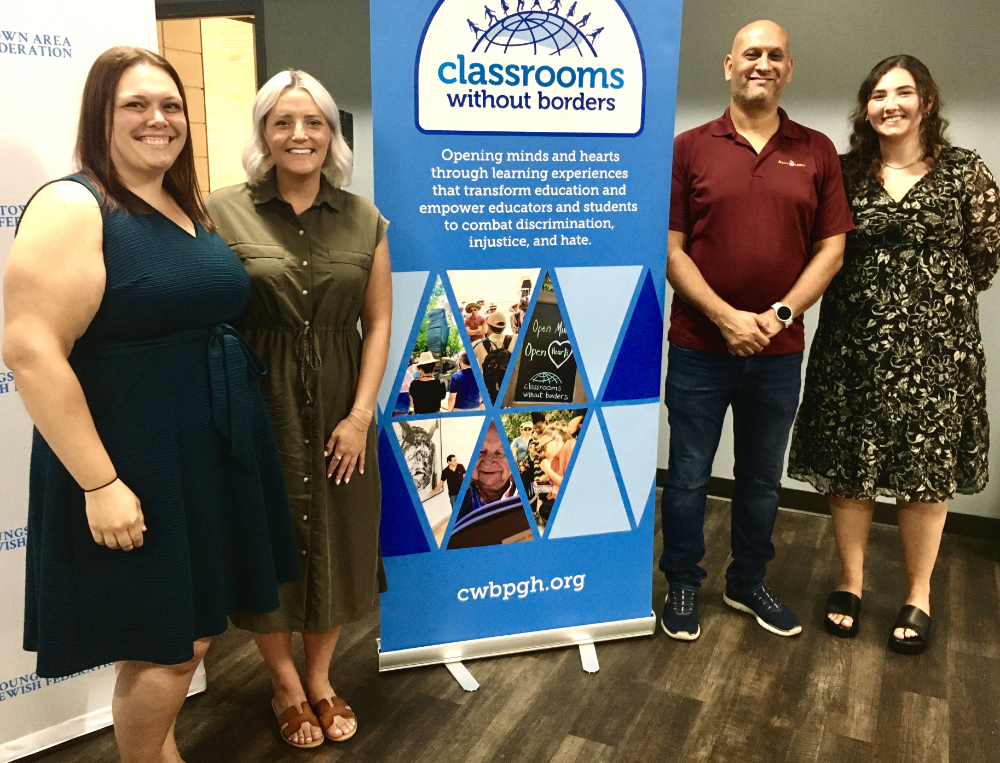
The area teachers who returned from a two-week Holocaust education trip to Poland and shared their experiences Thursday at the Jewish Community Center of Youngstown are, from left, Ashley Kekel, Kayla Richey, Kobi Sigler and Madelyn Wansack. Not pictured is Brenda Kekel, a 23-year teacher in the Southern Local School District.
YOUNGSTOWN — Kayla Richey became emotional as she found herself amid the serenity of birds and butterflies while standing on a site where tens of thousands of Jews had been killed decades earlier.
“It was emotionally confusing,” Richey, a geography, sociology and history teacher at Campbell Memorial High School, said. “They found a pair of scissors, a button and the corner of the second gas chamber.”
Richey was referring to an archaeological dig that took place at the infamous Treblinka extermination camp in which an estimated 700,000 to 900,000 Jews were murdered when it operated between July 23, 1942, and Oct. 19, 1943. The emotional experience was part of a two-week trip she and four other local educators took in June to Poland, courtesy of the Youngstown Area Jewish Federation and as part of Classrooms without Borders.
Richey and three of the other four shared their emotional experiences during a panel discussion Thursday evening at the Jewish Community Center of Youngstown, 505 Gypsy Lane, on the North Side.
The others who embarked on the educational trip were Ashley Kekel, a seventh-grade world studies teacher in the Salem City Schools; Brenda Kekel, a 23-year educator in the Southern Local School District; Kobi Sigler, assistant principal as well as the Hebrew and Judaic coordinator at Akiva Academy; and Madelyn Wansack, a seventh- and eighth-grade English teacher at Bristol Junior High School.
Brenda Kekel, however, was unable to attend Thursday’s presentation.
Guiding the five educators on the trip was Howard Chandler, 95, of Starachowice, Poland, a Holocaust survivor who lost his sister, mother and younger brother. Chandler and his family were members of a Wierzbnik Jewish community, of which more than 4,000 members were killed at Treblinka.
The educators and their group also visited Auschwitz and the Majdanek death camp near Lublin, Poland, which, since 1944, has been the site of a memorial museum and education center devoted to the memory of the atrocities committed in a network of slave-labor, concentration and extermination camps and sub-camps.
Richey called her time at Auschwitz “eerie and unsettling,” saying she walked by where many Jews took their last steps before their deaths. In addition, she saw a children’s room where young Jews were killed, Richey told an audience of about 50 fellow educators and others who attended Thursday’s program.
During the question-and-answer portion, Richey said she hopes to teach a class that’s dedicated to Holocaust studies.
Ashley Kekel recalled having walked a 0.79-mile path on which many Jews were led to their deaths, along with seeing some of the crematorium ovens, mass graves, gas chambers and barracks.
The trip further solidified her desire to teach others the importance of social justice as well as standing against hate, bigotry, intolerance and antisemitism, Kekel added.
Nevertheless, the two-week experience had certain high points for Kekel, such as allowing her to learn more about Jewish and Polish cultures, she said, adding that she first learned about the Holocaust in sixth grade and tried to better understand how such atrocities could have been committed.
Sigler, who also found the trip to be highly emotional, said he learned about the Holocaust as a student, but “the effect you get (in person) is much different than any book or any teacher can teach you.”
Sigler, who’s from Akko, Israel, said he wants to further teach ways to stop this tragic history from repeating itself and to examine “how we got here.”
Wansack, a Kent State University graduate, praised Chandler for not succumbing to bitterness and instead, exercising the courage to return to his birthplace to share his story with others for educational purposes. His primary lessons include teaching students to refrain from interfering with others’ rights, being kind to others and combating hate and intolerance, she noted.
Wansack, who learned about the World War II atrocities in eighth grade, said she intends to instill in her students “that no act of kindness is too big or too small to make a difference in the world.”
Ellen Resnek, Classrooms without Borders’ educational programs and outreach manager, noted that the 13-year-old Pittsburgh-based organization fights to combat marginalization, hate and antisemitism through a variety of educational programs. Its goals also include bringing educators to historical places to have them walk the history to gain a deeper understanding and teach it “with more of an authentic lens.”
Kate Lukaszewicz, CWB’s education programs director, added that her organization also is committed to fighting bullying, as well as acting as a guardian to keep Holocaust history and stories alive – especially in today’s environment of continued antisemitism and bigotry.
To bolster her point, Lukaszewicz cited the Oct. 27, 2018, mass shooting at the Tree of Life synagogue in Pittsburgh in which 11 people were killed.
Bonnie Deutsch Burdman, the Youngstown Area Jewish Federation’s executive director of community relations and government affairs, mentioned House Bill 606, the Campus Accountability and Modernization to Protect University Students (CAMPUS) Act. The law intends to equip Ohio’s public and private universities with necessary tools and resources to enhance student safety while fostering more inclusive environments.
Specifically, the law provides campus safety grants and implements anti-harassment policies at Ohio’s colleges and universities, and holds accountable those who fail to enforce it, Deutsch Burdman said.
Local News
Campbell officials tout successes, look ahead
AMPBELL — As city council prepares to take its annual summer recess, several city officials reflected upon what ...
Property transfers for June 20
Property transfers recorded June 8 to 12 in Mahoning County and portions of Trumbull County: Austintown Gulch ...
Hubbard officials share contrasting views of data center tour
HUBBARD — One resident asked officials to consider adjusting or lifting the city’s yearlong moratorium on data ...
US House majority leader to keynote Valley event
U.S. House Majority Leader Steve Scalise will deliver the keynote address at the Columbiana County Republican ...

Canfield woman celebrates 100 years of life with party, parade