
Trending
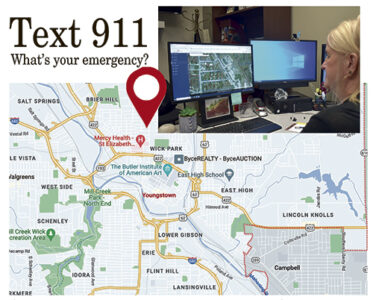
YOUNGSTOWN -- In the next year, Mahoning County will join Columbiana and Geauga among area counties that have implemented Text-to-911 technology, which allows communication with 911 by text message in an emergency.
It's not among the most important technology improvements on the horizon in the 911 industry, but it can save a life in situations where a person is physically unable or too afraid to make a voice call to 911.
The Mahoning County commissioners recently approved a $245,440 agreement between the county 911 center and AT&T, for AT&T to implement Text to 911 in Mahoning County.
The money to pay for this comes out of the approximately $550,000 per year the county 911 centers get from fees charged to each cell phone user, and the approximately $300,000 per year that comes from $2.96 per year charged to each improved parcel of land in the county.
Maggi McGee, 911 coordinator, said she expects AT&T to implement the new service some time this year or next, depending on AT&T's other projects.
HOW IT CAN HELP
McGee said one example of how Texting to 911 will aid someone is if someone breaks into a person's home.
"I am going to hide because I don't know who it is. If I'm texting 911, I can tell (911) what's going on. You could text 'Please don't call. I'm trying to stay silent.' Then the (911 call taker) can ask questions or give you updates (on the arrival of police), help is on the way, the estimated time of arrival," McGee said.
There are times when a person cannot physically speak because of some type of temporary or permanent disability.
"A lot of people fall. They hit their heads. They become semiconscious. Maybe they call 911 and can't speak. They are out of breath. It's another safety layer we can provide," McGee said.
"Maybe you can't speak, but you can text us. At least we can try to find out whether the person is hurt. 'Have you fallen?' "
She said the call takers are going to train on the texting, and 911 personnel will test it extensively before it goes live. Then there will be regular updates in training for call takers.
One reason for ongoing training is that there may not be a large volume of text emergency calls.
"We want to keep them sharp," she said of call takers. "They make sure it still works OK and they know what to do," she said.
DON'T ABUSE
SYSTEM
McGee said it will be important that the public not "try out" the texting system when it goes live because it is like people making unnecessary 911 calls.
"We don't want people abusing the system," she said.
She assures the public that it will work the first time they use it and the public will not need to try it out. She said 911 call takers will use automated responses to respond to a person texting to 911.
She said the automated responses are "tried and true" responses to various text messages from the public. She said a 911 call taker will ask questions to the citizen, just the way a 911 call taker asks a citizen questions in a voice call.
She said people on voice calls to 911 sometimes wonder: "Why are they asking all of those questions?'
"It's because while we are dispatching help, we want to send that additional information on to" first responders responding to the call, she explained.
McGee noted that voice calls provide the call taker with more information than a text message, so those are preferable to a text message.
"Let's say you called and you are really are in danger, but you have somebody there and you can't say anything. And we hear noises in the background," she continued.
She said the typical response from the call taker will be to tell the caller: "I'm just going to stay on the phone with you. Meanwhile, you don't know it, the call taker has already sent somebody" to help the caller.
"A phone call is much, much better. We get background noises. We know what's going on."
She said background sounds can indicate whether it is safe for an ambulance to pull up to the scene. "If we are sending an ambulance into a situation where there is still gunfire, we can't send them in until that gunfire is under control," McGee said.
DOMESTIC
VIOLENCE
Domestic violence situations might be key uses of Texting to 911. In such situations, a victim may not want their attacker to know the victim is contacting 911. McGee said in some domestic violence cases, the victim's call to 911 can be the thing that causes the perpetrator to escalate their violence toward the victim.
That may have been the case in the October 2021 killing of Ashley Lockhart, 25, in the parking lot of the Compass West apartments in Austintown. Her ex-boyfriend, Steve W. Green II, 26, is charged in her murder.
Lockhart's friend and cousin, Kateyn Lofaro, told The Vindicator in 2021 that Green was obsessed with Lockhart, with whom he had a daughter. Lofaro said Lockhart tried to appease Green when she could and apparently had never called 911 on him until the day she was shot and killed.
Police said the incident began with an Austintown dispatcher receiving a 10:37 p.m. call Oct. 8, 2021, from Lockhart about an ongoing domestic dispute outside of an apartment building on Compass West Drive. The dispatcher could hear arguing between Lockhart and a man. The dispatcher heard multiple shots through the phone and then screaming, and realized Lockhart had been shot.
Green's trial is set for Nov. 13.
OTHER
SITUATIONS
Texting to 911 also might aid someone who is being trafficked for sex or abducted, McGee said.
Or, it might help someone exercising vigorously outdoors who collapses. Or it might be used by someone hiking who falls. A text could help determine the person's location, McGee said.
She said adding the Texting to 911 "is not a mandate yet, but the state is pushing it very hard," and it is "appropriate in our day and age" because texting to 911 brings into play a technology most members the public use, especially younger people.
"When you look at people 35 and 40 years old and below, they text," she said.
McGee said there are also other, bigger updates coming in the 911 industry. They are known as Next Generation 911, which will require extra fiber to be installed. She doesn't want to have to implement Text to 911 at the same time as the bigger updates. Next Generation 911 will include video, she said.
LOCATIONS
Mahoning County's Text to 911 will be housed at AT&T, which is known as Mahoning County's "host," rather than Mahoning County having the equipment installed at the answering points in Mahoning County.
Because of the sophistication and AT&T's facilities and the redundancy built into the Mahoning County 911 operations, it would be nearly impossible for Mahoning County 911 to go down, McGee said.
The seven 911 answering points in Austintown, Boardman, Beaver Township, Canfield, Sebring, Struthers and Youngstown have backup generators in the event of a power outage, she noted. Campbell is considered a secondary answering point, with Boardman taking the call and transferring it directly to Campbell.
The 911 operations are also regulated by the Federal Communications Commission, the Public Utilities Commission and the state of Ohio, she said. "They make sure you have 911 because that is what the public relies on," she said.