
Trial sheds light on misplaced stop sign in Coitsville
NC man convicted of vehicular homicide raised that issue as part of his defense
Trending
COITSVILLE -- It's not often that a criminal trial results in a discovery that a stop sign is in the wrong place and it is moved to meet regulations. But that is what happened in one instance in Coitsville Township.
On May 20, a jury in Mahoning County Common Pleas Court found Robert C. Powell, 25, of North Carolina, guilty of aggravated vehicular homicide drunken driving for causing a crash at North Hubbard Road and U.S. Route 422 on April 10, 2025, that killed John Kulnis, 62, of New Castle, Pa. Powell will be sentenced in July.
The Coitsville Police Department, which investigated the crash and court testimony indicated that Powell was in the Youngstown area working as a contractor burying fiber optic cable when he drove in his pickup truck south on Hubbard Road, entering the intersection, broadsiding a Subaru Forester driven by Kulnis, which was traveling east on Route 422, killing Kulnis.
Powell had a stop sign. Kulnis had the right of way because he had no stop sign or other traffic-control device.
Powell's attorneys hired Eric Brown, an experienced accident reconstructionist with the Stark County Sheriff's Office who also does reconstruction work for his own company, to evaluate an oddity that turned up in the crash: a stop sign not in the right location at the intersection.
Brown testified at Powell's trial that the stop sign on the right side of North Hubbard Road facing Powell was, in fact, 92 feet from the intersection, well outside of the 50 feet from the intersection that the Ohio Uniform Manual of Traffic Control Devices says stop signs have to be.
Brown testified that the placement meant Powell could not see the oncoming traffic from the west to east -- the direction Kulnis was traveling -- at the point Powell accelerated from a stop sign and entered the intersection. There were obstructions, such as vegetation, in the way of Powell seeing the Subaru, Brown testified.
Brown said he discovered through photographs taken by an Ohio State Highway Patrol reconstructionist that at the time of the crash, there was a second stop sign at the intersection -- one on the left that was 52 feet from the intersection. That was 2 feet farther than it should have been.
Brown testified that photos from 2011 showed that the stop sign on the right was in the correct location -- 12 feet from the intersection -- in a 2011 photo. There was no reason given during the trial why the stop sign on the right was moved at some point between 2011 and April 10, 2024.
The Vindicator first checked with Mahoning County Engineer Pat Ginnetti, who said stop signs at that intersection are maintained by the Ohio Department of Transportation because of it being part of a U.S. route, not the county engineer's office.
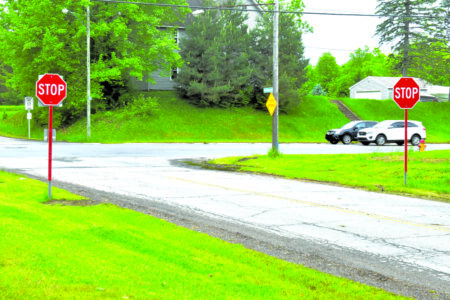
Meanwhile, The Vindicator went to the intersection May 21 and found that the stop sign Brown said was 92 feet from the intersection at the time of the crash was now much closer.
On May 29, the Vindicator contacted Justin Chesnic, ODOT assistant to the deputy director and public information officer. He checked into the Vindicator's questions and turned up the following: The stop sign on the right was moved about 40 feet closer to the intersection on March 12, 2026.
Chesnic said that happened as part of a "systematic sign review," which resulted in the sign to the right being moved by a contractor on behalf of ODOT to a location "parallel with the one on the left shoulder." He said he did not have "exact measurements" of how far from the intersection the stop signs were after that adjustment.
Chesnic also stated that after The Vindicator asked questions May 29 about why the sign on the right was 92 feet back, "ODOT went out to the location on June 1 to measure the signs to determine their distance from the intersection. We determined that the signs were no longer 50 feet or less from the intersection, so the signs were moved by ODOT to be within 50 feet of the intersection."
As for when the stop sign on the right was moved back to 92 feet, Chesnic pointed to a waterline project that apparently happened around 2021.
He stated, "A permit for a waterline project was issued on May 5, 2021. That project impacted the location of the stop sign on the right shoulder. The permit did not include relocating the stop sign, so ODOT has no knowledge of who or how the stop sign was relocated nor the distance this stop sign was relocated from the intersection."
That answer provides some clues as to when and why the stop sign was moved. But it doesn't answer why it was never moved back.
The Vindicator contacted Ginnetti again this week to discuss what Chesnic said about the waterline project. Ginnetti said AquaOhio owns the waterlines in that part of the county and would have been the organization that hired the waterline contractor.
The Vindicator contacted AquaOhio. Its spokesman, Jeff La Rue, checked into the matter and later stated in an email: "I can confirm that our contractor installed a water main at the intersection during the spring of 2021. We have not been able to find documentation about the sign being moved at that time or anytime during the five years since."
THE TRIAL
Powell attorney Jeffrey Jakmides said in opening statements in the trial that jurors should consider the fact that the right stop sign was not in the proper place at the time of the accident, that Powell was unfamiliar with the intersection and that Powell suffered a head injury in the crash that may have affected his ability to perform field sobriety tests. He failed them and would not consent to blood-alcohol testing.
But Mahoning County Assistant Prosecutor Pat Fening said everyone knows how important it is to look both ways before entering an intersection, and Powell's decision to stop, "gun it and hope for the best" is indefensible, especially since there was another stop sign to his left.
"The ... cause of this accident is he entered the intersection without looking (to see) if any cars were coming. If he would have done that, this would not have happened," Fening said.
Brown testified for the defense that the stop sign 92 feet from the intersection was "very much" "improperly placed."
Brown also testified that the Ohio State Highway Patrol was not able to retrieve data from a module in the truck Powell was driving that might have provided more information on Powell's actions. Brown stated that the speed limit on Route 422 was 55 mph, and his analysis indicated that Kulis was driving about 60 miles per hour. He stated that the speed limit on North Hubbard Road was 40 miles per hour.
Brown calculated that Powell accelerated for about 4 1/2 seconds from the stop sign until impact with the other vehicle. He said his calculations are "consistent with the driver's statement -- I stopped at the stop sign and then accelerated hard to get through that intersection because he knew that at least had some distance to travel."
Brown said a photo taken by the OSP reconstructionist showed the stop sign to the right being 92 feet away from the intersection.
He said the Ohio Uniform Manual of Traffic Control Devices states that stop signs "shall be erected at the point where the vehicle is to stop." He said an intersection can be "supplemented" with the word "STOP" painted on the road.
Brown said the rules state that, with some exceptions, "stop signs should not be placed further than 50 feet from the intersection."