
Patrol begins traffic enforcement ‘blitzes’ to reduce crashes in Valley
Trending
CANFIELD -- Whether reminding motorists to drive within the speed limit or not to drive impaired or distracted, Lt. Eric Brown, commander of the Ohio State Highway Patrol's Canfield Post, says education is a key part of what he and his employees do.
Brown has been making rounds talking about Ohio's new distracted driving law, fielding questions from motorists confused about the specifics of the law and the rationale behind it.
But he also started a new practice in March -- two months after he was promoted to lieutenant and named commander of the Canfield Post. His supervisors asked him for ideas to improve crash statistics for Mahoning County, the area his post covers, and he and his employees found one that went into use in March.
"Last year your fatalities were up. What can you do?" He was asked. "So I asked the troopers and the sergeant (at his post). They're the ones who are going to be out there working the roads. I said, give me some ideas.
"We had a very young trooper with less than a year on the job, and he said he thought we needed to make some signs and do enforcement blitzes or whatever you want to call it, and we'll put these signs out so the public knows we are working an area. I said that's a great idea."
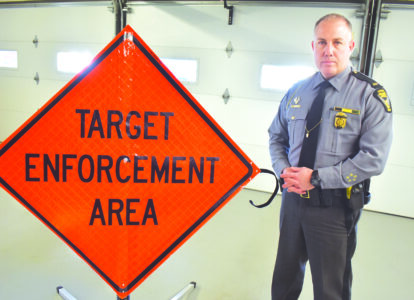
Brown partnered with the Ohio Department of Transportation in Canfield, which made three large, brightly colored, portable signs that say "Targeted Enforcement" in big letters that can be placed along the roadway.
He said the post knows where the biggest areas are for crashes based on extensive statistical data the agency collects. All agencies that handle crashes provide information that goes into that database.
"That dashboard is going to alert us to where there are traffic problems," Brown said. "We also rely on trooper knowledge. I've been here 26 years, and I can tell you the vast majority of crashes are occurring on U.S. Route 224, state Route 46, Interstate 680, Interstate 80 and U.S. Route 76 -- the main routes," Brown said.
The day and afternoon shifts began carrying out these blitzes in March, conducting four of them for three to four hours each time. These will take place from March through September, he said.
SATURATION
Brown said if three troopers are working an afternoon shift, they decide based on statistics where to carry out the blitz. He plans to have the blitzes about four times per month. The first blitzes were on U.S. Route 224, on Market Street and on Mahoning Avenue in Austintown.
For example, they might put out a sign on Route 224 at Tippecanoe Road and another one on 224 at Market Street near the Southern Park Mall.
"So we will saturate that section of road. We are going to take zero tolerance for traffic enforcement, and we're going to stop cars," he said. "We might write tickets. We might write warnings, but we're going to be visible. I guess you could say we're educating the public.
"If they see those signs and then they see a light on the trooper's car, they see a trooper sitting stationary or driving down the road, what are they going to do? They're going to put down their phone, they're going to put their seat belt on. They're going to watch their speed."
He said its a way to "think outside the box" on ways to urge motorists to behave more safely. "Hopefully it works. I'm going to keep my fingers crossed. I don't want to jinx myself, but we we're off to very good year," he said.
So far in 2023, no fatal crashes have occurred in Mahoning County. In 2022, there were 34 fatal crashes that killed 37 people in the county. But Brown knows the time period when the most crashes occur has not yet begun: May through August have the most crashes and fatalities.
"What we push is traffic safety, and we're not deceptive in what we do." Brown said. "We try to educate the public, and we're visible when we're out there."
Brown knows Mahoning County and the trouble spots because he has spent his entire 26-year patrol career at the Canfield post. "I started there as a trooper. I haven't left, so my roots are deep. I know the county and love it, and it's a blessing for me to stay there," he said.
He said the way he looks at his job is the Three Es -- education, engineering, and enforcement.
"The education side of it is what we're doing right now. Wear your seat belt, don't be distracted, don't drive impaired. We try to drive those home constantly in every safety message we put out to the public," he said.
Engineering involves conditions on the roadways, such as the curviness of Interstate 680. So you can ask yourself whether such a road would be safer if had fewer curves. "If there was additional lighting, would that help? If it had some sticky pavement, would that make it better?
"Let's say you have a rash of pedestrians getting injured at night? That could be a lighting issue. It could be that there needs to be a pedestrian closing sign or something like that," he said.
Brown said traffic enforcement is pretty straightforward, but it's good to find alternative ways of handling it, such as the new signs warning people that they are going to be held to a higher standard of safety and enforcing the laws as necessary to drive home the point.
TEXTING LAW
As for the new texting law that took effect April 4, Brown said he hopes it also will improve safety in Mahoning County. He compared it to what happened when seat belts became mandatory in the 1980s.
"Seat belts have definitely made a difference in traffic fatalities," he said. When the seat belt law was initially enacted, a lot of people didn't want to wear them because they weren't used to them, Brown said.
"When I grew up and I was riding around with my parents, we didn't wear them. But then it became the law and you saw the educational component of wear your seat belt, buckle up. It saves lives. So now it's commonplace.
"Driver education for years has emphasized wearing a seat belt. I think the same thing will happen with this distracted driving. A lot of people are on their phones. It's a behavior. It's going to take some time, but there is no doubt in my mind it's going to make the roadways safer."
Under the old law, distracted driving was a secondary violation, meaning it could be charged only if the driver was violating another traffic law that caused law enforcement to stop the driver. Now, driving distracted is a primary offense, meaning that a person can be pulled over and cited for driving while distracted.
"That's going to be a game changer," Brown said.
He said law enforcement officers have seen people being distracted for many years. "We look at people sitting at a red light or driving next to you driving down the road and you see how many people on their phones. It's disturbing," he said.
The new law is "going to save lives. The research has shown that people driving distracted are definitely causing crashes. This law has some teeth, whereas the previous texting while driving law, as a secondary violation" did not.
"We would see people driving down the road with their phone in their hand. They are driving straight but where is their attention going? To the phone. So we had to wait for them to commit some type of violation before we could take enforcement. So now, you see somebody driving down the road, and they have their phone in their hand, and that is going to be a violation."
Some critics claim the new law punishes people who have texted while driving without causing crashes.
But Brown said if a person is driving 55 mph with a phone in hand, and they glance at a phone for a few seconds, they are traveling several hundred feet without looking at the road.
"A lot can happen in that time. In just a split second, things happen … You may have been lucky, but sooner or later someone is going to pull out in front of you or you are going to drift off of the road. So there is no doubt I think this law I feel is going to be a game changer with safety."
STATE STATS
Brown cited state statistics showing that 60,421 people were involved in crashes involving distracted drivers from 2018 to 2022 in Ohio, with 1,274 of those in Mahoning County. There were 189 fatal crashes in Ohio from 2018 to 2022 that involved distracted driving killing 207 people.
He said there is a "huge number" of crashes happening because of distracted driving, "but a lot of that is not reported because it comes down to people being honest with us."
Under the new law, it will be easy to determine whether someone is texting and driving because the law prevents people from holding their phone unless it is up to his or her ear while making a call. There are several exceptions, such as use by emergency services personnel, such as firefighters or police officers in emergency situations. It is also legal to make a 911 call.
"Under the new texting and driving law, if you see someone driving and they're holding a phone in their hand and they are tapping the keys on that phone, then that is a violation," Brown said.
The law went into effect April 4, but there is a six-month grace period where no citations will be issued, only warnings.
"We can stop you if we see someone committing a (texting) violation. But it's an education period. … Come October then we can take enforcement on violations."
CONFUSING PARTS
A key part of the law that is likely to be confusing to most people deals with the difference between drivers having a phone up to their ear during a phone call, which is legal, and a person holding a phone away from the ear and looking at it, which is not legal.
Brown said an example of doing it not legally would be to have the phone in the console and it rings. "You pick it up and you are allowed one touch or swipe. Then you are just driving and talking and the phone's in your hand (not up to your ear), that's illegal. But if you swipe it to answer, 'Hello,' and put it up to your ear, that's legal. You can drive and put the phone up to your ear."
He said the new law was written as a "texting law. This law is aimed at people who are using this device, tapping the keys, looking it it, holding it in their hands. That is the focus of the law. So it does seem strange that a person can hold it up to their ear and talk on it, but that's one of the exceptions in the law." He said if a person puts the phone in the console on speaker, that is legal.
Another confusing aspect of the new law is that it allows a person to hold a phone in their hand when they are stopped at a red traffic light or not in a lane of travel. "You can have the phone in your hand," Brown said of that situation.
"If the lights turns green and they are still sitting there, that would be a violation because they should be proceeding down the road on the green light," Brown said. "We could stop them for that."
The new law allows someone to hold their phone in a traffic jam on the highway, for example. If the person is still holding the phone and traffic is moving, that's a violation, Brown said.
If a person is using a map application to get directions, the person can no longer type in an address while driving. It can still be used by voice activation. If the phone is mounted in the car and is providing directions, that is legal as long as the person is not holding the phone in his or her hand, Brown said.
"You just can't hold it. That's the whole theme of this law. You cannot hold it in your hand, except up to your hear, and you can't be punching keys. So if I program an address, and I set the phone down in my console, and it's talking to me telling me (directions), that's perfectly legal. Now if I have that phone out here (holding it in your hand away from your face) and it's talking to me, then I'm wrong."
It is easy to see a person holding a phone in the hand near the face but not up to the ear, making it easy for officers to determine whether someone is violating the law, Brown said.
erunyan@vindy.com