

Lawyers go to high court in fight over MetroParks bikeway
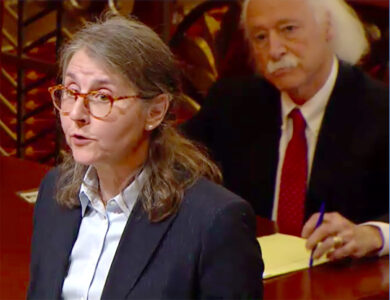
This image from the video of Tuesday’s oral arguments before the Ohio Supreme Court shows attorney Elizabeth Farbman, who represents the Mill Creek MetroParks, answering questions and presenting information to the justices. Behind her is attorney Carl James, who represents Smith Township property owner Diane Less.
Attorneys for Mill Creek MetroParks and property owner Diane Less made oral arguments Tuesday before the Ohio Supreme Court, on whether the court would allow the MetroParks to use eminent domain to take some of Less’ land for the final phase of the MetroParks bikeway.
There were two discussions: One was whether Ohio law allows a park district to use eminent domain to acquire land for a bike trail. Another was whether two Mahoning County Common Pleas Court judges erred when they ruled in the MetroParks’ favor without a “necessity hearing” — a tool to determine whether there is a “necessity” for using eminent domain in this instance.
Attorney Carl James, who represents Less, of state Route 165 in Smith Township, argued that a panel of Fourth District Court of Appeals judges in Circleville was right in finding that the MetroParks cannot use eminent domain in this manner.
Now that the oral arguments are complete, the justices generally will issue a decision in a case in four to six months.
The final phase of the MetroParks’ bikeway would be in southern part of Mahoning County, connecting the current second phase at Western Reserve Road in Canfield Township and travel 6.4 miles south to the village of Washingtonville at the Columbiana County line.
The bikeway would follow a former railroad bed now owned by Less and about 10 other property owners. If successful, the MetroParks would acquire 2.5 acres of Less’ land on the western edge of her property.
“This is private property, and private property cannot be taken unless there is a purpose under statute,” James said. If the statute does not allow for use as a bike trail, “it must be narrowly construed to the benefit of the landowner. That’s fundamental.”
NECESSITY?
James said there is no need for a “necessity hearing.” He said the appellate ruling, which is the basis for the appeal the Ohio Supreme Court is hearing, was that a bikeway is not for the conservation of natural resources.
Justice Jennifer Brunner asked James about whether this case is related to “collision or difference between urban and rural.” He said that issue is relevant only if the court wishes to consider sending the case back to the common pleas court to hold a necessity hearing.
“If you are in the necessity side, what the (appeals) court is saying is a rural area is different from an urban one, so a bikeway going through a rural farm has completely different context than” an urban park such as those in the Cleveland area. In rural areas, “you have security issues, injury issues.”
James questioned how one park policeman is going to “cover 12 roads in a remote, dense, forested area. These are legitimate concerns and why taking statutes have to be narrowly construed.”
He added: “Everybody loves Mill Creek Park in Youngstown, in Mahoning County. You would be hard-pressed to find a person who is not in favor of the park. But still, the board of commissioners of the park district are held accountable to limitations on how they can take land.”
PARKS POSITION
Justice Patrick DeWine barely let attorney Elizabeth Farbman begin her presentation when he interrupted her to ask whether the case needs to go back to Mahoning County judges John Durkin and Maureen Sweeney for the “necessity” hearing. “That is mandatory,” Farbman said of the hearing.
When James filed a response to the lawsuit the MetroParks filed seeking to acquire the right of way, it triggered the need for a necessity hearing, but no such hearing was held. Instead, the judges ruled in favor of the MetroParks, which caused Less and her attorney to file the earlier appeal.
The appellate judges should have held a hearing to determine the merits instead of ruling in favor of the park without a hearing, Farbman argued. “It is our position that the court of appeals incorrectly dismissed the (MetroParks’) lawsuit because no evidence was put into the record with regard to the necessity hearing,” she said.
A necessity hearing is designed to provide evidence “upon which the court can determine the sufficiency of the (MetroParks’) reasons for wanting to acquire the property,” she said.
“In this situation the appeals court deemed the bikeway to be unnecessary for and harmful to rural interests,” she said. “All of those facts can be tested in the mandatory hearing. We are requesting this court … to come to the only decision that … it needs to be taken back” to the Mahoning County judges “because there was no evidence taken.”
Farbman said Ohio law does permit park district to use this type of eminent domain “in order to build and or in this situation extend a bike trail / multi-use trail that will be used by folks who have accessibility issues, kids that are learning to drive a bike.”
erunyan@vindy.com
Local News
McDonald program marks 10 years
On the record Trumbull County
On the record Trumbull County WHAT: Commissioners meeting Wednesday PRESENT: Tony Bernard, Rick Hernandez and ...
Mayor, church leader offer help in elections dispute
Connecting for kids
Grant to be used to improve safety downtown
YOUNGSTOWN — The Youngstown Police Department announced Thursday afternoon that it has been awarded an Ohio ...
Police seek man targeting car wash vacuums in Liberty, Boardman
LIBERTY — Police in a pair of Mahoning Valley communities are looking for a suspect who reportedly damaged ...