

BLACK HISTORY: 1968 riot took heavy toll on Youngstown
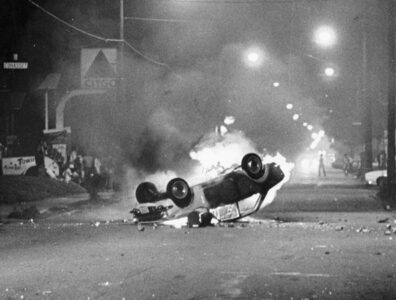
Submitted photos / Mahoning Valley Historical Society ... Rioters set this car on fire on Hillman Street during the height of disturbances on the South Side in April 1968 after the Rev. Dr. Martin Luther King Jr. was assassinated. The car owner narrowly escaped further injuries after evading rioters.
YOUNGSTOWN– Late in the afternoon of April 4 1968, Martin Luther King Jr. prepared to leave the Lorraine Motel in Memphis. As he stood on the second-floor balcony, a single shot to the face killed the civil rights leader.
“He was a man of peace who was cut down violently — and it was reflected in what occurred all across the country,” recalled Mahoning Valley activist Ron Daniels, 80,who was teaching at Youngstown State University at the time.
Outrage resulted in rioting, looting and arson from Washington, D.C., to Baltimore to Chicago. People in more than 100 cities took their frustration to the streets during a period that became known as the Holy Week Uprising.
Fifty-five years ago, Daniels felt the impending uprising and called a meeting inside New Bethel Baptist Church led by Freedom Inc., a political and civil rights group that wanted to “avert an outright rebellion” from spilling into the streets.
Traveling from the South Side of Youngstown, a group of 200 peaceful protesters marched to the Mahoning County Courthouse where Daniels delivered a speech to the crowd.
Recalling the contents of the speech several decades later is a challenge, but Daniels remembers the overall sentiment was toward a peaceful resolution.
“The appeal was for us to stay together, stay organized, for us not to destroy our own community and continue to stay involved,” Daniels said.
By and large, he said the black community trusted Freedom Inc. In return, Daniels and the leaders entrusted the community to heed its words.
That would not be the case.
VIOLENCE
Later in the evening, Daniels recalled the marchers regrouping on Hillman Street near New Bethel Baptist Church when police arrived.
“All hell broke loose,” he said. “The police violently dispersed the crowd – so there was a rebellion and an insurrection that took place in Youngstown that was precipitated by the failure of the police to de-escalate or respect the fact that work was being done to calm the community.”
Daniels said he regretfully remembers protesters saying to him: “We told you they weren’t going to respect us” as civil unrest spread across the Youngstown streets.
“It was painful to hear because they were basically saying: ‘You asked us to do right, we did right — and they still rolled up on us anyway,'” Daniels said.
Excerpts from “Mahoning Valley 400 Year Commemoration of African American History,” a locally published magazine, detail the extent of damage.
Although the violence enveloped the East and North sides of Youngstown, the majority was concentrated in the Hillman area. It spread from Hillman Street to Glenwood Avenue, Parkwood Avenue and Falls Avenue.
For some six hours the rioting turned the city into a war zone: Reports described 16 firebomb calls and 11 reports of looting. Buildings, mainly local black and white businesses, were damaged from bricks and rocks or from being set ablaze.
Two patrolmen were shot, one in the abdomen and the other grazed in the jaw, by a 23-year-old black man, who was also shot and treated at Southside Hospital before being placed under arrest following his recovery.
Mayor Anthony B. Flask placed the city under a curfew Monday night when the riots began, which was lifted Thursday morning with the hope of suppressing violence. As an extra layer of caution, many businesses and community events were canceled.
By the second day, Youngstown police had arrested about 100 adults. Reports of scattered firebombings and the shooting of a 13-year-old boy highlighted some of the unfolding unrest.
Tensions came to a head that day when a National Guard Jeep at a roadblock on Parkwood Avenue and Hillman Street was overturned by black youths. It was later determined the incident was sparked by two white youths who drove through the blockade, injuring several black people — two who were hospitalized. The two white youths later were arrested.
Later that evening Flask broadcast a message across TV and radio calling for men, women and children to show restraint. He declared a state of emergency that prohibited the assembly of more than three people and discouraged traveling unless to or from work.
That day 600 guardsmen in waiting, 300 encamped at Austintown Fitch High School, were sent into the city along with steel-helmeted Youngstown police to enforce the emergency measures. A few hundred more guardsmen remained on alert in the Akron area.
ON THE EAST SIDE
On the city’s East Side, 20-year-old Helen Youngblood on South Truesdale witnessed the violence unfold on local news. Images showed guardsmen entering the city and fiery footage portrayed the burning of the black businesses she remembered frequenting on Hillman Street.
Just a few days before, Youngblood remembered the Hillman area as one lined with houses owned by black doctors, lawyers and working-class blacks who worked in the steel industry.
During the chaos, she recalled not being able to go down the street because of the large presence of guardsmen on foot patrol.
By the time the rioting ended, almost all of what she knew of the area was gone.
“I understood to a degree the anger. But looking at the end result, they (the residents) didn’t realize those neighborhoods weren’t coming back,” Youngblood said.
Decades later, she published “Mahoning Valley 400 Year Commemoration of African American History.”
Daniels, meanwhile, would earn a master’s degree in international politics from State University of New York in Albany and in political science from the Rockefeller School of Public Affairs and a doctorate in Africana Studies from the Union Institute. He had administrative and faculty positions at Kent State University, Hiram College, Cornell University, the College of Wooster and York College.
He directed the Center for Constitutional Rights for more than a decade, was director of Freedom Inc. from 1968 to 1974, executive director of the Rainbow Coalition in 1987 and deputy campaign manager for Jesse Jackson’s presidential campaign in 1988, national chairperson of the Campaign for a New Tomorrow from 1992 to 1998, and ran for president as an independent candidate in 1992.
PEACE
Youngstown’s turmoil lasted for three days. Calm eventually prevailed thanks in part to the guardsmen who reinforced the local police, Daniels agreed. But he and Youngblood also are sure to credit black leaders such as Pastor Lonnie Simon for helping to bring peace.
Daniels recalled Simon saving him from arrest the first day things unfolded.
“If it wasn’t for the fact that he was on the scene to witness that me and Freedom Incorporated attempted to de-escalate, I could’ve been charged for rioting, insurrection — that would’ve landed me in jail,” Daniels said.
He argues to this day that violence could have been avoided had the police not intervened.
“Almost every rebellion that was precipitated across the country was a result of a police action. It would’ve calmed, it would have dissipated — because we gave them an outlet,” he said of the protesters.
As a well-known figure in the community during the 1960s, Daniels said he used his role to try to interface with police on multiple occasions to ease tensions, mostly without success.
Today, Daniels sees a lot of the same struggles between the black community and police. He cited the release of a video that showed Memphis police in January beating Tyre Nichols, who died. The accused officers are black, as was Nichols.
“The current system isn’t workable; it needs a drastic overhaul. The system is so insidious that it will have blacks looking at blacks the same way that whites look at blacks,” Daniels said. “Those black officers would not have treated a white person that way — it tells us that black people, brown people can carry out racist policy.”
cmcbride@tribtoday.com
Local News
McDonald program marks 10 years
On the record Trumbull County
On the record Trumbull County WHAT: Commissioners meeting Wednesday PRESENT: Tony Bernard, Rick Hernandez and ...
Mayor, church leader offer help in elections dispute
Connecting for kids
Grant to be used to improve safety downtown
YOUNGSTOWN — The Youngstown Police Department announced Thursday afternoon that it has been awarded an Ohio ...
Police seek man targeting car wash vacuums in Liberty, Boardman
LIBERTY — Police in a pair of Mahoning Valley communities are looking for a suspect who reportedly damaged ...