

‘Expert’ comes to defense of Youngstown murder suspect
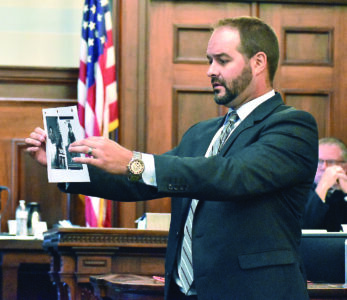
Mike Yacovone, Mahoning County assistant prosecutor, shows photos of a man to the jury during the Lavontae Knight aggravated murder trial Thursday. Knight is charged with aggravated murder in the death of Trevice Harris, 37, on Dec. 30, 2018...Staff photo / Ed Runyan
YOUNGSTOWN — A professor and author who has testified in criminal cases about 40 times on the witness identification of suspects in criminal cases told jurors by video Thursday that “memory is not necessarily a faithful record of what you have seen.”
Margaret Bull Kovera is serving as an expert witness for Lavontae Knight, who is on trial in Mahoning County Common Pleas Court in the aggravated murder of Trevice Harris, 37, who was shot to death Dec. 30, 2018, on the South Side.
Kovera said “there are parts of the brain that are designed to filter out extraneous information because when you are seeing an event, there is so much going on, there is so much sensory information that your brain just can’t handle all of it, so it automatically filters some of it out.”
She said several factors determine how well a person will retain a correct memory of an event or face — “how much time you spend looking at something, were there other things for you to look at that might draw your attention away from a stimulus?”
She said other factors that can affect a person’s memory of an event include “stress and whether the person you are trying to remember is the same race as you are. Those two things affect your ability to actually store that information that we did perceive in memory gainfully.”
Defense attorney David Betras said he asked for permission from the court to hire Kovera at state expense as an expert witness because he knew the testimony of Quanisha Bosworth, the girlfriend of Harris, who survived the attack on Harris, would be an important part of the trial.
Bosworth identified Knight during Tuesday’s testimony as the person who killed Harris and shot her in a car. She said she had seen Harris talking to Knight at two funerals several weeks before the shootings and also clearly saw Knight in a house on Ferndale Avenue on the South Side just before the shootings.
Defense attorney Brian Kopp asked Kovera for more information on how stress can affect a person’s ability to identify a person correctly.
“When people are under high stress, where they are in physical danger, we know that interferes with the ability to take the information seen and store it in memory in ways you can get it back later. We have studies showing that people experiencing high stress while seeing faces will be less accurate in their memory of those faces, even if that exposure lasts in one study up to 40 minutes,” she said.
“People tend to think … that stress is more likely to burn something into someone’s memory. And in fact the opposite is true. It actually interferes with one’s ability to form a memory that they can retrieve later,” she said.
She was asked about the effect a weapon has on a person’s ability to remember details of a person’s face.
“In order to encode something for later use, you have to be able to pay attention to it. The amount of time you pay attention to it affects how much information you can retain and encode about that thing,” she said.
“So when a weapon is present, the weapon draws your attention from faces,” she said.
In the Harris killing, Bosworth said Knight had a gun in a home on Ferndale Avenue, where she and Harris were held at gunpoint before being driven around the South Side and shot. Kovera said studies have shown that a gun “draws the eyes away from faces.”
Under cross examination by Jennifer McLaughlin, assistant county prosecutor, Kovera said she has worked about 20 hours on the Knight case at a rate of $300 per hour. Her bill so far is about $6,000. Kovera said she believes she has always testified on behalf of the defense in cases on which she has worked.
McLaughlin asked if a person would be better able to identify a person the more times he or she saw the person.
“Well, you could see people without being able to see their faces; for example if it’s dark, there’s no light, even if it’s a short distance you can’t see them very well so seeing them repeatedly wouldn’t help you,” Kovera replied.
McLaughlin asked whether it is “easier to recognize someone that you know than a stranger.”
Kovera replied, “It depends on how well you know them.”
After Kovera’s testimony, the trial ended for the day and will resume today. There could be additional defense witnesses. If not, closing arguments and jury deliberations will take place.
Most of the early part of the day Thursday was taken up with testimony from Youngstown police detective Chad Zubal, who is lead detective in the case. He testified more than 4 1/2 hours, including long periods of cross examination by Betras.
For instance, Betras wanted to know why Zubal did not try harder to speak to a person whose DNA was found in the back of the car in which Harris and Bosworth were shot. Zubal said he left his business card at a house where the man stayed, and the man called back, but the man did not show up for an interview at the police station.
Zubal said he tried additional times to talk to the man but was unsuccessful. Zubal also said Bosworth could not identify the man from a photo lineup as having been involved in the shootings.
erunyan@vindy.com
Local News
PUCO grants significant rate increase for SOBE customers
The cost for steam heat for most of downtown Youngstown will greatly increase — 93% for a majority of them almost ...
Western Pennsylvania revolutionized energy
EDITOR’S NOTE: America would not be the nation it is today without its vast stores of natural resources. But ...
Youngstown City Schools bus drivers air healthcare concerns
YOUNGSTOWN — Initially, Stacey Kennedy had no intention of becoming a city school bus driver, but after a ...
YSU art camp draws Valley high schoolers
Man turns himself in on charge of assault
YOUNGSTOWN — Thomas J. Tubbs Jr., 61, will be arraigned today in Youngstown Municipal Court on a 3-year-old ...
Bill would require Border Patrol to adopt shelter dogs
Congressman Dave Joyce introduced a bill to require U.S. Customs and Border Protection to establish a pilot program ...