

Congressional district shakeups aren’t new to area
Congressional lines set to change
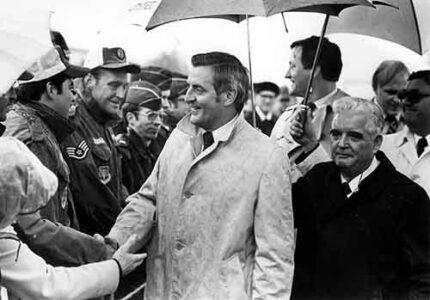
This undated photo shows former 19th District Rep. Charles J. Carney, a Democrat, right, with Vice President Walter Mondale. Carney served the district from 1970 to 1978. Submitted photos / Mahoning Valley Historical Society
Most of Mahoning and Trumbull counties were in the same congressional district for decades until the fall of former Congressman James A. Traficant Jr. and a loss of a seat in Ohio in the 2002 election changed things.
It’s now possible that all of both counties, along with Columbiana County, could end up in the same congressional district.
That’s up to the Ohio Redistricting Commission, which is likely to vote this week on a new congressional map.
But like a first Republican-proposed map that had the three counties together, it is subject to legal challenges and ultimately the Ohio Supreme Court to rule on its constitutionality.
The court decided Jan. 14 the first Republican-drawn map was unlawful because of gerrymandering.
Mahoning and Trumbull counties, with the exception of a section of western Trumbull County, were in the same 17th Congressional District — along with parts or all of Columbiana County, depending on redistricting — dating back to 1982, four years after Republican Lyle Williams was first elected in 1978, defeating four-term Charles J. Carney, a Democrat. Two years after Williams won re-election for the last time, Traficant beat him in 1984.
Even before that, Mahoning and much of Trumbull’s population centers were in the old 19th District, represented for decades by Democrat Michael Kirwan.
Because of population declines in the Valley, the redistricting before the 1992 election brought most of Columbiana to the 17th while that small section of Trumbull stayed in the 13th District.
WHY THEY SPLIT
But a couple of issues before the 2002 redistricting led to both Mahoning and Trumbull counties splitting and each having two House representatives, said Paul Sracic, a Youngstown State University political science professor and Bill Binning, the former YSU political science department chairman.
First, Ohio lost a congressional seat before that election because the state’s population didn’t grow as fast as the rest of the country.
The second was Traficant’s legal problems, they said.
In May 2001, Traficant was indicted by the federal government on 10 counts of racketeering, bribery, tax evasion and obstruction of justice. He was found guilty in April 2002 and expelled from Congress in July 2002.
The state’s redistricting process was done between the time Traficant was indicted and convicted.
“Traficant was the easy one to cut,” Sracic said. “It made it easier for Republicans to split the district because Traficant was under indictment. Something would have had to happen with the area anyway. The district had to either grow or be absorbed because it wasn’t large enough as the area lost population.”
Mahoning County always had been the “dominant county” in its congressional district, Binning said, dating back to when Kirwan was first elected to the then-19th District in 1936. Kirwan served until his July 27, 1970, death. Carney was elected in November 1970, serving until he lost to Williams in 1978.
“Mahoning’s power has been diluted since the division (in 2002) from Traficant’s troubles,” Binning said. “We don’t know if that would have happened anyway if Traficant didn’t get in trouble. But what invited Republicans to get rid of a district was Traficant’s woes. Would they have done that without Traficant’s issues? I don’t know.”
HOW THEY SPLIT
In 2002, Republicans split Mahoning and Trumbull counties and put them into districts represented by three incumbents: Thomas Sawyer, an Akron Democrat; Ted Strickland, a Lucasville Democrat; and Steven LaTourette, a Bainbridge Republican.
The population core of Mahoning and Trumbull counties — including Youngstown, Warren, Austintown, Liberty, Niles, Girard, Howland, Struthers and surrounding areas — went to Sawyer.
Seven northern Trumbull County townships were put in LaTourette’s district, and much of the suburban and rural parts of Mahoning County, including Boardman, as well as Columbiana County, were given to Strickland.
LaTourette and Strickland were re-elected in the newly-drawn 14th and 6th Districts, respectively.
Trumbull County, rather than Mahoning County, became the new 17th District’s most-populous county. The district also included portions of Summit and Portage counties.
But Sawyer lost the 2002 Democratic primary to Tim Ryan, then a state senator for a little over a year. Ryan won the general election and has served since.
LINES CHANGED AGAIN
The redistricting before the 2012 election changed the congressional lines again, giving the former 17th, renamed the 13th District, more of Summit County, which became its most populous county, as well as a little more of Mahoning County and a little less of Trumbull County.
With every election since 2012, Ryan’s margin of victory has shrunk as Mahoning and Trumbull counties, which were Democratic strongholds since the New Deal, have shifted politically with more Republicans either winning elections or losing by closer margins than just a few years ago.
“We’ve become a swing district,” Sracic said. “Democrats are not guaranteed wins anymore.”
Ryan opted a year ago to run for the U.S. Senate after Republican Rob Portman announced he wouldn’t seek another term in 2022.
“It would have been difficult to draw a Democratic district for Ryan,” Sracic said. “It’s really hard to figure that out. It’s probably why he decided to run for Senate.”
Ryan has said redistricting had nothing to do with him seeking the Senate seat.
WHAT’S NEXT?
It isn’t known what will happen to the Mahoning Valley in the latest congressional redistricting.
The Republicans on the Ohio Redistricting Commission had approved an initial map that reunited all of Mahoning, Trumbull and Columbiana counties, with seven counties to the south in a Republican-leaning district.
The Ohio Supreme Court tossed the map, saying it gerrymandered the state, particularly in Hamilton, Cuyahoga and Summit counties.
Democratic state legislators have proposed a map that splits Mahoning County in half with its eastern portion in a district with all of Trumbull in a Republican-leaning district and the rest in a solid Republican district with southern counties.
“It seems Mahoning and Trumbull would be in the same district in the new map,” Binning said. “I don’t see what advantage there is to dividing the two. It makes sense to keep them together as there’s a lot of commonality between the two counties.”
A state constitutional amendment, approved in 2018 by voters, restricts the number of counties that can be divided when drawing a new congressional map.
Of the state’s 88 counties, 18 can be divided into two districts and five can be split three ways.
“There’s a lot of requirements with these districts,” Sracic said. “Keeping the Valley together is not that much of a priority. They have so many other problems and priorities that this isn’t one of them.”
The commission has until March 13 to approve a congressional map. It can also face legal challenges with a decision on its constitutionality made by the Ohio Supreme Court.
Politicians through the years
U.S. representatives of the Mahoning Valley:
19th District
Michael Kirwan, Democrat — elected in 1936 and served until his death on July 27, 1970
Charles J. Carney, Democrat — elected in 1970 and served until 1978
Lyle Williams, Republican — elected in 1978
17th District
(the district became the 17th in the 1982 election)
Lyle Williams, Republican — defeated in 1984
James A. Traficant Jr., Democrat — elected in 1984 and served until he was expelled on July 24, 2002
Tim Ryan, Democrat — elected in 2002
13th District
(the district became the 13th in the 2012 election)
Tim Ryan, Democrat — still serving
Local News
‘Price Is Right Live’ returns to Packard
Folks can c’mon down to Packard Music Hall for a chance to play “The Price Is Right.” “The Price Is Right ...
McDonald program marks 10 years
On the record Trumbull County
On the record Trumbull County WHAT: Commissioners meeting Wednesday PRESENT: Tony Bernard, Rick Hernandez and ...
Mayor, church leader offer help in elections dispute
Connecting for kids
Grant to be used to improve safety downtown
YOUNGSTOWN — The Youngstown Police Department announced Thursday afternoon that it has been awarded an Ohio ...