

Police using body cams
Youngstown officers begin their training
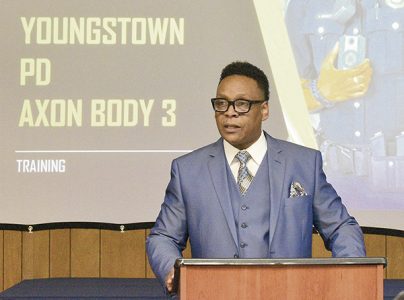
Staff photo / Ed Runyan Youngstown police Chief Carl Davis stands at the head of the classroom where training for using body cameras took place Wednesday in the Youngstown Police Department.
YOUNGSTOWN — Sixteen Youngstown police officers sat in a training room Wednesday and began to learn how to use body cameras that they will test for the next month or two. They will be on the streets using them as early as today.
It is the official start of the body camera program that Carl Davis announced he would implement shortly after he became Youngstown police chief in January.
Body cameras have “several inherent benefits — documentation of evidence, enhanced officer training, preventing and resolving complaints brought by members of the community,” he said. They also “strengthen transparency, performance and accountability in our department.”
The last of those — enabling the police department and public to identify officer misconduct — is the one that makes headlines. But research shows that “the use of body-worn cameras can significantly reduce the number of citizen complaints by as much as 75 percent,” Davis said.
Davis made the remarks from the front of the classroom at the Youngstown Police Department at the start of instruction.
“Several agencies also report drops in the number of use-of-force incidents,” he said. Less than one-tenth of 1 percent of the 74,000 calls for service answered by Youngstown police officers involved use of force incidents, Davis said.
“Although that number is low, anything we can do to try to bring that number even closer to zero is worth looking into,” he said.
The department likes the Axon brand of body cameras, which is the brand the department is testing to determine whether to move forward with purchase.
Jose Morales Jr. of the internal affairs division, who is heading up the body camera program, said during the trial period, “We will be testing one of the vendors we have taken an interest in so far.”
He said the officers will get to assess the cameras and “share their feedback.” No final selection on a vendor has been made, Morales said.
“I think it’s worth mentioning that we actually had more volunteers than we had cameras to pass out during the trial period,” he said. “So our guys seem pretty eager to get these cameras out in the field; so that’s great because this body-worn camera program, once fully adopted, will create better transparency between the department and community.”
Councilwoman Anita Davis, a former Youngstown police officer, attended the training session, telling the officers and others, “Everybody thinks (body cameras are) about watching the cops and making sure the cops are doing their job correctly, and it is. But the other part is, it will help you.”
Chief Davis credited Anita Davis for being one of the leading proponents of using body cameras in the department.
Anita Davis said a large percentage of the complaints from citizens are about the way an officer spoke to a citizen — or even how they “stood,” Davis said.
“The complaints I heard when I was the officer in charge were about how officers spoke to the people, how they stood, how they walked in the door. It wasn’t about the use of force,” she said.
For example, she said a person would complain, “I don’t like the way Carl was standing,” she said, calling them “BS complaints.” She said, “Look at these as a tool that for the most part — I’m going to tell you right now — will be beneficial to you.”
She said she thinks when the public gets a look at “more of what you’re looking at instead of the stuff that is on Facebook, that is always going to be negative … but they need to know that most of your day, you are doing the right thing.”
Local News
McDowell issues apology for communication mixup
YOUNGSTOWN — Mayor Derrick McDowell publicly apologized for a communications mixup during a recent tour by ...
On the record | Trumbull Educational Service Center
Trumbull County WHAT: Trumbull County Educational Service Center governing board meeting Monday PRESENT: ...

Mayor urges press to treat Youngstown fairly
From North Jackson to Okinawa

REMEMBERING THE HOLOCAUST: ‘Rise above the evils’
Liberty man found not guilty of assault on girlfriend, baby
WARREN — A jury found Michael R. Derr, 33, of Liberty, not guilty Tuesday of two counts of felonious assault, but ...