Bomber pilot taught others to fly
Missions were to ‘obliterate military targets’ in WWII
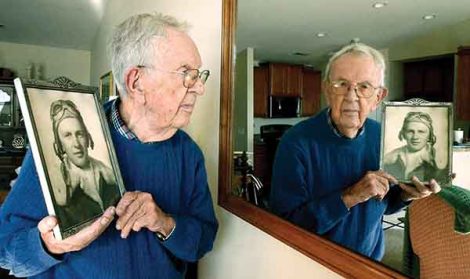
World War II bomber pilot Donald R. Brooks, 98, of Poland, with a wartime portrait of himself. Brooks, who served June 1942 to December 1945 in the U.S. Army Air Forces, flew a Consolidated B-24 Liberator, a large, heavy, four-engine bomber. Staff photo / R. Michael Semple
POLAND — In a relatively short time, Lt. Donald R. Brooks was converted from student to teacher — while often quite high above most people.
“The Germans were shooting the daylights out of us (in Europe),” Brooks, 98, an Army Air Forces and World War II veteran, said. “We needed pilots to fly four-engine planes; it was a case of need, and we were filling the need.”
Brooks, who served from June 1942 to December 1945, received extensive training to do just that — and used his specialized skills to teach others to follow in his footsteps. Specifically, he became a bomber pilot and flew a Consolidated B-24 Liberator, a large, heavy, four-engine bomber that went faster, higher and farther than the B-17 Flying Fortress model it succeeded.
A few years after graduating in 1940 from Erie Academy High School in Erie, Pa., where he also met his late wife, Dorothy, Brooks received his layers of training that began with basic training in Miami Beach, Fla., then on to Bruce Field in Ballinger, Texas, where he learned skills necessary to be a pilot. Following that was advanced training at the Ellington Field Joint Reserve Base near Houston before he was assigned as an instructor pilot.
Part of that entailed subjecting his students to similar training he had received, he explained.
Brooks also became part of the 5th Air Force, 380th Bomb Group, 530th Squadron, which flew 31 missions — two of which were in Australia, he recalled. After that, he was stationed in Mindoro, Philippines, before being transferred to an island near the southernmost tip of Japan, which, as Brooks remembered it, was a staging area for troops and heavy equipment.
Some of the bombing missions he flew were to “obliterate military targets,” including one in China that the Japanese used to repair their damaged submarines, before “they could be used against us,” Brooks continued.
A few lighter moments during his military career included enjoying an elaborate Christmas dinner in 1944 in New Guinea, which also was a refueling stop. Brooks was among those soldiers who spent a few nights in that country while en route to Australia, he said.
Another was when Brooks was among 10 soldiers named “Crew of the Week” and featured in the Oct. 27, 1944, edition of the March Field Beacon, an Army Air Force publication.
When he returned home after the war had ended, Brooks earned a bachelor’s degree in business from Ohio State University, then used the GI Bill to enroll in the Case Western Reserve University School of Law in Cleveland. He earned a two-year degree from CWRU, and in June 1949, passed the bar exam on the first try, he recalled.
Nevertheless, Brooks’ career headed in a different direction, because he began to work for his father’s tire business and became a franchised tire dealer. Personal reasons also factored into the choice, he explained.
“I didn’t practice law because I had a wife and two kids,” Brooks said, adding that he also was unable to find any law firms interested in hiring him.
Nevertheless, the longtime veteran had a lucrative career in his father’s business before the younger Brooks retired in October 2000 after it had been bought out.
“I haven’t missed any meals. I stayed out of jail,” he said with laughter.
In Brooks’ case, however, retirement doesn’t equate with inactiveness. He remains a longstanding member of the Youngstown Kiwanis Club, which he joined in the 1960s and for which he has served as past president.
The WWII pilot also enjoys playing competitive bridge and is part of a group that meets regularly at the Southside Bridge Club on Market Street. Before the health pandemic hit last March, he played the popular card game about three times weekly, he said.
For his service, Brooks was given several medals, including one he earned from having served in the Philippines. He also has kept an extensive record of his three years in the military, including numerous documents, black-and-white photographs and a detailed list of the missions he flew.
Brooks, whose wife died in 2008, has two daughters, one son and two granddaughters.
news@tribtoday.com
Local News

Maplewood softball headed to state championship
Jewish Caucus members take part in town hall
YOUNGSTOWN — Fears about rising antisemitism, community safety and growing political division dominated a town ...

Flying High grads overcome turbulence, launch careers
Alberini retains Trumbull Dem chairman post
NILES — Things look to stay the same for the next four years for the county’s Democratic party, as party ...
Speaker focuses on fossils found in Ohio