

LEGACY OF MAY 4, 1970: Impact of KSU shootings remains, ex-students say
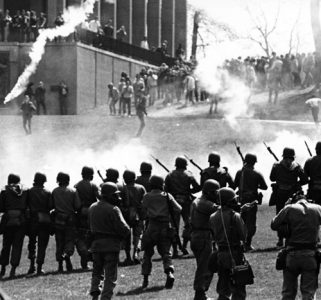
Ohio National Guard personnel walk toward a crowd of protesters near Taylor Hall on the Kent State University campus on May 4, 1970, after firing tear gas. The guard later fired on students, killing four of them, including a woman from Boardman. Kent State University News Service May 4 photographs. Kent State University Libraries. Special Collections and Archives
Jeanne Tucker didn’t participate in the anti-Vietnam War protests when she was in college.
Early in her college career, she would hang an American flag outside her window in response to the protesters outside her dorm.
Now 71, Tucker is a vocal supporter of liberal causes and has participated in numerous marches and protests. What she saw May 4, 1970, as a student at Kent State University, at least in part, is responsible for that transformation.
“I learned back then that you have to speak out,” said Tucker, who lives in Mineral Ridge. “I do feel Kent made me an activist.”
Four students were killed, and nine were wounded when members of the Ohio National Guard fired more than 60 shots in 13 seconds during a protest on campus.
The impact of those 13 seconds 50 years ago reverberates well beyond the university located less than an hour from the Mahoning Valley.
What happened at Kent State has been the subject of books, films and television programs that debate the factors that led to the shootings and the effects of their aftermath.
“It was one of the major turning points. If it could happen in middle America — and it happened in Kent, Ohio, not that far from home — it could happen anywhere,” said Channing Jackson, a retired U.S. history teacher at Champion High School who was a sophomore at Kent in 1970.
FROM BOARDMAN
Sandy Scheuer, one of the students killed on May 4, was a 1967 Boardman High School graduate and an honor student. Her parents spent the following day — their 27th wedding anniversary — answering questions about their daughter’s death.
Her mother, Sarah Scheuer, told the Youngstown Vindicator about trying to reach their daughter after learning of the shooting.
“I tried to call — it was very hard to get a line, the phones were so jammed up,” she said in 1970. “When I finally got through (around 3 p.m.), they said they had been trying to get to us. They said there’d been trouble, that we should come right away.”
By the time they reached Kent, their daughter was dead.
Marty Cohen of Warren didn’t go to Kent, but he knew Scheuer as a teenager from United Synagogue Youth parties.
“She was just a kind person, a very unassuming, sweet girl,” he said. “She was just a nice, middle-class Jewish girl.”
Cohen later was part of an acoustic group called Harlequin, which regularly performed “Ohio,” the protest anthem recorded by Crosby, Stills, Nash & Young about the shootings.
“You know the line, ‘What if you knew her and found her dead on the ground?’ I thought of her every time we sang that,” Cohen said.
ANTI-WAR RALLY
What happened on May 4 was the culmination of a tumultuous weekend on campus and growing unrest nationwide following President Richard M. Nixon’s announcement on April 30, 1970, that U.S. forces had invaded Cambodia and the Vietnam War was escalating.
There was an anti-war rally on campus during the day on Friday, May 1, and confrontations that night between protesters and police in downtown Kent.
Jackson’s fraternity had a party that night, and when he and some of his friends went to Perkins restaurant afterward, “It looked like downtown Kent turned into war zone.”
That’s when Ohio Gov. James A. Rhodes called in the National Guard.
Larry Deuber, who taught for 30 years at Newton Falls High School and worked as a substitute for another 19 years after retiring, was a junior living off campus.
“It was like a movie, just watching (military) vehicle after vehicle going down the road toward campus,” he said.
Saturday night the ROTC building next to the Commons was set afire and destroyed by protesters.
Rhodes arrived in Kent on Sunday morning and indicated he would seek a court order declaring a state of emergency, according to a history of the events on the KSU website.
Leaflets were distributed the morning of May 4 stating that all rallies, including the one scheduled at noon that day, were prohibited as long as the Guard was on campus.
When students gathered at the Commons, they were ordered to disperse by Robert Canterbury, brigadier general of the Ohio National Guard.
‘SOUNDED LIKE FIREWORKS’
Jackson was at the rally at the instruction of his professor, Thomas S. Lough.
“What he did was controversial that day,” Jackson said. “The class was social problems, and he took us all out and we went to the big rally, which was growing by the minute.”
After listening to the anti-war chants for a while, Jackson and a couple of his friends decided to go get lunch at the student union.
“No sooner did I order lunch and pay for it when I heard, ‘pop-pop-pop-pop-pop.’ It sounded like fireworks,” Jackson said. “Hundreds of people tried to get into the student union lunch area. A friend came over and said, ‘They’re shooting people out there.'”
Jay Wonders, 70, of Warren, was a freshman at Kent and was talking to a guardsman by Taylor Hall when the shooting started near the Prentice Hall parking lot.
“I remember watching them shoot, seeing people fall down and thinking, ‘Is this really happening? What’s going on here?” Wonders said. “It still haunts me, the whole affair.”
Tucker lived in Prentice Hall, and most of the dead and wounded students were shot in the Prentice parking lot. She was eating lunch in the cafeteria when she heard gunfire.
“I walked out into carnage,” she said.
Some of the injured and tear-gassed students went into Prentice seeking shelter. Tucker knew from her first-aid training how to help those who had breathed in tear gas. She was at a loss when she saw a student who had been shot in the foot.
“We didn’t cover rifle wounds,” Tucker said. “There were crying groups of people, blood. I just kind of walked around. I couldn’t believe what I was seeing.”
The campus was shut down, and students without cars had to try to reach their families and find a way home.
Much like students today, who are doing classwork at home due to the COVID-19 virus, students at Kent and many other colleges had to complete their spring quarter classes by mail.
Jackson and Deuber didn’t let what happened affect their educations.
“I didn’t let it get me down,” Deuber said. “I knew what I wanted to do, and that never changed. I knew I wanted to be a teacher since junior high.”
Tucker, who was close to graduating, ended up taking incompletes in her classes and didn’t get her degree until 1975.
“I didn’t know what to call it then, but I definitely had post-traumatic stress,” she said.
Wonders didn’t go back after his freshman year.
“I think I processed it by shutting down,” he said. “I just turned my back on it. I didn’t want to be involved. I gave up on school until a much later date.”
He had a number of different jobs, thanks to many plant closings. “Mostly I was a machine tool builder,” he said.
Witnessing those events at Kent had the same impact on Wonders that it had on Tucker.
“It turned me into a lifetime bleeding-heart liberal,” Wonders said. “It turned me into somebody who was a little more politically active, someone who was more aware and paying attention to what was going on.”
agray@tribtoday.com
Local News
‘Price Is Right Live’ returns to Packard
Folks can c’mon down to Packard Music Hall for a chance to play “The Price Is Right.” “The Price Is Right ...

McDonald program marks 10 years
On the record Trumbull County
On the record Trumbull County WHAT: Commissioners meeting Wednesday PRESENT: Tony Bernard, Rick Hernandez and ...
Mayor, church leader offer help in elections dispute
Connecting for kids
Grant to be used to improve safety downtown
YOUNGSTOWN — The Youngstown Police Department announced Thursday afternoon that it has been awarded an Ohio ...