

Bridge by Steve Becker
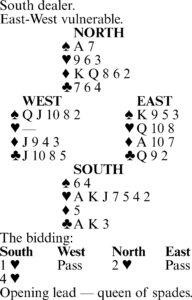
One of declarer’s greatest enemies is complacency, which frequently develops when, after viewing dummy, declarer decides there’s really nothing to the play.
Consider this deal where South is in four hearts. He wins the spade lead with dummy’s ace, and, without giving the matter much thought, next leads a heart to the ace, planning to draw trump and later discard a club on one of dummy’s high diamonds for an overtrick.
But if declarer leads a trump to the ace at trick two, he goes down one. After discovering the 3-0 trump break, the best he can do is play a diamond to the queen and East’s ace. East then cashes a spade and shifts to a club. Declarer takes his A-K of clubs and exits with a club.
After East takes the queen and returns a diamond, declarer, reduced to nothing but trumps, has to ruff and concede a trick to East’s queen of trump for the setting trick.
A more cautious declarer would adopt a different approach, however. Before leading a trump to the ace at trick two, he would stop and ask himself what, if anything, might jeopardize the contract. After concluding that the only threat was a 3-0 trump division, he would then channel all his thoughts into guarding against that possibility. This, in turn, might lead him to the winning line of play.
To protect against a 3-0 distribution with East holding all three trumps, the correct play is to lead a trump from dummy at trick two and finesse the jack after East follows low! If the jack wins, the battle is over then and there.
And what if the finesse loses? In that case, the best West can do is to cash a spade and lead a club. Declarer wins, draws the one missing trump and concedes a diamond to the ace. South takes the club return, crosses to the nine of trump and disposes of his club loser on dummy’s high diamond to make the contract.
Tomorrow: The road to winning defense.
(c)2026 King Features Syndicate Inc.
Lifestyles
Spice up your grilled leg of lamb
Ihsan Gurdal, the owner of Formaggio Kitchen in Cambridge, Massachusetts (a specialty food shop and the first place ...
Lovina shares memories of the move to Michigan
We will be extra busy cleaning and preparing to host communion services here in three weeks, so I decided to get an ...

Make roasted carrots pop on an Easter table
DEAR ANNIE: Kids’ privilege has distorted their perspectives
DEAR ANNIE: My spouse and I chose to raise our kids in a neighborhood with excellent schools and a strong sense of ...
Bridge by Steve Becker
HINTS FROM HELOISE: Report phone scams to FTC
DEAR HELOISE: I know you warn people never to give out their personal information, but since this past Christmas, I ...