

How evergreens manage to stay green in winter
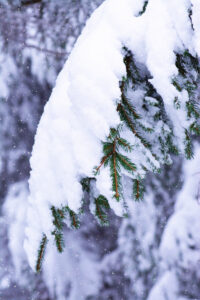
Submitted photo
Our gray days and white snow seem to dominate our winter, but with observation, you will notice that some of our plants remain green in spite of our cold temperatures.
Evergreens seem to dominate our green winter palette, perhaps simply because of their size, reaching great heights. Most deciduous trees lose their leaves completely in the fall, but evergreens retain their needles. Chlorophyll provides the green color for summer leaves and absorbs sunlight, which the tree uses to turn carbon dioxide from the air and water into sugar — the food the tree needs for growth.
Colder temperatures and less daylight in the fall halt this process, called photosynthesis. In deciduous trees, shorter days and colder temperatures trigger the breakdown of chlorophyll and the formation of a separation layer that causes leaves to drop, stopping photosynthesis until spring. Evergreens keep their green needles throughout winter, and although photosynthesis slows in cold weather, they can continue to be limited on mild winter days.
Additionally, nutrients from the soil play an important role, keeping the trees strong and sturdy. Calcium, potassium and iron are minerals that the soil provides to keep trees healthy. Storing these nutrients during summer, trees will use them as needed throughout our cold months.
Evergreen needles retain water to keep them green, however, there can be some needle loss during our winter and into spring, but the needle drop is intermittent, unlike deciduous trees. Needles dropped cover the ground under the tree, may provide a blanket for the shallow roots to retain moisture, avoiding desiccation.
Conifer trees such as pines and spruces will slow their growth but never become completely dormant. With thick, waxy coating, their needles can retain more water, thus retaining most of their needles.
Bark is the insulator for protection, but cracks in the bark expose it to damage from freezing temperatures. Heavy snow, wind and freezing temperatures can all contribute to the future health of the tree.
Needle lifespan of conifers, according to the Ohio State University Ohioline, can be between two and 10 years. Examples are Eastern White Pine and Scots Pine, two to three years; Eastern Hemlock, three to four years; Yew, three years; Blue Spruce, two to five years; and Norway Spruce, six to 10 years. Having one or more of these conifers on your property can provide you with the information for needle drop expectation, realizing your tree continues to be healthy.
One interesting exception is our native deciduous conifer, the Eastern Larch. From the pine family, its needles change color in autumn from green to a beautiful golden color, shedding them annually with new needles budding in spring.
In parks and neighborhoods, with the melting snow, we can discover some early green leaves peeking through the soil, such as Dead Nettle, Colts Foot and Skunk Cabbage, welcoming spring. Hellebore, Lenten Rose and Rhododendron retain their green leaves during winter and are easily recognized.
Spring will arrive in time, but winter has provided us with those plants that retain chlorophyll, the pigment that provides a bit of green color to an otherwise white landscape.
Perhaps we will become encouraged to think about planting season if we haven’t already.
Lifestyles
HINTS FROM HELOISE: Cut tissues in half so box will last
DEAR HELOISE: I find that most of the time, I only use a very small portion of a tissue. I’ve found that I can ...

Monday evening TV listings
Start your seeds inside
Bridge by Steve Becker
This deal occurred in the final of the 1992 U.S Bridge Championship. The declarer was Michael Rosenberg, who ...
How evergreens manage to stay green in winter
TO YOUR GOOD HEALTH: Avoiding dialysis can prove harmful
DEAR DR. ROACH: A loved one of mine has had kidney problems for his whole life. He’s now on the transplant list, ...