

Your conifer isn’t dead; it’s deciduous
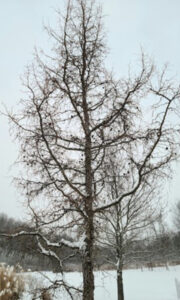
Submitted photo European larch “Contorta” is an interesting tree in winter. Dead cones may remain on the tree for up to 10 years.
It’s often easy to make assumptions about living things, but nature has a way of showing us that there are always exceptions to any “rule.”
One is that all conifers are evergreens. To the uninformed, a conifer with yellow to brown needles in the fall and bare branches in the winter must be dead. In fact, there are three species of deciduous conifers that will grow in Ohio.
• Of the three, dawn redwood has the most fascinating story. Long thought to be extinct and known only by a fossil record dating to the late Cretaceous Period, living specimens were discovered in China in 1941. In 1947, Harvard’s Arnold Arboretum funded an expedition to collect seeds that were distributed to botanic gardens worldwide. An online search showed that these trees are readily available today.
As its name would infer, this tree is huge. Its pyramidal shape can reach a height of 100 feet and a width of 25 feet. It should be planted in full sun in soil that is deep, moist and neutral to slightly acidic.
The foliage is feathery and pretty. The cones are small, egg-shaped and hang on long stems. Over time, the branches droop and fissures develop in the bark. North Carolina State University recommends giving this fast growing tree plenty of room, perhaps using it as a specimen tree on a large property.
• Bald cypress reminds me of the warm, wet southern swamps where alligators live. Related to the dawn redwood, it can tolerate a wide range of slightly acidic soil conditions from temporary flooding to somewhat dry. If grown in or near water, it will develop knobby growths called “knees” from its horizontal roots.
This pyramid-shaped tree also has the potential to be quite large — 50 to 70 feet tall and 20 to 30 feet wide — so allow for this when planting. The trunks of older trees are wide at the bottom, becoming narrower higher up. Foliage resembles that of the redwood and cones are 1-inch spheres.
• There are 11 species of larch with cultivars of the European larch most often available for landscaping. Years ago, I planted a “Contorta” cultivar and its twisted branches add both summer and winter interest to my garden.
Wisconsin Extension describes the needle-like leaves of larch as vivid green or blue green in summer to old gold in autumn. Leaves emerge from spurs on the branches and the trunk. One- and one-half inch oblong cones grow upright on the branches and may remain for years.
This tree can reach 70 feet in full sun and adapts to most well-drained soils. During last summer’s drought, I had to provide supplemental water when I noticed the needles were turning prematurely yellow.
These three species are relatively pest and disease free, although Japanese beetles have been a problem on my larch. If you have space, consider one of these unique trees for your property.
For more information and images, go to: https://bygl.osu.edu/node/1730.
Lifestyles
HINTS FROM HELOISE: Always keep your phone close to bed
DEAR HELOISE: I have a suggestion for anyone living alone, especially older adults: Put your phone next to your bed ...
Your conifer isn’t dead; it’s deciduous
Valley Grows calendar
Here are upcoming gardening events through the Ohio State University Extension Office. For more information and a ...
Brighten your winter by forcing flowering branches
DEAR ANNIE: Do not tolerate demeaning jokes over height
DEAR ANNIE: I’m a 73-year-old married woman, and my husband and I have a full social life. We regularly host ...
Bridge by Steve Becker
France won the 1992 World Team Olympiad, handily defeating the United States in the 96-board final. Oddly enough, ...