

‘Technology should work for people’
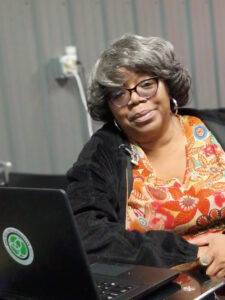
Correspondent photo / Susan Wojnar Lillie Rogers, 62, of Youngstown, said she’s been increasing her knowledge about technology through classes at the Oak Hill Collaborative on the city’s South Side.
“Ugh! I detest these so much!”
Mick Kundus, 66, of Champion, doesn’t hesitate when asked about modern technology. He can text. He can send email. He understands the basics. But downloading apps, remembering passwords and navigating online portals have turned everyday tasks into exercises in frustration.
“I can download some of them, but they always claim to be free — and nothing is free,” Kundus said. “I usually get 300 emails of new sales offers every time I download a new app.”
Even accessing his medical information has become a struggle. Trying to log into MyChart proved so aggravating that, at one point, he swore he would “rather not receive treatment” than attempt to navigate the portal again.
Kundus’ exasperation is echoed by many older adults across the Mahoning Valley. Technology is no longer optional. Doctor appointments are scheduled online. Test results are posted to patient portals. Banking, bill paying and even government services increasingly require digital access. For seniors who did not grow up with computers or smartphones, the shift can feel overwhelming — and isolating.
Across the Youngstown area, however, a growing network of organizations and businesses is working to close that gap, offering training, in-home support and affordable devices to ensure seniors are not left behind.
FAMILY TECH CONNECT
At 4237 Oak Knoll Drive in Youngstown, Family Tech Connect LLC has built its mission around one simple idea: bring patient, personalized technology help directly to seniors.
“We’re a family,” said Vince Bevacqua, chief operating officer of the family-owned company. “My brother Lucas has a degree in information technology, my brother Neil is a business student at YSU and a social media expert — and we’ve always had a huge spot in our hearts for our grandparents.”
Those grandparents, who live in Maine and Florida, helped inspire the business. Technology became essential to staying connected across the miles, and their grandfather Joe encouraged the brothers to use their skills to help other seniors do the same.
The company formally launched during the COVID-19 pandemic when isolation exposed just how wide the digital divide had become. Bevacqua, who had been laid off from a career in television news and public relations, found himself constantly troubleshooting technology for his father-in-law, who was then in his 80s and still working in international sales.
“There was no help for him at work,” Bevacqua said. “If a smart guy like my father-in-law needed help, I knew many others did as well.”
Family Tech Connect offers free in-home personal tech coaching funded in part through grants from Direction Home of Eastern Ohio. Coaches visit by appointment, troubleshoot devices and create individualized plans to help seniors gain confidence.
Services range from setting up smartphones, tablets and laptops to connecting printers and smart home devices. The team also assists with downloading apps, setting up email, navigating Zoom or FaceTime and accessing telehealth portals.
“Apps can turn your device into a portal for family visits,” Bevacqua said. “They can connect you with doctors, stores and businesses. But many seniors find them confusing, so they don’t get these benefits. We make using apps simple.”
Mobility and transportation are often barriers, he noted, which is why home visits are critical. For established clients, the company also offers a weekday helpline for real-time troubleshooting.
Over five years, Family Tech Connect has served roughly 3,000 clients, many in their 80s and 90s. Two have been over 100.
“They’re trying to lead as full a life as they can,” Bevacqua said.
He emphasizes that reluctance toward technology is not about intelligence.
“Most didn’t grow up with it or work with it, and no one has shown them how to use it,” he said. “There’s a lot of frustration — for seniors and their families.”
Sometimes success comes in small but meaningful ways. Bevacqua recalls teaching a man with Parkinson’s disease how to use voice-to-text after tremors made typing impossible.
“The next time we saw him, he had the biggest smile,” Bevacqua said. “He had been able to text his son.”
SCOPE SENIOR SERVICES
In Warren, SCOPE Senior Services — Senior Citizens Opportunity for Personal Endeavors — has earned national recognition for its technology programming.
Under the leadership of Executive Director Mike Wilson, SCOPE was named a Program of Excellence Award winner by the National Council on Aging’s National Institute of Senior Centers and recognized in 2023 as one of the top two senior centers in the nation for technology training.
“These aren’t luxuries anymore,” Wilson said. “Technology access is essential. If you can’t use it, you’re locked out of services you need.”
At the heart of SCOPE’s effort is IT Director Kevin Weber, who provides one-on-one instruction and group classes at the Warren Senior Center, 375 N. Park Ave. Weber helps seniors set up devices, remove viruses, recover hacked accounts and learn basic skills such as emailing, online job applications and accessing Social Security benefits.
“Seniors are often intimidated before they even start,” Wilson said. “We hear it all the time: ‘My family gave me this, and I don’t even know how to turn it on.’ Some people won’t open the box. Kevin meets them right where they are.”
For homebound seniors, Weber often makes house calls. His patience, Wilson said, is key.
“He’s incredibly patient. That makes all the difference.”
Cybersecurity education is also a major focus. Seniors receive help identifying scams, filtering spam and protecting themselves from identity theft — a growing concern as fraud schemes increasingly target older adults.
All services are funded through senior levy dollars, ensuring that cost is not a barrier.
As Weber prepares to relocate in the coming months, SCOPE plans to partner with local Cell Phone Repair stores to continue offering assistance through certified technicians.
Wilson believes demand will only grow.
“Technology should work for people — not scare them away,” he said.
OAK HILL COLLABORATIVE
On Youngstown’s South Side, Oak Hill Collaborative is addressing both sides of the digital divide: access and education.
“Our focus is really about access and understanding,” said Assistant Director Sarah Russell. “We’re trying to increase broadband capacity, provide computer skills education and make hardware more economical and attainable.”
The nonprofit offers free beginning computer classes five days a week in small groups of six to eight participants. Courses cover basics such as typing and email, as well as Microsoft Word and Excel, online safety, smartphone management and telehealth navigation.
One of the most impactful offerings is telehealth training, Russell said.
“If you can’t connect, how good is that service?” she asked.
Oak Hill also incorporates lessons on artificial intelligence, explaining what it is and how to use it safely.
“We want people to understand it, not fear it,” Russell said.
Through its Hardware for Homes program, seniors who complete courses and meet income guidelines — often those living under 200% of the federal poverty level — may receive a free laptop. One-on-one technical assistance continues after devices are distributed.
Word of mouth remains the organization’s strongest recruitment tool.
“If seniors aren’t familiar with technology, they probably aren’t on social media,” Russell said. “Personal connections really matter.”
For Lillie Rodgers, 62, of Youngstown, those connections have been life-changing. Since June 2025, she has attended classes to better manage what she calls her “crazy phone.”
“I wanted to be able to keep up with my grandkids with texts and Zoom meets,” she said. “I didn’t have the phone skills to do that.”
Now she says she has mastered that “and more,” learning Excel, Windows basics and even Photoshop. She also has gained awareness of online scams and misinformation tied to artificial intelligence.
“I was leery of learning it,” Rodgers admitted. “I still don’t particularly like it, but I want to understand it.”
Stacy Barlow, 61, of Youngstown, arrived more recently — and from a different starting point. After her husband passed away, she realized he had handled all of their digital tasks.
“I’m starting from scratch,” she said. “Very basic.”
At first, she leaned on friends and family but grew tired of constantly asking for help. Now she attends classes regularly, determined to gain the skills needed to access services like MyChart on her own.
“I know I need to learn,” Barlow said. “And I’m making progress.”
TURNING BARRIERS INTO BRIDGES
For seniors like Kundus, frustration with apps and passwords is real — and often justified. Technology changes rapidly, and support is not always built into the systems older adults are expected to use.
But across the Mahoning Valley, organizations such as Family Tech Connect, SCOPE and Oak Hill Collaborative are proving that with patience, personal attention and affordable access, the digital divide can be narrowed.
For some seniors, success means sending a first text message. For others, it means logging into a medical portal without fear. For many, it simply means regaining a sense of independence in a world that increasingly lives online.
Technology may never be Kundus’ favorite thing. But thanks to local efforts, seniors throughout the region are finding that it does not have to be an insurmountable obstacle. With the right support, it can become what it was always meant to be: a tool — not a barrier — to staying connected.
Lifestyles
To Your Good Health: Raising BP won’t protect retina
DEAR DR. ROACH: I am an 82-year-old woman who was diagnosed with glaucoma about three years ago. I have been taking ...

Bridge by Steve Becker
Are the side effects associated with statin drugs imaginary?
Statins are the most prescribed drugs in America. At last count, more than 50 million people were taking ...

Friday evening TV
‘Technology should work for people’
Dear Annie: Balancing independence with newfound curiosity
DEAR ANNIE: I need advice about a situation I never expected. I’m 37, single and mostly happy with my life. Then ...