

Seeking mourning cloak butterflies
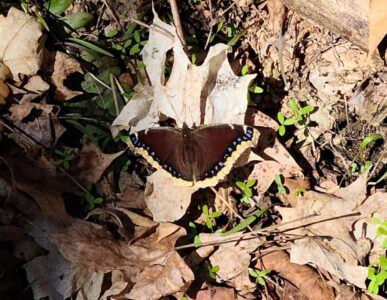
Submitted photo This mourning cloak butterfly seemed to pose for its photo taken during a morning woodland hike in March 2025.
For me, spotting a butterfly on a sunny morning jaunt through the woods is a sign that winter is not going to be here forever. And nothing is as lovely a sign as the mourning cloak butterfly.
This butterfly can make that early season appearance by spending the winter as an adult sheltering under bark, in rock crevices or among piles of brush. In fact, it is not unusual to see them while there is still snow on the ground. Sap leaking from holes in the trunks of trees made by yellow bellied sapsuckers offer an early food source.
Mourning cloaks can have a wingspan of up to 4 inches. The open wings are purplish black with yellow edges. A row of eye-catching blue spots follows the edge of the black as it meets the yellow. One theory suggests that the butterfly received its name because its coloration resembles the dark mourning cloaks once worn in Germany and Scandinavia.
These butterflies are members of a group called brush-footed butterflies. They appear to have only four functional legs because the first pair are hairy or brushlike.
Mourning cloaks mate in early spring and lay their pale yellow eggs around twigs on willow, elm, hackberry, poplar, aspen and hawthorn, which function as their host plants. When the spiny caterpillars hatch, they feed in groups and can defoliate one branch before moving on to the next. This continues for five to six weeks before reaching a mature size of 2 inches. Caterpillars are identified by the row of red spots running down the center of a black body covered with spines. These spines do not sting like the spines of some caterpillars can.
Mature caterpillars hang from branches to form the chrysalis. Adult butterflies emerge three weeks later in June or July. Adults can live for nearly a year and are thought to be the longest living species of butterfly in the U.S.
In addition to tree sap, butterflies also feed on fresh dung, rotting fruit and occasionally, nectar.
Mourning cloaks are not the only butterflies that overwinter as adults.
Two members of the anglewing group, the comma and the question mark (tempting to call them punctuation butterflies), also do, but with some unique chemistry that makes it possible.
They accumulate glycerol in their bodies synthesized from fat that serves as butterfly antifreeze. These two also sip tree sap from sap sucker holes as an early food source.
Soon there will be many butterflies to observe, but if you enjoy a winter walk, be aware that butterflies can be seen then, too.
Lifestyles
TO YOUR GOOD HEALTH: Diabetic ulcers can be healed
DEAR DR. ROACH: I have a diabetic nonhealing ulcer on my right heel. I was told that the blood circulation in my ...
Meet the mildews
Gardening can be a very rewarding hobby but at times very frustrating. Having lived in and gardened at the home ...
Valley Grows calendar
Here are upcoming gardening events through the Ohio State University Extension Office. For more information and a ...
Seeking mourning cloak butterflies
HINTS FROM HELOISE: Readers weigh in on early arrivals for doctor
DEAR HELOISE: Regarding Mr. Kupstas’ comment that was published in a recent column, I expect medical office staff ...
DEAR ANNIE: This Presidents Day, be the change you seek
DEAR READERS: Presidents Day isn’t the flashiest holiday. There are no fireworks, no heart-shaped chocolates, no ...