

Brighten your winter by forcing flowering branches
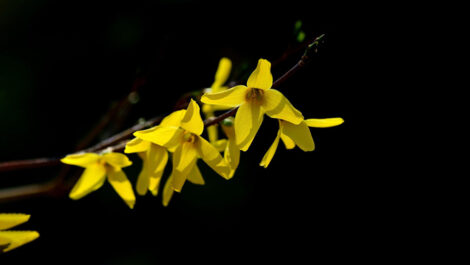
Submitted photo A tall vase of blooming branches like this one can chase away the winter “blahs.”
We can all be a bit tired of winter by this time of year. So, if you’re eager for spring, bring it into your house by “forcing” spring branches into bloom. A tall vase of blooming branches can chase away the winter “blahs.”
Forcing is a process by which the plant is fooled into thinking conditions are spring-like. Although most outdoor branches can be forced, the flowering ones are most impressive. Forsythia is thought to be one of the easiest to force, but flowering cherry, pear and quince are often successful and give off a lovely fragrance, as well as producing a variety of pale pink, red and white flowers. Don’t forget the pussy willows, as well as red twig dogwood, redbud, Chinese or lacebark elm, apricot, apple and most viburnums. All of these can be forced with few problems.
The trees and shrubs that bloom in spring form their flower buds the previous fall. So, after about eight weeks of winter weather, branches are able to bloom if given the proper conditions.
Choose branches with the plumpest buds, because the larger the bud, the quicker it will open. The narrow pointed buds are usually leaf buds. Cut branches in early afternoon when temperatures are above freezing. When pruning, use sharp pruners and cut branches ten to twelve inches long. Be selective to maintain the shape of the plant. Younger branches usually have a larger number of buds. Cut various branches for a variety of blooms and color indoors.
After cutting the branches, soak them for several hours or overnight in a bathtub of warm water. Branches must be completely submerged with their ends under water. This soaking process softens the flower buds, allowing for easier forcing. If unable to soak in a tub, place the stem ends immediately in water, possibly in a bucket, and mist frequently the first few days, or enclose in a plastic bag out of direct sunlight.
Following the soaking process, cut about an inch from the branches. Make one or two slits in the bottom of the stem before placing it in water to aid in the quick uptake of water. It will look like a cross or a star pattern when looking at the stem from the bottom.
Keep branches in water in a cool area (60-65 degrees). If possible, keep the branches near a humidifier, or mist them, because low humidity or direct sunlight will cause buds to drop off. Branches need bright, but indirect, light.
When buds begin to show color, the branches can be used in arrangements. Using a floral preservative added to the water may increase the “vase” life of your branches / arrangements. Preservatives not only provide nutrients, but also kill bacteria and fungus. Cloudy water indicates the presence of microorganisms; therefore, it is time to change it. These preservatives are available at garden stores or florists. Purdue University offers several formulas for making your own preservative. The first is: 2 cups lemon-lime soda, 2 cups water, and ½ teaspoon chlorine bleach. Another option is: 2 tablespoons fresh lemon juice, 1 tablespoon sugar, and ½ teaspoon chlorine bleach, mixed with 1 quart water.
Moving your arrangement to a cooler location at night will help it last longer, as with any fresh arrangement. If you turn your thermostat down at night, there is no need to move it.
Some branches may develop roots. These can be used for a new plant. Remove the branch and plant it in an individual pot, keeping the soil moist until permanent roots are formed. When warm weather arrives, the new plant can be planted outside. The chance of growth is not guaranteed, but can be fun to watch for success in your effort! For additional information, visit https://u.osu.edu/thenews/2021/02/28/bring-a-little-spring-color-indoors/
Lifestyles
HINTS FROM HELOISE: Always keep your phone close to bed
DEAR HELOISE: I have a suggestion for anyone living alone, especially older adults: Put your phone next to your bed ...
Your conifer isn’t dead; it’s deciduous
Valley Grows calendar
Here are upcoming gardening events through the Ohio State University Extension Office. For more information and a ...
Brighten your winter by forcing flowering branches
DEAR ANNIE: Do not tolerate demeaning jokes over height
DEAR ANNIE: I’m a 73-year-old married woman, and my husband and I have a full social life. We regularly host ...
Bridge by Steve Becker
France won the 1992 World Team Olympiad, handily defeating the United States in the 96-board final. Oddly enough, ...