Prehistoric landscape
Large plants create ‘dinosaur’ garden
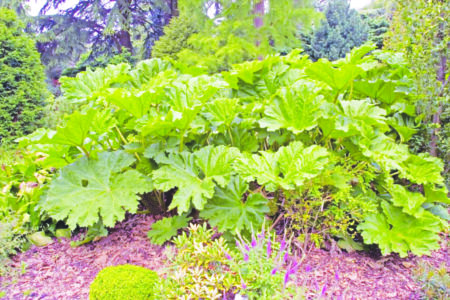
Giant Rhubarb Gunnera manicata -- also known as dinosaur food -- is an ornamental grass that grows 4 feet across and stands 8 feet tall. It's great for the gardener trying to cover larger areas with fewer plants. (Submitted photo)
My gardens are getting harder to maintain, so my new idea will address two things at once:
• First, if I plant large, leafed plants, I cover a bigger area with less material and maintenance;
• More importantly, the second reason is my grandsons love dinosaurs. By planting this prehistoric-looking garden with a few well-planned paths and hiding spots, they can explore and let their imaginations run wild.
There are several zone 5 plants available for this project. Researching them will allow you to plant them in the proper spot to thrive.
Umbrella plant Darmera peltala — also called Indian rhubarb — forms a vaselike clump of wide lilypad-like foliage that turns red in the fall. It grows 4 feet tall and 3 feet across, with flower clusters of pink or white florets.
Rodgersias aesculifolia forms clumps of green foliage with plumes of astilbe like white flowers mid-summer that are good for cutting or drying. It takes on bronze color come fall. It grows into clumps 3 to 5 feet tall and 3 to 4 feet wide.
Ligularias — also called leopard plant — have impressive foliage with yellow or orange flower heads. With some research, you’ll find a variety of leaf shapes from which to choose. It grows 3 to 8 feet tall and 2 to 4 feet wide.
Giant Silver Mullien Verbascum bombyciferum — a short-lived perennial or biennial — is an ornamental plant forming large mound silver woolly leaves 2 feet across the first year. The second year, 6-foot stalks of yellow flowers form.
Cup Plant Silphium perfoliatum has bold yellow, daisylike foliage and soars 10 feet in height and spreads 6 feet across. It is known for the cups that form where the toothed leaves meet the thick stems.
Sub and Substance hosta is 3 feet tall and 5 feet wide, with yellow green leaves. Empress Wu hosta features green leaves 5 feet tall and 8 feet wide.
Ornamental grasses are another excellent selection. One that is hardy in zone 6 (down to zone 3) that I might try is the Giant Rhubarb Gunnera manicata. Sometimes called dinosaur food, it grows 4 feet across and stands 8 feet tall.
One drawback is it needs moist boggy ground. Another would be having to dig up the root ball after season. I’m guessing it would be quite large.
I might give it a shot by cutting back and covering the crown to see if it would survive after taking a slice of the crown to overwinter inside.
Let’s not forget tropical plants that can be dug up or brought inside at the end of season.
Banana tree, elephant ears and canna are a few. To find anything about these plants, use the names listed above and “university extension” as part of your internet search. You’ll find detailed information on growing these plants.
While you’re doing further research on these plants, I’ll be out looking for dinosaurs to include in my prehistoric landscape.
Baytos in an Ohio State University Extension Master Gardener Volunteer in Mahoning County.
Lifestyles
Parkinson’s Awareness Month: Things to know
April is Parkinson’s Awareness Month. Some people may be asking what Parkinson's disease is, while others ...
Bridge by Steve Becker
Hints from Heloise: With scent, less is more
DEAR HELOISE: The French have a saying: “Scents are made to be discovered, not announced.” — David K., in ...

How some seniors benefit from looking after their grandchildren

Friday evening TV