Q and A: Growing beautiful pussy willows
Q: My mother used to have a beautiful pussy willow plant that I enjoyed every spring. Any idea on where I can get one? And how to plant and grow it? — Ester from Youngstown
A: Oh, it is easy to grow, but it can get quite large.
Most garden centers will offer the native plant.
Pussy willows are one of those plants that are just there. There’s nothing fussy, fragrant or showy about them.
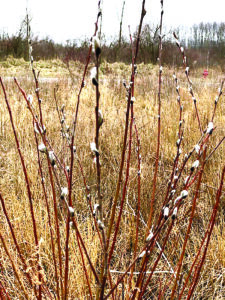
Pussy willow (Salix caprea) are native to Ohio and one of the first signs that spring is coming.
The pussy willow get its name because the fuzzy little tufts that appear at winter’s end look like cat’s paws and feel like fur. These are the flowers of the pussy willow. These “flowers” are called catkins. Catkins provide fuzzy softness to some birds, especially hummingbirds, and are often added to the nests.
Male pussy willows produce the large catkins. Female trees produce very small, almost undefinable catkins. If you want to attract pollinators, be sure to get a male tree.
Pussy willows prefer to have wet feet and often will be found near streams, ponds or moist woods. The pollen production of catkins is tremendous.
Pussy willows are easy to grow. You can take a twig and stick it into damp soil. It will quickly take root if it is kept moist. They grow very long tap roots and love to drink up the water.
If you have a rain garden or a wet spot in your yard that gets some sunshine, you have a perfect place to grow pussy willows. It is quite hardy here and is not fussy about compacted soil.
You can also cut a twig from your mom’s plant if you have access and just root it in water.
Pussy willows will grow 6 to 20 feet and are fast growers, sometimes getting a little out of control. After it blooms, you can prune it heavily for another great flower show next spring.
Pussy willows provide a valuable source of food for wildlife. Early March catkins provide some of the first season nectar and the plans become a magnet for pollinators. When the temperature hits 55 degrees, the first bees begin to appear.
When the catkins turn yellow, pollen is available. Pussy willows have strongly scented nectar. Sugary nectar provide carbohydrates; the pollen provides protein. Mason bees and miner bees are usually spotted first, as are some flies.
The pussy willow later serves as a larval host for the viceroy butterfly, which is often confused with the monarch because they look very similar. The difference is that the viceroy is smaller and has a crossing black vein on the hind wings. It serves as host of mourning cloak butterfly, which is large but not often seen with its dark brown and maroon wings with cream-collared ragged edges.
Songbirds are attracted to the pussy willow. I often see goldfinches and chickadees on the branches.
I like to cut a few branches in late winter, before the pollen appears. Do not put them in water unless you are trying to root. They will stay dry and nice for decoration for years. They also make a nice addition to potted containers for accent and high with other spring flowers.
To learn more about this plant, go to http://go.osu.edu/pussywillow.
McKinley is an Ohio State University Extension Master Gardener Volunteer in Mahoning County. Call 330-533-5538 to submit questions to the Plant and Pest Clinic. During the off season, questions can be submitted at any time. Find details at go.osu.edu/mahoningclinic.
Lifestyles
Daughter-in-law’s mental health taking a toll
DEAR ANNIE: I need some serious help. Our son, 36, has been married for three years. In May 2024, our ...
Woman’s spinal pain after surgery fails to improve
DEAR DR. ROACH: My wife is suffering from a failed back surgery that was caused by a neurosurgeon. The operation ...
Bridge by Steve Becker
It’s funny how some players get mad at their partners. An acquaintance of mine, Abernethy C. Growler, is a member ...
Organizing the junk drawer
DEAR HELOISE: Every house has a junk drawer, and everyone knows exactly which drawer it is. The reason that it ...

Church services, weddings, birthdays and Mother’s Day