
Trending
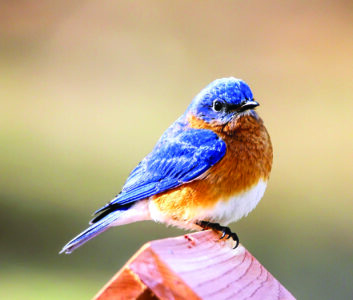
Eastern bluebirds (Sialia sialis), often referred to as "harbingers of spring," are small -- about 7 inches -- cavity nesters often found near meadows. A relative of the robin, this native songbird sports a blue back, rusty breast and white underside.
Because they only nest in cavities found in dead trees that are cut and cleared, nesting is made difficult. Nesting boxes are one solution to this problem.
Fourteen years ago when I became a volunteer naturalist, I was trained to monitor the boxes in Austintown Park. Cleaning the boxes in March is necessary to prepare for the coming nesting sites that begin as early as April, with the first of two and perhaps three clutches.
When nesting has begun, I visit the boxes more frequently -- weekly or biweekly -- to ensure successful nesting.
After the male selects a suitable site, the female will accept the site. The nest is constructed in a circular pattern with four to five blue eggs, laying one daily. After all eggs are laid, the female will incubate them to ensure chicks hatch simultaneously.
The eggs shells are eaten by the mother for calcium lost in egg production and to avoid any odors. Both parents feed the helpless chicks for 15 to 18 days until fledging. The chicks remain with their parents for at least seven more days learning to find their own food.
When monitoring, I wear gloves, a mask and bring a stool as the boxes are approximately 6 feet high.
Often the tree swallow (Iridoprocne bicolor), a 5-to-6-inch native bird with iridescent blue back and white abdomen, will build an easily identified nest with beautifully placed feathers surrounding the nest perimeter. A hat is necessary because they will dive-bomb my head but are harmless.
A flashlight helps with counting the chicks or eggs, and I enjoy taking pictures. After the chicks are about seven to 10 days old, I don't open the door to avoid premature fledging, but only observe the parents' activity.
Nest boxes are easy to build, erect and maintain. There are many sites online to help with construction, but certain dimensions are important.
Constructed from untreated lumber, the box should never be painted or stained on the inside and should provide easy access for maintenance. A roof over the 1 3/8-inch entrance hole is for protection from rain, with no perch.
Ideally, boxes should face east, but south and north are acceptable. Place them about 100 yards apart, with baffles to prevent predation.
I submit the statistics kept to Austintown Park Superintendent and Cornell Nest Watch. Every year there are population fluctuations, but the information is essential for correct numbers.
Monitoring has been both an educational and rewarding experience in making a difference for one of our native songbirds.
For identification details, go to http://go.osu.edu/bluebird.
For detailed plans for bluebird nesting boxes, go to http://go.osu.edu/bluebirdbox.
Katie Kane Shipka is an Ohio Certified Volunteer Naturalist for The Ohio State University Mahoning County Extension.