

Keep ground cover on its side of the bed
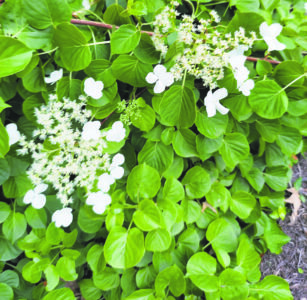
Climbing hydrangea provides groundcover that wonát take over the flowerbeds. This vine can also be left to ramble over a flowerbed to become a groundcover that looks like waves as the vine grows. (Submitted photo)
Q: Can I plant a ground cover that won’t take over the rest of my flower beds?
• Ginny from Salem
A: Yes, but ground covers can be tricky, as many of them are fast spreaders. This is great if you are trying to fill a space, but many times this means the plants are either overpowering the space or just plain invasive. Thus, you should be picky in choosing a ground cover that you can manage with ease.
Traditional ground covers include English ivy, ajuga (bugleweed, carpet bugle), pachysandra and Vinca minor (myrtle, common periwinkle). Many times, these plants are just like mint.
Once it is in the ground, you may be sorry about your choice and the location. Vinca is considered truly invasive in many areas.
One of the things I notice about ground covers is their ability to provide cover for rodents for the winter. Thus, ground covers are not a good idea right up next to your home. Mice, chipmunks and others can use these areas for their habitat.
Questions to ask when selecting a ground cover:
1. How fast does the plant spread?
2. Is it potentially invasive?
3. How many plants will I have to purchase?
Some suggestions for your garden:
• Hosta — There are many shorter varieties (and some truly miniature ones.) Consider curved lines of different varieties for color, or just a large bed of one variety. They can be divided nearly every year to spread them out. If you have more shade and moisture — try ferns.
• Sweet woodruff — Loves lots of shade, grows well in our zone, beautiful white flowers in spring, dainty green foliage, dies back in dryer areas.
• Liriope — This dark-green-leafed plant is often mistaken for a short grass. It is mostly evergreen (but only partially last winter). Some varieties will spread moderately, others a clump forming. The plant sends up a lovely purplish bloom in August / September as other plants are fading.
• Climbing hydrangea — This vine can also be left to ramble over a flowerbed to become a ground cover that looks like waves as the vine grows. Consider a variegated one for a more dynamic look.
• Vines — Think about other vines that may work as a ground cover. Consider how far out they grow and cover an areas.
To make a decision on ground cover, look to your neighbors and neighborhood. What looks good? What looks bad? Does mulching look like a better option?
And don’t forget to view public gardens. You’ll be able to see plants up close with the proper names. Take a photo to purchase the correct plant later.
A ground cover can be anything you want — even junipers make an impressive show. Try to decide what the purpose of the ground cover is before making a decision.
For a list of ground covers and more information, go to http://go.osu.edu/groundcovers.
Barrett is the Ohio State University Extension educator for agriculture and natural resources in Mahoning County. Call the extension office hotline, 330-533-5538, 9 a.m. to noon Mondays and Thursdays to submit your questions.
Lifestyles
Valley Grows calendar
Here are upcoming gardening events through the Ohio State University Extension Office. For more information and a ...
DEAR ANNIE: From retirement dreams to raising kids again
DEAR ANNIE: I never imagined I’d be packing school lunches again at 62. My husband, “Tom,” and I raised our ...
TO YOUR GOOD HEALTH: Recognize triggers of strokes, migraines
DEAR DR. ROACH: I read your recent column about migraines and strokes. About 40 years ago, I began having ...
Learn about the salamanders of Ohio

Plant, pest clinic returns on April 2
HINTS FROM HELOISE: Impact of your diet on scalp, dandruff
DEAR HELOISE: Forty years ago, when I was doing Weight Watchers, I had terrible dandruff until a new hairdresser ...