
County struggles to place pit bulls
Breed represents 95% of all dogs at shelter
Trending
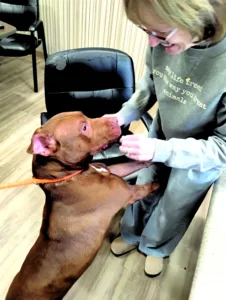
Clay needs a home and a face to lick, and he's pretty sure it's yours.
He's a 3- to 4-year-old pit bull mix who has been at the Mahoning County Dog Warden's shelter since last November, after he was found on Cassius Avenue in Youngstown.
And just like his legendary boxing namesake, he's likely to knock you down - forcefully, but much more kindly. Just say hi and he'll come charging like a fuzzy brown freight train, smiling as wide as his flappy jowls can manage, and ready to lick layers of skin off before you can say "oof!"
"He loves it here. He would love it more in a real home," said Mahoning County Dog Warden Lisa Hill. "He's a very good boy, just goes with the flow. And he's very handsome."
Fair warning - Clay cares for cats about as much as Muhammad Ali cared for Joe Frazier. It's probably his only flaw.
He's one of countless pit bulls housed at the county kennel, a problem Hill said is not improving. More than 95% of the dogs housed there are pit bulls, a population that has become increasingly difficult to place in adoptive homes. And just like the shelter, the county is inundated by overbreeding.
A Thursday Facebook post from the dog warden’s office lamented the problem:
“We don't need more pit mixes. Their owners are not keeping them. We love them. They deserve better. Humans are failing them.”
The situation is similar at Animal Charity of Ohio, where Executive Director Jenny Falvey said pit bulls account for 73% of their shelter population.
Hill said the composition of the county’s shelter population has changed dramatically since she began volunteering in animal welfare in 2009, when Ohio still classified pit bulls as inherently vicious under state law.
“We would see maybe two or three come in a week,” she said. “There was a variety of dogs, and pit bulls were in there, but it was more balanced. And once the ban lifted, it just started to change. Less variety, more and more pit bulls.”
Ohio removed its statewide breed-specific vicious-dog designation in 2012, but local governments retained authority to enact certain restrictions.
Hill said after that, she saw an increase in breeding motivated primarily by profit. Dogs frequently ended up in county custody after being sold to people unprepared for the responsibilities of pit bull ownership.
Falvey said irresponsible breeding is only part of the problem. Accidental litters, inadequate access to spay-and-neuter services and the sheer number of animals already awaiting adoption all contribute to the growing population.
“There just aren’t enough homes for all the animals sitting in shelters and rescues,” she said.
The breed’s physical characteristics and historical association with dogfighting absolutely present challenges, although both directors emphasized that pit bulls are not inherently aggressive toward people or other animals.
The pit bull’s ancestry can be traced to 19th-century Britain, where bulldog-types were bred for bull-baiting, a blood sport involving attacks on tethered bulls.
After Parliament outlawed bull-baiting in 1835, breeders crossed bulldogs with smaller, more agile terriers, for dogs that combined strength, speed and tenacity. The resulting bull-and-terrier dogs were used in rat-baiting and dogfighting, including contests staged in enclosed pits, from which the name originated.
British and Irish immigrants brought the dogs to America during the 19th century. They subsequently found roles as farm and working dogs, helping manage livestock, hunt and guard property.
The United Kennel Club formally recognized the American Pit Bull Terrier [Spuds Mackenzie] in 1898. The American Kennel Club recognized the related American Staffordshire Terrier [Petey from "The Little Rascals] in 1936. Today, the term pit bull umbrella includes several related breeds and mixed-breed dogs with similar physical characteristics.
Falvey said pit bulls and their mixes remain disproportionately represented among dogs used in fighting locally, although other breeds can also be exploited.
“In dog fighting, they look for speed and strength, so dogs are conditioned and bred for certain physical traits that allow them to endure such brutality,” she said.
Jess MacMurchy, a deputy dog warden assigned to investigations, said the breed’s relatively wide mouth is another physical characteristic that contributes to its continued use in dogfighting.
Falvey emphasized that the animals subjected to those conditions are victims of abuse.
“They are, in essence, prisoners in a world of brutality,” Falvey said.
Dogs rescued from fighting environments may exhibit trauma-related behaviors that complicate their adoption, she said, but many can successfully transition into homes with appropriate care and support.
Falvey stressed that not every pit bull comes from a fighting environment, and many live successfully in households with other dogs. Hill said the overwhelming majority of pit bulls entering the county facility are friendly animals that simply need attention, training and a stable home.
“Ninety-nine percent of the pit bulls we get in here are just big babies. Friendly, just want a home,” she said. “They need some training because usually they’re not the best cared for, so they don’t have a lot of experience. But once they get that under their belt, they’re great dogs.”
The consequences of inadequate care were evident in a family of six dogs abandoned over the weekend, Hill said. Her office took in two adult dogs and four puppies about 7 or 8 months old.
The puppies had experienced little meaningful interaction with people during a critical period of their development.
“The puppies aren’t used to people,” Hill said. “They have missed a huge portion of their socialization.”
They have begun accepting affection from shelter workers but remain frightened by unfamiliar human contact.
“They like us petting them, but at the same time they’re still really scared because they haven’t known that.”
Hill hopes to place the puppies with foster-based rescue organizations that can provide individual attention and help them develop confidence around people.
Their progress will depend on their individual temperaments and the environments where they are placed, but Hill hopes they can make substantial improvements within a couple of months.
The challenge extends beyond dogs that have experienced neglect or abuse.
Falvey said the high concentration of pit bulls in shelters means prospective adopters have fewer opportunities to choose among different breeds, while the dogs themselves face considerable competition for available homes.
“Quite a few shelters are sitting on a higher number of this breed, so there are fewer options,” she said. “And they can be very powerful dogs, and not everyone wants a really powerful dog.”
Addressing the population imbalance will require greater attention to breeding practices and access to affordable veterinary services, Falvey said.
Hill said the county and state need to focus more on enforcing the laws on the books and emphasizing spaying and neutering.
She also said her office will be kicking off a pet-ownership education program in the spring to help humans better understand the responsibilities of keeping their furry companions.
"But on the flip side, we also do need some stronger laws for breeding," she said. "A lot of it’s education and people need to be held accountable for just letting their dogs breed and breed and breed and not follow the laws we have. You’re supposed to have a vendor license. Then you get a kennel license. So we can kind of make sure everything’s going OK. But people aren’t doing that."
Falvey also said she supports stronger oversight of breeding operations, including licensing requirements that could help distinguish responsible breeders from those producing dogs primarily for profit or illegal fighting.
“If you want to be a responsible breeder you should have to put forth the requirements to do so; breeding just for money or bloodsport should not be tolerated,” she said.
She urged local governments to invest in spay-and-neuter resources, particularly for residents who cannot afford veterinary procedures or lack reliable transportation. Although discounted services are available, Falvey said even relatively modest expenses can prevent people from having their animals sterilized.
Without accessible services, accidental litters can contribute to an already overcrowded shelter and rescue system.
One thing neither director wants is another ban.
Although breed-specific bans have been proposed and enacted in various communities, Falvey does not believe they address the underlying causes of overpopulation.
“When you look at bans, you can ban a breed but the next version then pops up, so we have to look at the real core issues,” she said.
For all the problems with pit bull breeding and the bad press they get, Falvey and Hill both stressed that the dogs in their shelters do deserve homes, and families should be much less reluctant to give them a chance.
“They’re lovely, affectionate dogs, incredibly intelligent dogs, they can be wonderful family dogs,” Falvey said.
Some are content to be couch potatoes, she said, while others enjoy lots of activity. Clay seems a prime example of the latter variety.
Hill said patience, consistency and a sense of security are essential for dogs learning to trust people, particularly those that have experienced neglect.
Both Falvey and Hill noted one particular characteristic: for all humans can put them through, pit bull breeds tend to be among the most forgiving of animals.
“They’re like kids, you know, take the time, teach them correctly, and the rewards you’ll get on the back end are tenfold,” Hill said. “They’re very, very loyal.”
Falvey said the responsibility ultimately rests with the people who breed, raise and care for the animals, rather than the dogs themselves.
“They didn’t choose that life and that conditioning from those situations, humans created that,” she said. “And, truly, as powerful as they are in strength, they are equally powerful in being a loving companion."
If you would like to adopt Clay or any other dog at the warden's shelter, visit https://www.mahoningcountyoh.gov/FormCenter/Contact-Forms-5/Dog-Warden-Adoption-Application-66. To adopt from Animal Charity of Ohio, go to: https://www.animalcharityofohio.org/adopt.
If it's Clay you're after, bring pretzel sticks. He brakes for pretzel sticks.