
Canfield crews master mastodon search
Dig begins in hopes of finding more remains of prehistoric mammal
Trending
CANFIELD — The search for remains of a prehistoric mastodon has shifted into high gear in the city.
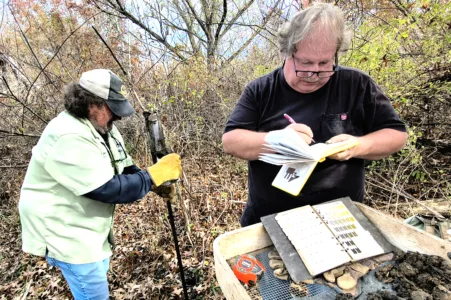
A group of archaeologists and historical society members spent time last week taking soil samples at Fair Park. They were taking the first steps in the search for the rest of the Canfield mastodon that was accidentally discovered almost 90 years ago.
The jawbone of a prehistoric mastodon — a huge, hairy relative of modern elephants — was discovered in 1931 when the owner of a greenhouse near the area had dug a trench to bring water to his lot to provide water for his crops. The greenhouse was known for its tomatoes. The skull was left in the area, with no one seemingly knowing what it was.
According to information from the Canfield Historical Society, the trench digging had yielded the jawbone of a mastodon. A few years later, around 1934, Leo Dunning of the Dunning-Crum Coal Co. was excavating in the area for a reservoir and found the bone.
It was said he was fascinated with it and took it back to his office as a conversation piece. Eventually the fossil was donated to Mill Creek Park for display at Lanterman's Mill nature center, but then it disappeared.
Earlier this year Canfield Historical Society members mentioned the jawbone to members of the Mahoning Valley Historical Society, which had the mastodon fossil in its inventory. Arrangements were made and the jawbone was brought the Bond House, operated by the Canfield Historical Society, and was put on display along with on-loan mastodon fossils from the Carnegie Natural History Museum in Pittsburgh and the Ohio History Connection in Columbus.
In April, CHS member Jerry Dixey conducted a walk of Fair Park and the area where the fossil was said to have been found. For Dixey, it brought back childhood memories.
"I and my brother Jack used to play around Smith's Pond," he said. "I told people attending the walk to not wear their best tennis shoes as it would be muddy."
From that initial walk and several meetings between the Canfield Historical Society and the MVAS, a request was sent to the city of Canfield, asking permission to use a nonevasive hand auger to take soil samples.
"I said I was all on board," said City Manager David D'Apolito during a recent city meeting.
With the permission granted, a team was formed with Jerry Dixey, Jack Dixey and Suzie McCabe from the CHS, along with MVAS members Roger Jones and Lora Brady, and Brian Fritz, a professional archeologist with Quemahoning LLC.
They made the trek to the west end of Fair Park to use a hand auger designed to take soil samples without being invasive to the surrounding landscape.
Last week the team took the soil samples near where the original jawbone fossil reportedly was found.
"Using extensions, we reached a depth of 315 centimeters equivalent to 10 feet, 4 inches," said Brady. "We checked every 10 centimeters. The hand auger is only 3-1/4 inch in diameter. The column revealed the stratigraphic profile of the soils and sediments from this isolated area."
In his report, archeologist Fritz talked about the area the group worked in.
"The precise route of the water line and the location where the remains were encountered were not documented sufficiently to relocate the discovery with confidence," said Fritz in his report on the soil samples. "The mastodon locality must therefore be regarded as an approximate location somewhere within or near the low-lying portion of the park."
In his report, Fritz said the one hand-auger boring was advanced to a depth of 315 centimeters below the ground surface, and the recovered materials were examined for soil horizons, sedimentary characteristics, evidence of former land surfaces and conditions relevant to the preservation of faunal remains.
"The study was not intended to confirm the presence of additional mastodon remains or to establish the precise location or age of the original discovery," he wrote. "Its purpose was to document the local soil stratigraphy, identify the depositional environments represented beneath the park, and evaluate whether sediments capable of preserving Late Pleistocene faunal remains are present."
The original sample taken did not yield any mastodon, but it did warrant further investigation. One idea was to use ground penetrating radar, but that was ruled out last week.
"We had the ground radar equipment there before we did the soil samples," said Jerry Dixey. "The gentleman that had the equipment looked at the site. He said because of the terrain and also the overhead power lines, the radar would not be an option."
The next step will be in the spring when the team returns for further hand auger drilling. One of the 3-1/4" test holes should reveal fossil remains and perhaps the rest of the mastodon.
"To find the exact location of the remains from this mastodon skull would be difficult," Brady said. "However, the hand auger method and purpose are to tell us if the soil and sediments support the preservation of late Pleistocene faunal remains."
She said mastodons are not uncommon in Ohio.
"Approximately 150 to 200 of these Proboscidean remains have been found throughout the state," she said. "Many in Columbiana County and nearby Salem, Ohio. A fine example of a near complete Mastodon was found in the 1920s in Johnsontown, Ohio, which is on display at the Cleveland Museum of Natural History."