

Phoenix House revisited
Recovery after explosion plods along slowly
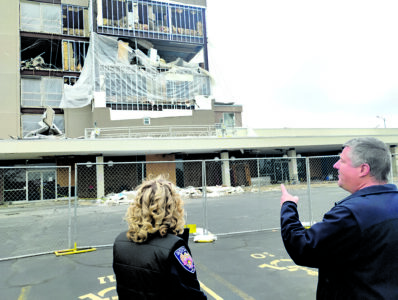
Staff photo / Dan Pompili Austintown Fire Chief Dave Schertzer, right, talks with Austintown Police Chief Valorie Delmont about the condition of the Phoenix House senior living center. A natural gas explosion on Nov. 22 killed one man, left the building uninhabitable for now and displaced its more than 130 residents. itrs =its more than 130 residents.
AUSTINTOWN — Four months have passed since the fatal explosion at the Phoenix House senior living center, and while all surviving residents are still safely housed, no timeline for a return to the building is in place.
A gas leak was deemed the cause of the Nov. 22 blast at 850 N. Meridian Road that killed Steven D. Smith, 63, and left the facility’s more than 130 residents in immediate need of new homes. Many continue to receive support from local charity organizations.
Meanwhile, Austintown officials, although no longer responsible for the overall care and management of the building, are still monitoring the situation to ensure that ownership, Austintown Studio Apartments, is taking the necessary steps to make the property secure and perhaps move toward rehabilitating Phoenix House.
So far, they say, the pace is somewhat concerning, as is the process.
“Fire inspection, (fire) Chief (Dave Schertzer), myself, have been in contact with the Mahoning County Prosecutor’s Office, who have been in touch with management at Phoenix House. It sounds like the insurance companies may still have a hold,” said Austintown Township Administrator Mark D’APolito at this week’s monthly staff meeting.
D’Apolito said the damage to the building, while extensive, does not meet the threshold — 60% of the insured value of the entire building — for the township to receive an escrow payment to cover associated costs of the building’s upkeep.
The scale typically applied to that payment, under Ohio Revised Code, is $2,000 for every $15,000 worth of damage, as long as the threshold is met.
Zoning Inspector Dominic Moltchan said that in cases where a house or building is damaged by an explosion, fire or other insured catastrophe, the insurance company pays a sum to the township to hold for the insured party, to cover costs such as repairs, rebuilding and demolition.
If the homeowner or building owner does not make the necessary improvements to the property, the township can then use that money to cover its own costs to ensure the property is maintained. That process involves a nuisance resolution proposed by the zoning office and passed by trustees.
But officials said it does not appear the township is likely to receive that money.
“Which means if a nuisance finding becomes necessary, it will be out of our pocket, then assessed, and then perhaps recovered, rather than being able to take it out of insurance proceedings directly,” D’Apolito said. “It’s also my understanding that the insurance company is continuing to investigate the cause and that is inhibiting the restoration work the building management is able to do. Obviously, I think it’s our preference that they move forward expeditiously on getting that sealed up.”
Much of the northern face of the building and the east side on the north end, between the third and fifth floors, is largely exposed, with debris clearly visible, such as a refrigerator poised precariously at the edge of a fourth-floor apartment.
Moltchan said much debris has blown out of the apartments and landed around the township and, of greater concern, it blows onto the nearby freeway.
“One of my biggest concerns is… the holes that were created, there’s no safety walls up yet, it’s going to be time soon when, especially with summer coming up, it’s going to be a nuisance. So hopefully they address it,” he said. “We will cite if we have to.”
Schertzer said the township will have representation at an April meeting among property ownership and management and the multiple insurance companies with interests in the building, which includes the renters’ insurance companies.
THE JOB AHEAD
The building has been unoccupied since an order issued Dec. 4 by the Mahoning County Building Department. The elevators are out of service, and nobody but construction crews, inspectors, and building management and security are allowed inside.
The township is not in charge of the building. Though Austintown police briefly provided security in the aftermath of the explosion, that job has since been turned over to Austintown Studio Apartments LLC.
Documents provided by the township show that in December, both Lyda Engineering Services of Youngstown and The Howland Co. of Boardman conducted a walkthrough of the building to assess the work that will have to be done.
The insurance companies may be holding things up, but from the township’s point of view, Howland Co. personnel can still be seen on the site, removing large, secure containers full of debris from the building.
The Lyda Engineering inspection summary recommended:
* Removing all debris from any affected units upon completion of the explosion investigation.
* Securing and removing any damaged sections of the building’s facade.
* Removing all floor coverings in the damaged areas to allow for closer inspection of the concrete floor.
* Removing fireproofing materials from the structural steel and bringing in a construction inspector to verify bolted connections are at required torque values.
* If any deterioration or damage is detected during the course of any work being performed, contacting the engineer immediately for further evaluation.
Township Fire Inspector Tom Neff said a demolition permit has been issued to allow Phoenix House’s contractors to begin removing all damaged construction materials so renovations and repairs can then proceed.
“They have submitted plans for the deconstruction of the building, to start into the repair phase, and start removing all the studs and the drywall and everything on the inside, and then they’re applying for a construction permit,” he said.
Moltchan said once they complete the demolition phase, they must first submit construction plans to zoning, then to Mahoning County Building Department, and then to Austintown fire for safety and code inspection.
“We will review the plans and make sure they have all the emergency lighting, all the fire-related stuff, sprinklers systems, alarms, and we’ll send them a letter telling them what they need to correct in regards to the plans,” Neff said.
Moltchan and Neff both said the building will have to be brought up to current fire and safety codes, not the same ones that were in place when the building was constructed in 1970 or at any point when upgrades may have been made along the way.
For now, the building remains uninhabitable.
A PLACE TO STAY
D’Apolito said the United Way of Youngstown and Mahoning County led the charge, along with countless other agencies and charitable organizations, to ensure residents of Phoenix House never missed a night of sleep in a safe, secure bed.
The explosion occurred about 12:30 p.m. Nov. 22 and by 11 p.m., all had been placed safely in a bed, officials said. Donations to Austintown Senior Center were distributed by the United Way.
Other groups, including American Red Cross, Catholic Charities, Direction Home and Farmers National Bank, have been credited with helping Phoenix House residents.
Roxann Sebest, UW spokesperson, said four months later, the nonprofit organization maintains its commitment to Phoenix House residents.
“Some have been able to find new housing through YMHA (Youngstown Metropolitan Housing Authority) or TMHA (Trumbull Metropolitan Housing Authority) or other apartments in town, and some are staying with family and friends, but everyone has housing,” Sebest said. “Nobody’s been kicked out or is homeless.”
About 55 residents, she said, are still staying at the Baymont by Wyndham hotel on South Avenue in Boardman, for which U.S. Rep. Michael Rulli, R-Salem, obtained housing vouchers through the Department of Housing and Urban Development. The motel reached an agreement with Phoenix House that allows those displaced residents to use HUD vouchers to pay rent at the motel.
Sebest said the United Way meets every couple of weeks with other charities and local agencies that were involved on Nov. 22, such as the Red Cross, MyCAP, Catholic Charities, Mental Health and Recovery Board, Meridian Healthcare and the other agencies.
She said the organization continues to partner with them to try to meet Phoenix residents’ needs.
“For a while, through January, we provided meals on a regular basis and as they signed leases, we began delivering food weekly to Baymont, working with Goodwill and St. Vincent dePaul Society to provide them with anything they need,” she said. “Local organizations have provided money, so we continue to provide them with the day-to-day things they need, down payments if they are moving somewhere new.”
She said residents have had no access to their apartments or belongings since December.
“They were able to get in once to get items, but they are basically working to rebuild their lives, so we help with basic needs,” she said.
Sebest said Austintown officials and Mahoning County commissioners have helped,l and the agency is working to stay in touch with Phoenix owners to see if or when residents can get in to retrieve personal items, or provide a clearer timeline as to when anyone might be able to move back to their apartments.
Cassandra Valentini, chief of community development and public relations for Direction Home of Eastern Ohio, said the Area Agency on Aging remains in contact with Phoenix House residents, many of whom were already clients.
“And we have some who we determined needed assistance through all this, and we’ve been able to connect them to our office and that’s been a blessing,” she said. “They want to go back to their homes, and when they do get there, they will still have assistance from us.”
She said a crisis coordinator goes to the Baymont twice weekly to make sure everyone is connected with the agency who needs to be and to attend to any concerns.
“Just the little odds and ends. These folks had the clothes on their backs and the one bag they were able to get from the building. Whether it’s curtains, a can opener. If they didn’t have it, we worked to get it for them,” Valentini said.
She said partnerships with Goodwill and St. Vincent de Paul have been instrumental in ensuring the residents have the furniture they need.
“Something to sleep on, something to put their clothes in. These people live on a fixed income; they don’t have a savings account they can tap into,” she said.
Local restaurants also helped to ensure the residents had food, and Valentini said they still help when they can.
“We leaned heavily on the restaurants in Austintown, and they stepped up with no questions asked about how many meals we need and where they need to be delivered,” she said.
Valentini said many residents also benefit from meals delivered by Jewish Family Services, paid for by Austintown Studio Apartments.
She said the issue highlights the problem many residents in the Mahoning Valley face.
“I think it’s very important for people to understand this is an ongoing issue and we have to continue to think about these folks and how we can help support them, and it also brings to light the housing issue we have locally — there just aren’t enough options.”