

YSU not immune from mid-major scheduling difficulties
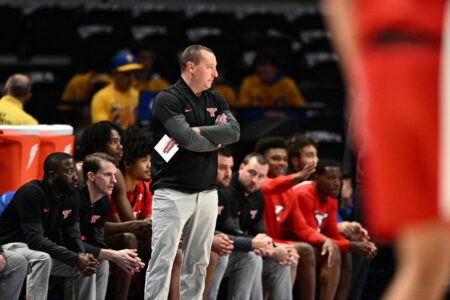
Correspondent file photo / Robert Hayes Youngstown State men’s basketball coach Ethan Faulkner looks on during the Penguins’ season-opening road trip at Pitt on Nov. 3 at the Petersen Events Center in Pittsburgh.
YOUNGSTOWN — Success has been a double-edged sword for the Youngstown State men’s basketball team in recent years.
The Penguins are a program on the rise, having won at least 20 games in each of the last three seasons. But like for most mid-major teams, that sustained success has continued to make non-conference scheduling more difficult year-in and year-out.
“The more success you have, the more challenging scheduling gets,” YSU head coach Ethan Faulkner said earlier this season. “All these different teams, what they’re trying to do when they’re scheduling games is build an NCAA tournament resume. The high-major teams, it’s about scheduling Quad 1 and Quad 2 games, or scheduling Quad 4 games against teams they feel they can beat by 15, 20, 30 points — it’s going to help their metrics as they move forward into NCAA tournament play.
“You play a Youngstown State and you win a game by 5-10 points or you don’t win the game, that is really detrimental for them in terms of their NCAA tournament resume. So as we continue to have success, it’s going to continue to get more and more challenging to get the games we want.”
Faulkner is far from the only coach to express his concerns with scheduling at the mid-major level. Illinois State’s Ryan Pedon and George Washington’s Chris Caputo have each echoed similar sentiments in recent weeks.
“It’s just so challenging in this landscape,” Caputo said. “The fix is in. The NET, it is what it is. We all know what it is, and you just can’t manipulate it.”
The scheduling difficulties have forced the Penguins to become “road warriors” for almost the entire first month of the season the past few years.
In 2022-23, the year YSU won its first Horizon League regular season title, the Penguins played two home games against Division I opposition (UT Martin and UC-San Diego) during the month of November and two in December (Ohio and Southern).
In 2023-24, YSU had just two home games against Division I foes during the entirety of non-conference play (Utah Tech and Navy).
Last year, the Penguins played each of their first six games away from home and only had two non-conference home games against Division I teams (Western Michigan and Toledo).
This season, YSU played five of its first six games on the road and has just two home games against Division I teams in non-conference play (Chicago State and USC-Upstate).
“What’s frustrating for us is we have a real fan base. We have people that really care about it here, that want to be here and see us play,” Faulkner said. “That’s what frustrates me — we don’t get a chance to really engage our fan base until late December into conference play. It is what it is. We understand that, and we’re going to continue to try our best to get those home games. But it’s proven over and over again to be very challenging for us.”
Any other non-conference home game during those years was against non-Division I opponents, teams like Westminster (Pa.) and Bethany (W.Va.), or like this year’s opponents Thiel, Penn State Shenango and Bryant & Stratton College.
Faulkner said he never wants to play any more than two games against non-Division I foes in any given season.
“That gives us opportunities to get a home game or another Division I opponent,” Faulkner said. “Or it might give us an opportunity to get another Quad 1 or Quad 2 game for us in the event that we win the Horizon League, and in the NCAA tournament that gives us a better opportunity to move up seed lines.”
But difficulties filling the schedule led to YSU having three of those games on the slate this season.
“We couldn’t get the schedule filled out in a manner that we had 31 games,” Faulkner said. “We knew where we were going and knew who we were playing. But we really took the third non-D-I game because we couldn’t get another Division I game.”
Even with all the difficulties, there is some change coming down the line.
In June, the NCAA approved a proposal from the Division I Men’s and Women’s Basketball Oversight Committees that increased the regular season to a maximum of 32 games, effective beginning with the 2026-27 season.
That would give schools the possibility of an extra home game per season, while also increasing the flexibility for playing in multi-team events (MTEs) without it impacting the overall schedule.
Currently, Division I has a 28+3 or 29+2 model, which means if you play an MTE with three games, you get 28 other scheduling opportunities, and if you play an MTE with two games, like YSU did this year with the Jacksonville Classic, then you get 29 other game opportunities. If you don’t play an MTE, you only have 29 opportunities to play games.
“You can schedule those (32) games however you want,” Faulkner said. “You can play as many MTEs as you want. They’re going to give us total freedom over that 32-game schedule. I think there’s definitely some pros and cons to that … but I do think it’s going to give us a little bit more flexibility with our schedule, particularly with being able to play multiple MTEs.”
Faulkner advocated for a regional MTE involving schools like Kent State, Akron or Duquesne. That would allow fans from each school to make the short trip to see familiar foes, which would increase attendance and also the revenue that each school could generate from the event.
“We’ve got some ideas in the works,” Faulkner said. “Maybe working with some other area teams. … Let’s all go to one place, let’s bring two or three teams there and then you get two games in one weekend.”
Local Sports

Penguins hold off Tampa Bay
YSU not immune from mid-major scheduling difficulties
Marchenko’s shootout winner to lift Blue Jackets past Red Wings
COLUMBUS — Adam Fantilli tied it with 1:31 left in the regulation with his second goal of the game, Kirill ...

Pirates get Garcia, Traveiso in 5-player deal with Boston
Ohio State, Indiana defenses get spotlight in Big Ten Championship
Capsules
Fielding wins HL Athlete of Year The postseason honors continue to pour in for junior McKinley Fielding, as she ...