Local coaches share thoughts on shot clock
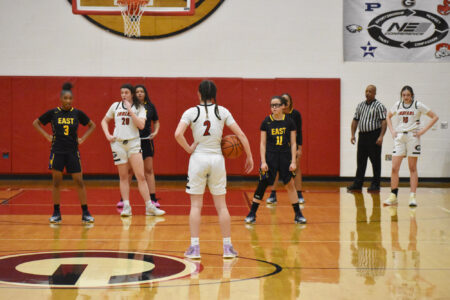
Staff photo / Preston Byers. Girard’s Mia Malito holds the ball for the final shot of the first half during the Indians’ playoff game against Youngstown East on Feb. 21.
The high school boys and girls basketball tournaments will dominate Ohio over the next few weeks, with many area teams hoping to advance to the district, regional and state tournaments.
But unlike the March Madness of college basketball or the NBA playoffs, Ohio high school basketball is different in that it does not feature a shot clock.
According to the National Federation of State High School Associations (NFHS), which writes rules for high school athletics and “provides guidance” to state athletic governing bodies like the Ohio High School Athletic Association (OHSAA), 27 state associations have adopted some form of a shot clock in high school basketball.
The OHSAA is not one of those 27 state associations.
“Ohio’s backwards in a lot of things we do, and that’s one of them. We should have had a shot clock 20 years ago,” Howland boys head coach Dan Bubon said. “As far as I know, there’s a shot clock in every level of basketball other than American high school basketball. I don’t know what we’re waiting for.”
After the OHSAA board of directors approved an overhaul of its athletic divisions Feb. 15, NBA superstar LeBron James took the opportunity to publicly campaign for a shot clock in Ohio high school basketball.
“Cool cool cool but when will the Board of Directors approved [sic] a shot clock for Boys & Girls basketball??? We have to grow our kids motors, minds and style of play,” James posted on X, formerly known as Twitter, on Feb. 16.
James, a native of Akron and a former St. Vincent-St. Mary and Cleveland Cavaliers star, as well as a current member of the Los Angeles Lakers, lives in California, a state that has mandated a shot clock in both boys and girls high school basketball for decades.
Proponents of the shot clock say it will eradicate ‘stalling’ by teams that choose to hold the ball for several minutes at a time, particularly late in games. Opponents argue putting a limit on a team’s offensive possession will diminish the quality of play.
Ursuline boys coach Keith Gunther, who has led the Irish program for more than 20 years, said he sympathizes with both sides, although he has his preference.
“Honestly, I’m fully in favor of it just because of the style that we’ve always played. I would love to have it,” Gunther said. “But I can also understand a lot of people who don’t want it. A lot of people play a [slow] style that’s difficult for a lot of teams that play fast-paced to guard because if you’re getting in a situation where you’re playing a team that can run sets for a minute and a half, it turns into a possession game and slows the game down.”
Gunther said a shot clock could potentially upend consistently successful programs that employ a slow, methodical offense to offset a talent disadvantage. He also explained that implementing a shot clock would force coaches and teams to become more creative.
“I think some of us will just have to work a little bit harder. … I think it’s gonna make you coach a little better in my personal opinion, because even though teams like to get it up and down, most teams don’t want to get up and down and shoot it in five to 10 seconds,” Gunther said. “So you got to be smart in what you’re doing, smart in running some sets and you got to be a little more creative in what you’re doing.”
Bubon’s Howland Tigers and Pat Birch’s Boardman Spartans played an All-American Conference game in January in which Bubon, with his team clinging to a two-point lead on the road with three minutes left, instructed his players to hold the ball unless they saw an opening for a “100%” layup. The strategy forced Boardman to foul Howland the rest of the way as the Tigers pulled away and won 52-42.
After the game, Bubon admitted he doesn’t enjoy resorting to those kinds of tactics.
“I’ll be honest, there are times when we pull the ball out at the end and we have a lead and we hold until they foul us, and I really don’t like that,” Bubon said. “You do it because you want to win, but I don’t like it. It’s not really basketball. Basketball is trying to score.”
Birch agreed that Bubon’s strategy, while effective, isn’t great for the sport.
“I don’t feel like you should have to start fouling with three minutes ago in a game,” Birch said. “And to me, it is what it is because that’s a good strategy, but I don’t like that part of the game.”
If approved, the length of the shot clock would likely be a heated debate among fans and coaches. The NFHS approved a 35-second clock, although some states and levels of play have experimented with times suiting their preferred playstyle.
While pro basketball utilizes a 24-second shot clock, men’s college basketball has changed the length of its shot clock several times since its full introduction in 1985. Initially set at 45 seconds, the NCAA reduced it to 35 seconds less than a decade later and has now settled at 30 seconds since 2015. Women’s college basketball has used a 30-second shot clock for more than 50 years.
Both Canfield girls head coach Matt Reel and Warren G. Harding boys coach Keelyn Franklin believe a 35-second clock would not affect most teams’ play that much, but they would both be in favor of it, if only for late-game situations.
If Ohio adopted a shot clock, Reel said he would prefer it be initially set at 35 seconds while acknowledging that he also has concerns about how officials and clock operators would handle the change.
“I think a shot clock favors the better team because there will be more possessions. If it was only 24 seconds, it would be tough for a lot of teams to generate shots,” Reel said. “I think it would make the end of games better because there would be less delay and less fouling. And anything that prevents a team from holding the ball for six minutes would be welcome.”
Regardless of how long the shot clock is or when it is adopted, several area coaches agree that it is likely an inevitability.
“It’s gonna happen eventually. The questionnaire we get every year from the state asks about it. You know it’s coming eventually, but they worry about just getting it installed in every gym and learning the little idiosyncrasies of doing it, but it’s coming,” Bubon said. “I don’t know if it’ll be here by the time I’m still coaching, but I hope it is. I’ve always wanted it. I think it makes the game better.”
Have an interesting story? Contact Preston Byers by email at pbyers@tribtoday.com. Follow him on X, formerly Twitter, @PresByers.
Local Sports
Plastic worms have changed, they but are still a go-to lure
Plastic worms have evolved over the years from the basic nightcrawler-shaped wigglers crafted by inventor Nick ...
High School Sports Roundup from May 1
FROM THURSDAY BOYS LACROSSE Boardman 12, Cardinal Mooney 2 — Boardman honored its seniors by outscoring ...
Capsules
Curbstone idle on Monday The Curbstone Coaches will not be having their weekly luncheon on Monday. The 57th ...

Malkin wants to run it back with Pens
Bubon returns to Harding as head coach
Sometimes the timing just works out. Dan Bubon felt as if his time was winding down at Howland. Holding the head ...