Barefooted villain: Salem’s Karlis reflects on career, AFC title kick vs. Cleveland
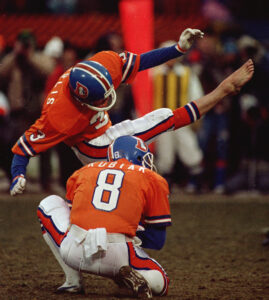
AP file photo Then-Broncos placekicker Rich Karlis (3) follows through on his overtime field goal that gave them a 23-20 victory over the Browns for the AFC Championship in Cleveland on Jan. 11, 1987. Holding the ball is Gary Kubiak (8).
The year is 1976.
Salem rising senior Rich Karlis was convinced by his friends to rejoin the football team after a brief stint playing his freshman year. He had always enjoyed the sport, growing up a devout Green Bay Packers fan, but had never kicked a football.
That season he served as the primary kicker and punter for the Quakers. It came to him quickly, but he didn’t get much of a chance that year to show his stuff.
A little over a decade later, Karlis, now in the NFL, ripped out the hearts of northeast Ohio football fans everywhere.
The barefooted Quaker-turned-Bronco cemented his status as a villain in the stories of Cleveland football folklore by kicking the game-winning field goal in overtime to send Denver to Super Bowl XXI. Even now, saying the name “Rich Karlis” will get you a dirty look from some people.
It wasn’t an easy road to the history books though. Far from it. Karlis, a walk-on at the University of Cincinnati, kicked just 16 field goals at the college level, 13 extra-point attempts (all within his senior year) and saw no action until he was a junior. His junior year he was utilized almost entirely for kickoffs, except for one field goal attempt.
Following his senior year, he expected an extra year of eligibility to refine himself for the NFL Draft, but that year never came. So the 1981 NFL Draft came and went without Karlis’ name being called and he was left with a feeling of “now what?”
He kept kicking, that’s what.
After a brief stint in Houston on the Oilers’ offseason roster, Karlis returned back to Cincinnati to finish his degree.
In the meantime, to stay fresh, Karlis would sneak onto the Bengals’ practice fields off the I-71 overpass and kick field goals for as long as he could. He was kicked out, but that didn’t deter him. In fact, it became a nightly endurance round of how long he could kick before he got caught.
“I would sneak into the Bengals practice facility down under the viaduct, in the bowels of Cincinnati and kick on those NFL posts until they kicked me out,” Karlis said. “Then I’d come back the next day and do it again.”
These nighttime practices were paired with letters to each of the 28 NFL teams at the time. Out of the ones that responded, only one came with an invitation, that being the Denver Broncos, who had an open free agent camp.
Out of the nearly 500 attendees, 75 of those were kickers.
“(The kickers and punters) sat around for about four hours while they tried out the other positions,” Karlis said. “Then they brought us in and said to get into groups of five and had us kick from 20, 30, 40 and 50 yards. I probably kicked as good as I had ever kicked that day. All of a sudden, they said ‘192, what’s your name and where are you from?’ At the end of the tryout, they agreed to sign me and gave me a $500 signing bonus.
“I came to camp and kicked against four other guys, including the incumbent. My first kick was in a preseason game against the Rams. It was a 40-yarder and I put it right over the outside of the left upright. I thought for sure I was packing my bags, but they kept me around for a couple weeks. I made a field goal and then another, and based on going 2-out-of-3 they kept me.”
Things didn’t get easier once he made the team either. Karlis’ rookie year was cut short by the 1982 players’ strike. Just as he was finding his footing in the NFL, it looked as if it could have ended right there.
“I finally made the team and I had a short kick in overtime to beat the 49ers, the defending world champions. I was excited and then the next week, we go on strike for eight weeks,” Karlis said.
Especially since during the strike, Karlis twisted his ankle playing pick-up basketball.
Luckily for him, his roommate in Denver at the time was a part of the equipment staff and was able to help nurse the injury.
“We were locked out (from the medical staff), but it just so happened my roommate was the assistant equipment manager,” Karlis said. “So he used to smuggle stuff home and he did my physical therapy in our apartment because I couldn’t go into the trainer.”
Fast forward to the 1986 season, when the strike was resolved and Karlis was a staple in the Broncos lineup. With an 11-5 season, an AFC West championship and the second seed in the AFC, things were going well.
Karlis was 20-of-28 that season with a long of 51 yards.
After taking down the defending Super Bowl runners-up, New England in the divisional round, the stage was set for the AFC title game — Cleveland.
The top-seeded, 12-4 Browns welcomed Denver to town. Both teams traded blows throughout, but with 5:39 left on the clock, a 20-13 lead and the Broncos pinned on their own 2-yard line, Cleveland had the champagne bottles ready.
Denver had different ideas.
The story has been told time and time again, but quarterback John Elway had the biggest performance of his career at that point. The gunslinger orchestrated a 98-yard touchdown drive over the span of five minutes to force overtime.
Of course, it all could have ended there if Karlis doesn’t hit the game-tying extra point.
In fact, the sure-footed Salemite mentioned he was more nervous about the extra point than he was about the game-winner. Mainly because on the extra point he was kicking into the Dawg Pound, who littered the field with dog bones in attempts to hit anyone in blue and orange.
While he had already made two so far that game, the field conditions were at their worst by that point. It had all the makings of a disaster.
“The field conditions were so poor and the weather was just so miserable,” Karlis said. “I’d already had two field goals earlier in the game. (Browns kicker Mark) Moseley and I were kind of duking it out. For me, I don’t remember being overly nervous about it. I was really just more concerned with my footing, especially at that end of the field, because they just painted the dirt green and it was almost like kicking out of a sand trap. It was very loose and (Broncos backup quarterback and holder Gary) Kubiak and I came out and tried to make a spot to kick out of and we ended up making a hole and filled it back in with the sand and said ‘Let’s just go with it.’
“If you look at my kicks throughout my career, I never really hooked the ball or sliced the ball too badly, but on that kick, my plant foot definitely slid into the ball because of the loose turf. And that’s why a ball had that really funky flight on it. People don’t realize that behind that goal post was about another 50 yards before you got the stands, so from a TV angle — it was a terrible TV angle — you can’t tell whether it went in or not just because the cameras are probably 100 yards away. I even hesitated, but I looked straight down at that post and that referee never hesitated. Now I don’t know if he was just cold and they wanted to get the heck out of there or what, but he didn’t hesitate to call it good.”
Both the extra point and 33-yard field goal went through the uprights, and that was it. The comeback was completed and Karlis found himself on the cover of Sports Illustrated.
The Broncos went on to the Super Bowl and lost, then went back the following season and lost again.
Karlis remained a member of the Broncos until 1989, when he signed with Minnesota after a contract dispute. That season he played with fellow Salem graduate, as well as brother-in-law, Kirk Lowdermilk.
After one season in Minnesota, then one game in the 1990 season in Detroit and about an hour’s worth of time in Atlanta, Karlis hung up the cleats. Admittedly, he probably could have played longer, ending his career at just 31, but at that point, he just wasn’t enjoying it.
“If I wasn’t having fun anymore, I wasn’t going to do it,” Karlis said. “It was a little bit of a rash decision. I don’t know what I was in a hurry about because I probably could have kicked another five years. I probably should have just cooled off on it for six months and kind of let the dust settle but I kind of made up my mind and never looked back.”
Going from one career to another, Karlis started working in sports marketing for Qwest, which later became CenturyLink. In that time, Karlis helped work out sponsorships with the NBA, NHL, the Olympics and helped secure the stadium sponsorship rights for the Seattle Seahawks.
Now retired from the marketing world, Karlis runs a business from his home south of Denver, the aptly-named Barefoot Bronco Woodworking. In addition to raising horses, chickens and honeybees at home, Karlis makes many different items including charcuterie boards, chess boards and even drink coasters with an engraved Salem Quaker logo.
Growing up around his dad’s business, Karlis and his father were jacks of all trades. He’s no stranger to tools, but this has still been an adjustment.
“We did a lot of different things. Anything from roofing, commercial roofing, to painting, to concrete work, to gym floors. You name it, we did it,” Karlis said. “I’ve always been comfortable around tools, but in the last couple of years, woodworking has just been a big change for me. Like around the property, I’ve built a lot of things outside, but really the last couple of years learning and developing a skill of finer woodworking has been a great learning curve and I’ve thoroughly enjoyed it.”
While he could never win the big one with the Broncos, Karlis has cemented himself as a hero in the eyes of Denver sports fans for years to come. As for friends in family back in northeast Ohio? Let’s just say they wished him well that cold January afternoon, but not that well.
Local Sports

Scheffler looks to stay sharp at 3M Open
Pirates split doubleheader with Yankees
Lee homers, drives in four as Guardians fall to Minnesota 10-6 in Ramirez’s return
Ramirez returns to Guardians from injury
NFL training camps set to open with changes and hope