Middle East war widens
Iran retaliates on many targets after US-Israel attack
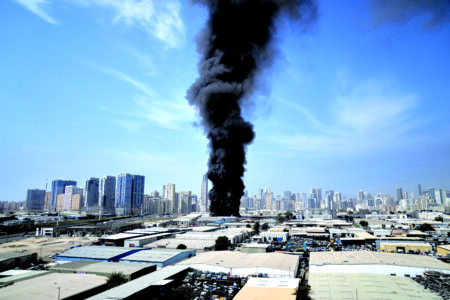
A black plume of smoke rises from a warehouse at the industrial area of Sharjah City in the United Arab Emirates following reports of Iranian strikes in Dubai, United Arab Emirates, Sunday, March 1, 2026. (AP Photo/Altaf Qadri)
DUBAI, United Arab Emirates (AP) — The U.S. and Israel pounded targets across Iran on Sunday, dropping massive bombs on the country’s ballistic missile sites and wiping out warships as part of an intensifying and widening military campaign following the killing of Supreme Leader Ayatollah Ali Khamenei.
Blasts rattled windows across the country and sent plumes of smoke high into the sky above Tehran. More than 200 people have been killed since the start of the strikes that killed Khamenei and other senior leaders, Iranian leaders have said.
Iran vowed revenge, firing missiles at Israel and Gulf Arab states in a counteroffensive that the U.S. military said resulted in the deaths of three service members — the first known American casualties from the conflict. Israeli rescue services said strikes had hit several locations, including Jerusalem and a synagogue in the central town of Beit Shemesh, where nine people were killed and 28 wounded, bringing the overall death toll in the country to 11. Eleven people were still missing after the strike, police said.
But the attacks on Iran showed no signs of relenting as the U.S. and Israel took aim at key military, political and intelligence targets in what appeared to be a widening war that carried the potential for a prolonged conflict that could envelop the Middle East and destabilize it. The strikes represented a startling show of military might for an American president who swept into office on an “America First” platform and pledged to keep out of “forever wars.”
Trump vows vengeance for US deaths
U.S. President Donald Trump said in a video posted to social media that the U.S. would “avenge” the deaths of the service members and that “there will likely be more” killed before the conflict ends.
Israel, which had pledged “nonstop” strikes, said it was increasing its attacks, with 100 fighter jets simultaneously striking targets in Tehran, Brig. Gen. Effie Defrin told reporters at a briefing. The targets included buildings belonging to Iran’s air force, its missile command and its internal security force, which violently quashed anti-government protests in January.
The U.S. military, meanwhile, said B-2 stealth bombers struck Iran’s ballistic missile facilities with 2,000-pound bombs. Trump said on social media that nine Iranian warships had been sunk and that the Iranian navy’s headquarters had been “largely destroyed.”
Europe has mostly stayed out of the war and pressed for diplomacy, but in an indication that the conflict could draw in other nations, Britain, France and Germany said Sunday they were ready to work with the U.S. to help stop Iran’s attacks.
Prime Minister Keir Starmer said Britain would allow the United States to use its bases to strike Iranian missile sites. The U.K. maintains nearby bases on Cyprus and the Chagos Islands, a British archipelago in the Indian Ocean.
The weekend attacks were the second time in eight months that the U.S. and Israel had combined against Iran. In the 12-day war last June, Israeli and American strikes greatly weakened Iran’s air defenses, military leadership and nuclear program. But the killing of Khamenei, who ruled Iran for more than three decades, creates a leadership vacuum, increasing the risk of regional instability.
Trump, who a day earlier had encouraged Iranians to “take over” their government, signaled Sunday that he was open to dialogue with Iran’s new leadership.
“They want to talk, and I have agreed to talk, so I will be talking to them,” he told The Atlantic.
Iranian strikes extend beyond US and Israel
In the Gulf, Iran’s retaliatory strikes went beyond U.S. and Israeli targets, pushing the conflict into cities that have long marketed themselves as regional safe havens.
The foreign ministers of Qatar, Saudi Arabia, the United Arab Emirates, Kuwait, Oman and Bahrain said Sunday that their countries retain “the legal right to respond and the right to self-defense” after Iranian strikes hit hotels, airports and other sites in multiple cities throughout the Gulf.
In the United Arab Emirates, authorities said most Iranian missiles and drones were intercepted. But some either got through or fell as debris, killing three people, injuring others and causing significant damage.
Bahrain and Kuwait said Iranian strikes in both countries hit civilian targets.
Israel fires on Lebanese capital
In other developments, Israel launched strikes on Lebanon’s capital, Beirut, after the Lebanese militant group Hezbollah fired missiles across the border early Monday.
It was the first time in more than a year that Hezbollah has claimed a strike against Israel. The Israeli military said it intercepted a projectile that crossed the border and that several others fell in open areas. No injuries or damage were reported.
Hezbollah said in a statement that the strikes were carried out in retaliation for the killing of Khamenei and for “repeated Israeli aggressions.”
Associated Press journalists in Beirut were jolted awake by a series of loud explosions that shook buildings and caused windows to shatter. Warplanes could be heard flying low overhead.
Lebanese government officials had urged Hezbollah not to enter the fray in support of Iran, fearing another war. The country has not recovered from the last Israel-Hezbollah war, which nominally ended with a U.S.-brokered ceasefire in November 2024. Since then, Israel has continued to launch near-daily strikes in Lebanon aimed at stopping Hezbollah from regrouping.
Latest News
Honors awaiting teachers in Valley
Forty-one educators from across Trumbull, Mahoning and Columbiana counties will be recognized Tuesday at the second ...
Middle East war widens
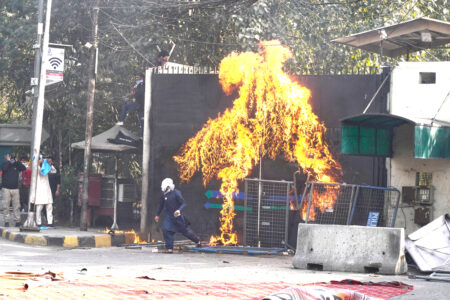
At least 22 killed in anti-US protests

East High students sport school pride in T-shirts from Idaho
Britain, France, Germany pledge support to US
PARIS (AP) — Three close allies of the United States said Sunday they are ready to join forces to defend their ...